How are black holes, which do not emit light directly, typically inferred observationally?
Answer
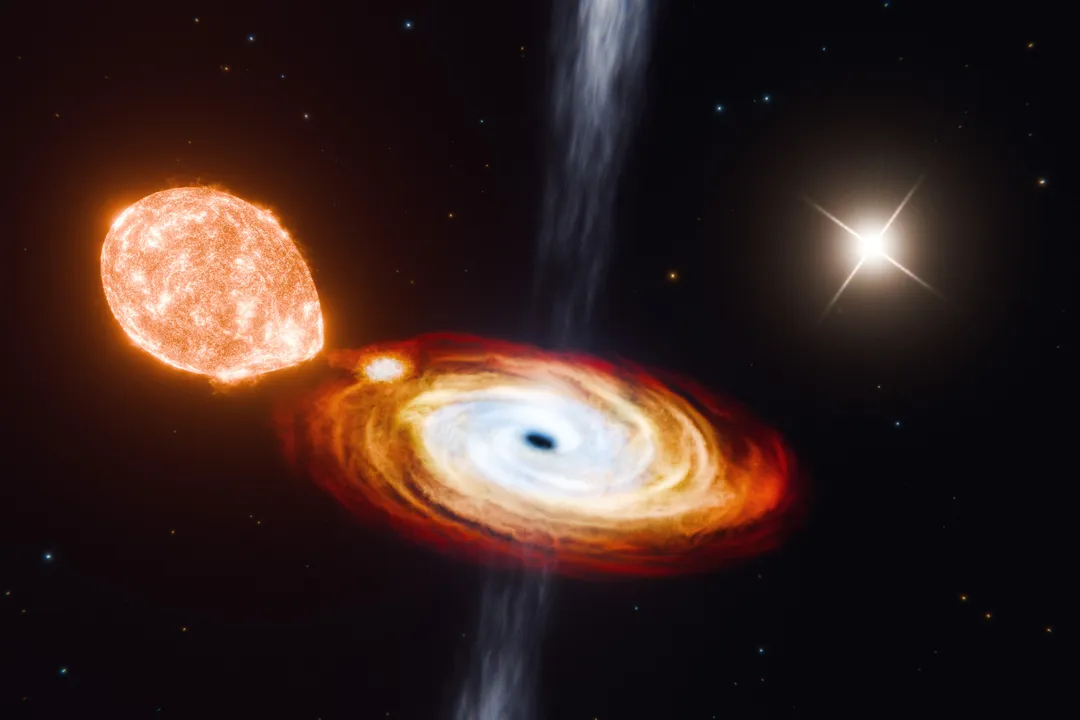
By observing the behavior of nearby gas or companion stars, or by detecting gravitational waves generated by their orbits.
Black holes are inferred by observing the behavior of nearby gas or companion stars, or by detecting the gravitational waves produced by their orbital mechanics, as they do not emit light themselves.
#Videos
Astronomers Uncover First Triple Black Hole, Evidence of Gentle ...
Related Questions
What major shift does the confirmation of the first black hole triple system represent in astrophysics?What is the typical structural arrangement described for a black hole triple system?How are black holes, which do not emit light directly, typically inferred observationally?Which two observatories were cited as providing data crucial for detecting the faint triple system?According to the text, what does the 'gentle formation' pathway for a triple system imply about its origin?What contrasts the 'dynamical interactions' formation model with the 'gentle formation' model?Why is detecting a triple system composed primarily of dormant, stellar-mass black holes particularly challenging?What is the expected chaotic long-term outcome for an isolated three-body gravitational encounter?What is the typical mass range cited in the text for stellar black holes relevant to this system?How does the confirmation of this first triple system impact future astrophysical simulations and predictions?