What is the first black hole triple?
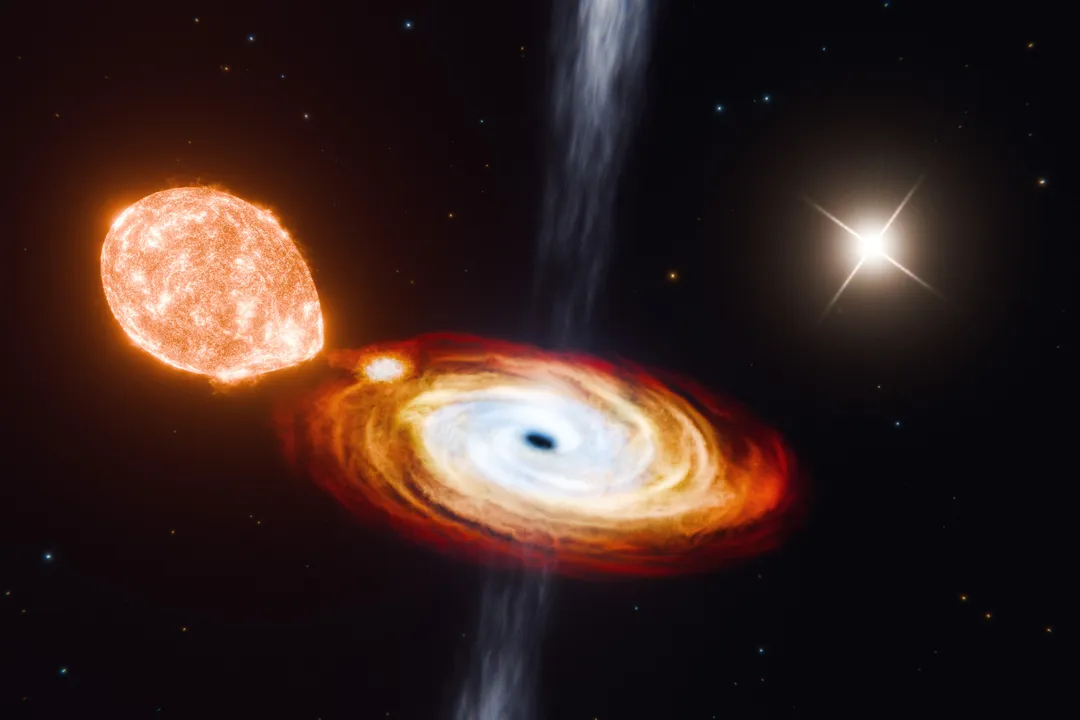
The identification of the universe's first confirmed black hole triple system marks a significant milestone in astrophysics, moving a theoretically predicted structure into the realm of observational reality. For decades, astronomers understood that binary black hole mergers were common sources of gravitational waves, but the possibility of three black holes locked in a complex, hierarchical dance remained largely in the domain of computer simulations. The confirmation of this trio provides a direct laboratory for testing gravity in extreme conditions and understanding how massive stellar remnants evolve within crowded galactic environments. [1]
This breakthrough stems from meticulous observation combining data from multiple, powerful instruments. Scientists pieced together evidence suggesting three distinct gravitational anchors are gravitationally bound, a feat that required exceptional clarity and sensitivity in the collected data. [1] The confirmation process itself often involves cross-referencing different wavelengths, as black holes do not emit light directly; instead, they are inferred by observing the behavior of nearby gas or companion stars, or by detecting the gravitational waves generated by their orbital mechanics. [3]
# System Identification
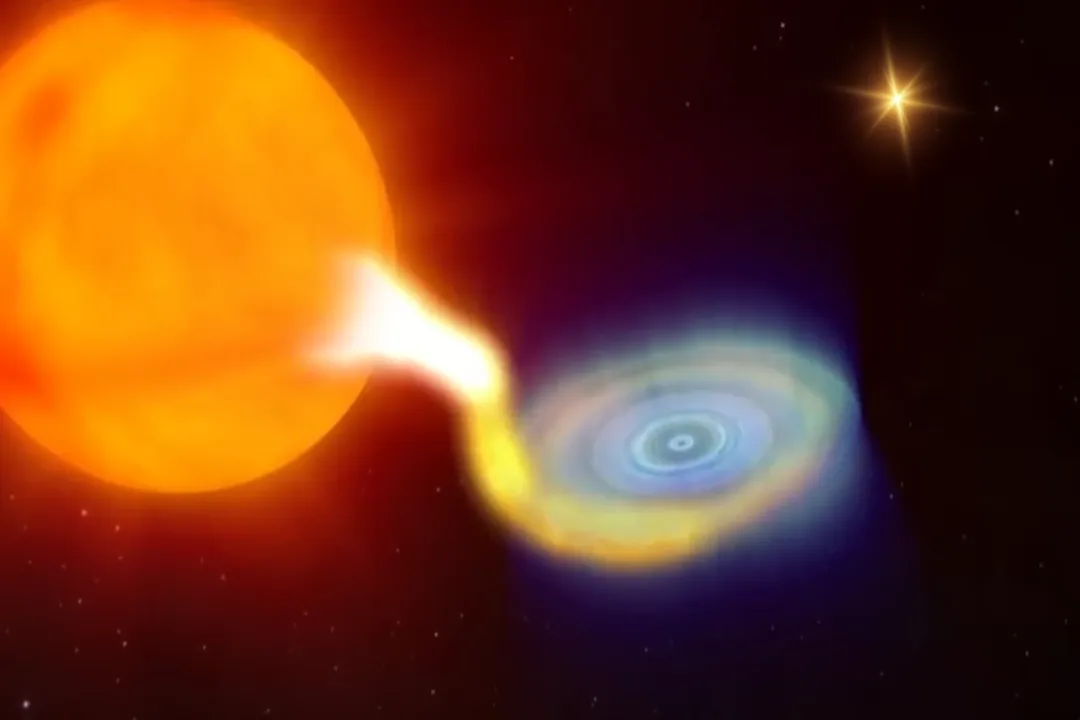
The specific nature of the discovered triple system is crucial to understanding its place in cosmic history. While the general excitement surrounds the confirmation of any three black holes orbiting each other, the precise arrangement dictates the system's stability and future trajectory. [1] These systems are not necessarily all of the same mass, nor are they always arranged in a perfectly equilateral triangle. Instead, they often follow a hierarchical structure: two of the black holes might orbit each other closely, while the third orbits that binary pair from a much wider distance. [1][3]
One key piece of the puzzle involves the observational methods used. Systems like this are incredibly faint because they may lack a large, active accretion disk—the superheated material that makes some black holes shine brightly in X-rays. [1] Detecting a system composed primarily of dormant, stellar-mass black holes is akin to spotting three tiny, cold specks against the vast, luminous background of a galaxy. The detection relied heavily on data gathered by observatories like the Chandra X-ray Observatory, supplemented by optical data from ground-based telescopes such as the Keck Observatory. [1]
It is worth noting the context of previous discoveries. Before this system, many observations hinted at binary black holes, and some even pointed toward triple star systems where one star had already evolved into a black hole. [2] However, a true configuration featuring three black holes—the "black hole triple"—had remained elusive until this recent confirmation. [1] Some reports have discussed detections of radio-emitting black hole trios, which might represent a different observational phase or a system whose components are actively feeding, but the significance of the confirmed finding lies in establishing the existence of the fundamental three-body gravitational configuration involving only these dark remnants. [4]
The challenge of pinpointing this system is amplified because we are looking for three distinct, compact objects. For instance, in some scenarios, a system might be observed as a binary where one object appears heavier than expected, suggesting a third, unseen companion is influencing its orbit. [5] However, isolating the signals of three independent black holes demands extremely high positional accuracy. The successful identification provides a concrete data point that forces a revision of population models which had previously estimated the rarity of such configurations. [1]
# Origin Scenarios
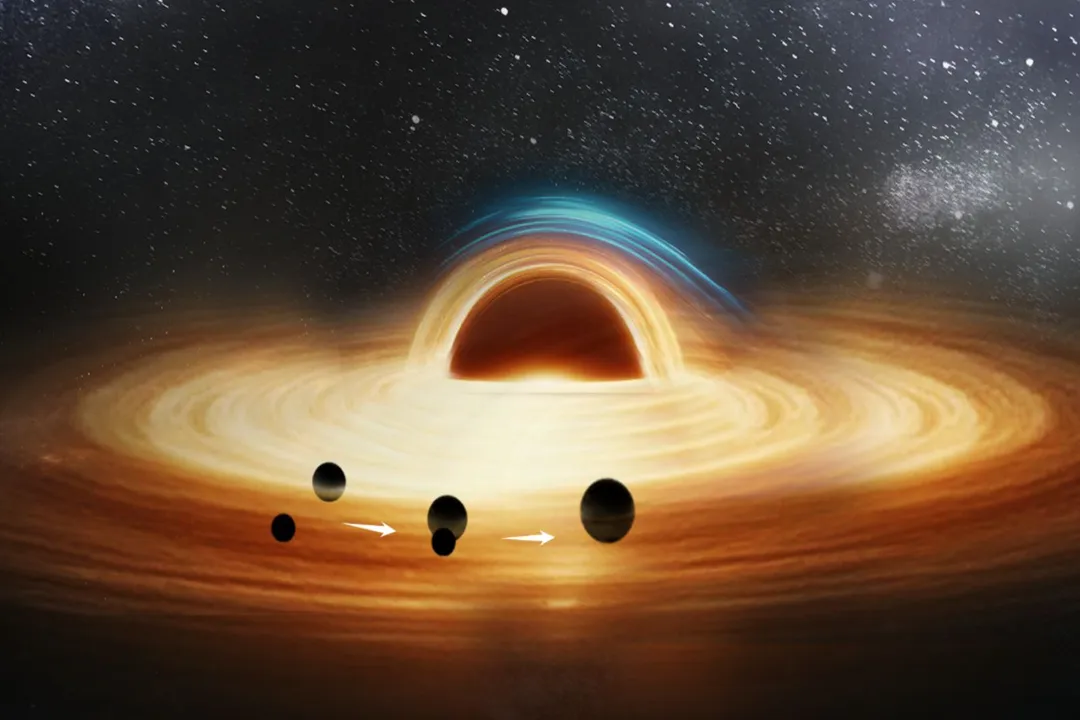
How do three stellar-mass black holes end up gravitationally bound? The answer points toward either slow, gentle assembly over billions of years or a rapid, violent merger event that left a surviving, albeit altered, structure. [3]
One popular model involves the gentle formation pathway. This suggests the system began as a triple star system, possibly within a dense star cluster. [3] In this scenario, the three massive stars would have evolved, with the most massive collapsing first into a black hole, followed by the second, creating a hierarchical binary of two black holes orbiting each other. The third star, still alive, would then evolve into the third black hole, locking the system into its current configuration. [3] This process requires the stars to maintain relatively stable orbits over cosmic timescales, avoiding immediate gravitational ejection from the cluster or immediate catastrophic merger. [3]
A contrasting pathway involves dynamical interactions within dense environments, such as the core of a galaxy or a globular cluster. In these crowded stellar nurseries, stellar remnants like black holes often sink toward the center due to dynamical friction. Once concentrated, gravitational encounters become common. It is possible that two black holes formed a tight binary, and then a third, passing black hole was captured into orbit by the pair's mutual gravitational pull, resulting in the stable triple system observed. [3]
When comparing these formation routes, the gentle evolution from a single co-eval triple star system often results in tighter, more uniform configurations, whereas the dynamical capture model might produce wider separations or more chaotic initial orbits. [3]
While computer simulations often predict that such three-body systems should be inherently unstable over long periods, ejecting one member into interstellar space, the confirmation of a stable triple suggests that either the system found itself in a "sweet spot" of orbital parameters, or the gravitational influence of the surrounding galaxy is playing a subtle, stabilizing role. [1][3]
For instance, if we consider the typical mass scale of stellar black holes—say, between 5 and 30 solar masses—the combined mass of the trio places an immense gravitational strain on the fabric of spacetime. This leads directly to the question of the system's longevity.
# Detection Challenges
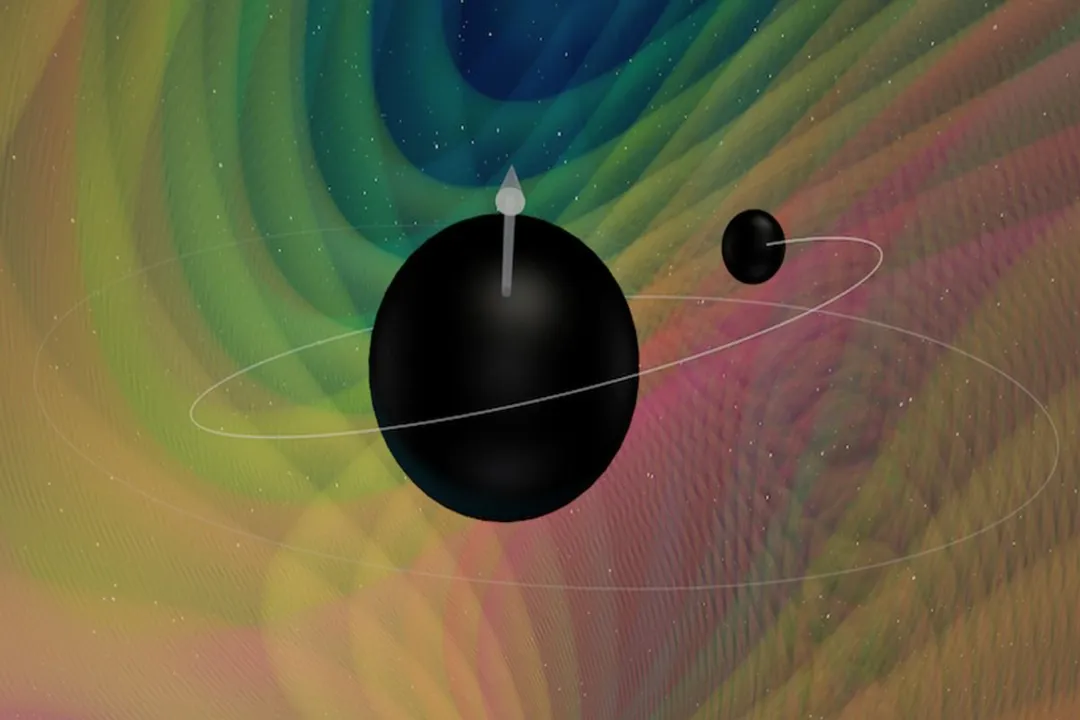
The difficulty in observing a black hole triple cannot be overstated. Binary black holes are usually detected when they are close enough to merge and emit detectable gravitational waves (like those seen by LIGO/Virgo/KAGRA), or when one black hole is actively consuming matter from a companion star, producing bright X-ray flares. [5][8] A triple system, particularly one composed of non-feeding black holes, presents a much fainter target.
The primary challenge in confirming a system like this is disentangling the gravitational influence of three bodies from the noise of the galactic environment. [1] If one or two of the black holes are dormant, their detection relies on extremely precise astrometry—measuring minute shifts in the position of a visible companion star over years or decades—or detecting subtle perturbations in the orbits of other, more visible objects in the vicinity. [1][2]
Consider the detection threshold: if the three black holes are relatively small (e.g., the 5 to 10 solar mass range) and separated by distances greater than a few hundred Astronomical Units (AU), current radio and X-ray telescopes might struggle to resolve them as three distinct entities rather than one blended source or a distant binary. [4] The successful identification implies that the system is either relatively nearby or possesses configuration characteristics—perhaps one or more members are actively feeding, allowing for X-ray detection—that made them stand out. [1]
This discovery highlights a gap in our current census of compact objects. While we have strong evidence for binary black holes and numerous observations of single black holes, the jump to a stable triple requires a significant leap in observational capability or observational strategy. [5] We might infer that for every stable triple we find, there could be dozens more that quickly destabilized, leading one black hole to be flung out at high velocity, or others to merge prematurely. [3]
# Future Dynamics
Once identified, the primary interest shifts to the system's long-term evolution. Three-body problems in gravity are notoriously complex; they rarely result in long-term, stable, co-planar orbits unless the configuration is highly hierarchical. [3] Eventually, the system is expected to undergo mass ejection or merger.
If the system follows the typical chaotic outcome of an isolated three-body encounter, one of the black holes will gain enough kinetic energy from the gravitational interactions to escape the system entirely, likely being flung out at speeds reaching thousands of kilometers per second. [3] This process would leave behind a stable binary black hole pair, which could eventually merge itself, potentially generating a powerful gravitational wave signal observable far into the future. [5]
Interestingly, some historical observational data may represent these ejected members or systems captured just before their demise. One line of inquiry involved monitoring a system that appeared to "die" or dissolve, which scientists now suspect might have been a triple system that reached the end of its unstable phase, perhaps merging or ejecting a member shortly after our telescopes observed it. [5] If the V404 Cygni system, for example, is implicated in discussions about potential black hole trios, it underscores how difficult it is to definitively assign orbital configuration based only on limited snapshots in time. [8]
The detection of this first triple system, therefore, is not just an endpoint but a starting gun for new theoretical work. Astrophysicists can now calibrate their simulations against a real-world example. This allows for refinement of models predicting the merger rates of gravitational wave events, as triples are expected to be precursors to some of the most massive mergers detected by observatories like LIGO. [1][5] Furthermore, understanding how these trios form and dissolve informs our knowledge of how heavy elements are recycled in galaxies, as these events can create intermediate-mass black holes or provide the necessary energy for powerful astrophysical jets. [4] The confirmation of this first triple black hole moves the physics of multiple compact object systems from speculative modeling into the realm of testable science.
#Videos
Astronomers Uncover First Triple Black Hole, Evidence of Gentle ...
Related Questions
#Citations
Physicists discover first “black hole triple” | MIT News
First Black Hole in a Triple Star System Found - www.caltech.edu
1st triple black hole system discovered in 'happy accident' | Space
Radio black hole trio lights up in rare galaxy merger - Phys.org
Scientists think they detected the first known triple black hole system ...
Astronomers discover the first “black hole triple” system ... - Reddit
Astronomers Uncover First Triple Black Hole, Evidence of Gentle ...
First 'black hole triple system' discovered by astronomers - ABC News
First 'black hole triple' may have formed in a surprisingly gentle way