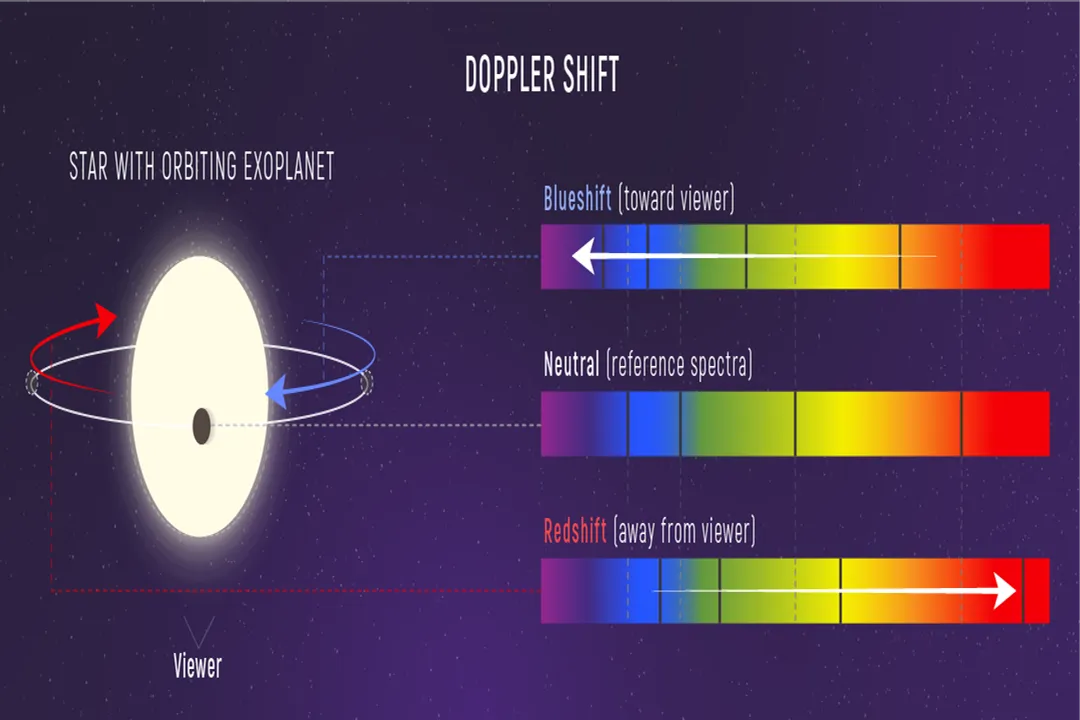
What is the typical visual effect on an intrinsically yellow star, like our Sun, when it is moving away slowly?
Answer
It will still predominantly appear yellow, perhaps shifting slightly toward orange or red.
Doppler shifts are usually not dramatic enough to overwrite the dominant visual color dictated by the star's high surface temperature. A yellow star moving away will remain primarily yellow.
Related Questions
What primarily determines the actual color of a star observed by an eye?Which phenomenon describes the change in observed light properties when a star source is moving relative to an observer?What term describes the shift in a receding star's light toward the longer, red end of the spectrum?If a star is hurtling toward Earth, what happens to its observed light spectrum?What is the typical visual effect on an intrinsically yellow star, like our Sun, when it is moving away slowly?What feature, rather than general visual color, do astronomers use to reliably detect Doppler shifts?What causes the dark absorption lines observed in a star's continuous spectrum?How do scientists confirm that a measured spectral displacement is due to radial velocity?If an intrinsically blue-white A-type star shows its spectral lines consistently shifted toward longer wavelengths, what conclusion is drawn about its motion?What two distinct pieces of information does a star's full spectrum provide to astronomers?