What star in the sky doesn't move?

The star that appears fixed in the night sky, providing a constant reference point for observers in the Northern Hemisphere, is known as the North Star, or by its formal designation, Polaris. [8] For millennia, this relatively bright beacon has served as an anchor in the celestial sphere. While almost every other star seems to trace grand arcs across the heavens as the hours pass, Polaris maintains a remarkably steady position. This unique behavior is not an illusion caused by our vision or specialized equipment; it is a direct consequence of the fundamental geometry of our planet’s orientation in space. [1][4]
# Earth Rotation
The apparent motion we witness nightly is caused by the Earth spinning, or rotating, on its axis every twenty-four hours. [1] As the Earth turns from west to east, the sky appears to wheel overhead from east to west. If you imagine a spike driven through the North and South Poles of the Earth, extending outward into space, the celestial sphere appears to rotate around the tip of that spike. [1] The North Celestial Pole is the specific point in the sky directly above the Earth’s North Pole. [8]
Polaris just happens to be positioned extremely close to this North Celestial Pole. [1] Because it is so near the pivot point around which the entire sky appears to revolve, its actual movement across the dome of the sky is negligible to the naked eye. [4] Imagine spinning a basketball while holding a small pen tip very close to the exact center point of the axis of rotation—that tip will barely shift its position, even as the ball spins rapidly. [4] Polaris functions much like that pen tip relative to the Earth's rotational axis.
# Fixed Point

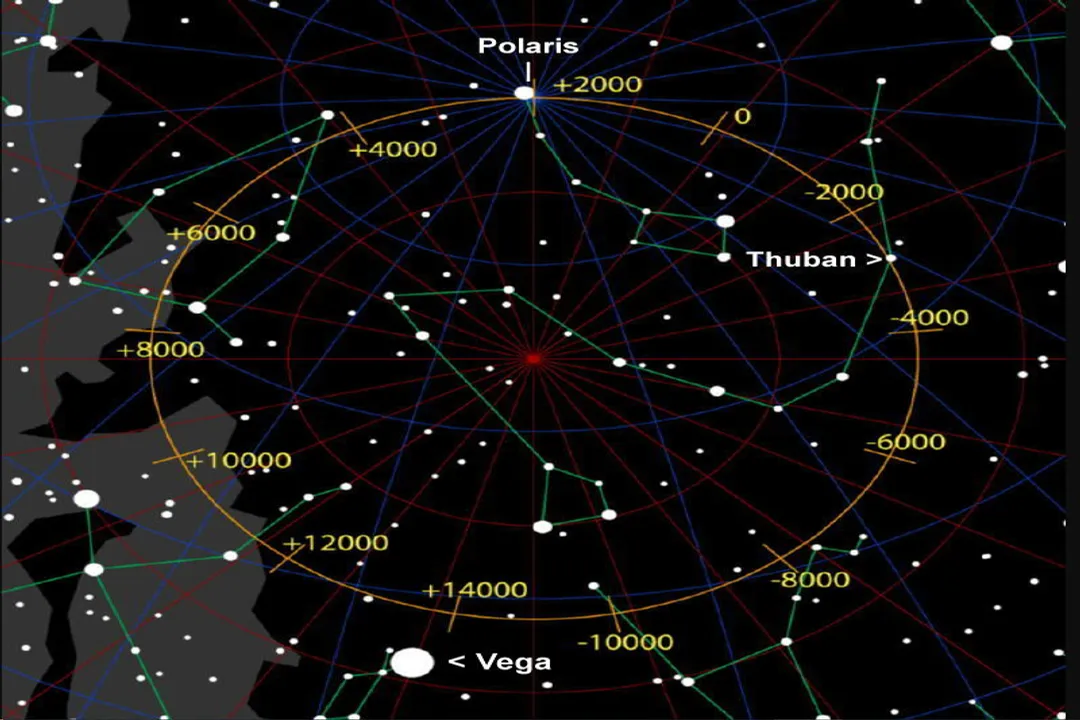
The term "North Star" implies permanence, yet the reality is more complex than a star simply being glued to one spot forever. Polaris is the North Star now, meaning it is the star closest to the geographic North Pole in the sky at the present time. [1] This alignment is not eternal. Over thousands of years, the Earth’s axis slowly wobbles, much like a slowing top, in a cycle known as precession. [1]
This slow wobble means the location of the North Celestial Pole drifts across the sky over a period of about 26,000 years. [1] Consequently, the identity of the North Star changes over deep time. For instance, about 2,000 years ago, the star Thuban (in the constellation Draco) served as the North Star, being much closer to the celestial pole than Polaris is today. [1] Looking forward, the bright star Vega will take on this role in approximately 12,000 years. [1] The crucial point is that at any given epoch, there is one star closest to the pole that acts as the marker for true north, and currently, that star is Polaris. [1]
# Brightness Comparison
A common misconception about the star that doesn't move is that it must also be the brightest star visible. This is factually incorrect. While Polaris is certainly a noticeable star, it does not hold the title of the brightest star in the night sky. [3] Sirius, located in the constellation Canis Major, is the brightest star visible from Earth, boasting an apparent magnitude of approximately $-1.46$. [3] Polaris, by contrast, has a visual magnitude around $2.0$. [3]
To put these numbers into perspective for someone casually observing the sky, we can examine the relative visibility:
| Star | Apparent Visual Magnitude | Visibility Note |
|---|---|---|
| Sirius | $-1.46$ | Brightest star overall |
| Polaris | $2.0$ | The stationary reference point |
| Magnitude 4 Stars | Visible under good, dark skies | |
| Magnitude 6 Stars | Faint limit for average human eye |
Since magnitude scales are inverse (lower numbers mean brighter objects), Sirius is significantly brighter than Polaris. [3] Polaris is better defined by its position than its brilliance. This means that if you are navigating by looking for the star that doesn't move, you must be prepared for it to be less brilliant than other stars nearby, especially when viewing from a location with light pollution, where fainter stars fade from view first. [3] Navigators rely on its constant location, not its visual dominance. [8]
# Navigation Aid
The stability of Polaris made it indispensable for navigation, particularly before the advent of modern electronic positioning systems. For sailors crossing featureless oceans or travelers traversing deserts, knowing where North was meant knowing the direction of travel relative to the globe. [8] When observing Polaris, the angle between the horizon and the star directly corresponds to the observer’s latitude. [8]
If you are standing at the equator (latitude ), Polaris will appear right on the horizon. [8] As you travel north toward the North Pole (latitude ), Polaris climbs higher in the sky, appearing almost directly overhead when you reach the pole. [8] This relationship is incredibly direct and reliable. A traveler in Denver, Colorado, for example, whose latitude is roughly North, will find Polaris approximately above the northern horizon. This principle remains true regardless of the time of night or the season of the year. [8]
If you are ever trying to determine your own latitude in the Northern Hemisphere using this method, it is worth noting that Polaris is not exactly on the pole; it is slightly offset. If you measure the star’s angle above the horizon, your result will be off by a small amount—perhaps half a degree or so, depending on the exact year. For casual observation or basic celestial navigation, this tiny error is negligible, but for precise surveying, an observer would need to consult an almanac to correct for Polaris's current angular separation from the true celestial pole. [1]

# Altitude Variation
While the rotation of the stars around Polaris is what defines its stillness, the altitude of Polaris itself relative to the horizon is dependent on the observer's position on Earth. This is a key aspect of its utility. If you live in New York, Polaris appears at a certain height; if you move to Miami, it appears lower in the sky. [8] This dependence on latitude provides a constant check on one’s geographic location in the Northern Hemisphere.
Consider an observer who has memorized the position of the familiar Big Dipper asterism (part of Ursa Major). The two "pointer stars" at the end of the Dipper's bowl point directly toward Polaris. [8] This is a reliable star-hopping technique. However, if that observer travels far south, the entire Big Dipper may drop below the horizon entirely, making direct use of the pointers impossible. In such cases, the navigator must rely on other constellations that remain visible in the southern sky or use a sextant and a star chart, though Polaris itself will be too low or already set to be useful for latitude calculation if they are far enough south. This illustrates that the "star that doesn't move" is only useful as a fixed reference for those positioned appropriately in the northern latitudes.
# Locating Polaris
Finding Polaris is generally straightforward, provided you have a clear view of the northern sky. As mentioned, the most famous guide involves the Big Dipper. [8] Follow the line drawn through the two stars on the outer edge of the Dipper’s cup, away from the bowl, until you hit a moderately bright star—that is Polaris. [8]
Another reliable guide is the constellation Cassiopeia, which resembles a distinctive 'W' or 'M' shape, depending on the time of night. If you imagine drawing a line from the center of the 'W' and extending it out, it will eventually lead toward Polaris, although this path is longer and less direct than using the Dipper pointers. [8]
When searching the sky, remember that you are not looking for the brightest object, but the one that remains stationary relative to the horizon as other familiar patterns wheel around it. On a new moon night with no city lights, you might see hundreds of stars, but only one of them will remain fixed in its spot throughout the night. [1] Observing this phenomenon firsthand, watching the entire celestial sphere circle this single point over several hours, provides a tangible connection to the mechanics of our planet’s rotation.
#Videos
Why Polaris Is the Most Confusing Star in the Sky - YouTube
Related Questions
#Citations
Does the North Star ever move in the sky? - EarthSky
Why Polaris Is the Most Confusing Star in the Sky - YouTube
The “North Star”, Polaris, isn't the brightest star in the sky - Reddit
Why does Polaris, the North Star, seem to not move at all ... - Quora
Why does the North Star appear to never move? - Facebook
What is the bright star that never seems to move and sometimes the ...
What is the North Star and How Do You Find It? - NASA Science
The Timeless North Star Polaris, also known as the ... - Instagram