In Hubble’s Law ($v = H_0 d$), what must be precisely measured to calculate the recession velocity ($v$)?
Answer
The redshift ($z$)
Scientists determine the velocity of a distant galaxy by measuring its redshift value ($z$) from its light spectrum. This measured velocity ($v$) is then used with the Hubble Constant ($H_0$) to solve for distance ($d$).
#Videos
How Do We Measure the Distance to Stars? - YouTube
How Scientists Measure The Distance To Stars and Galaxies
Related Questions
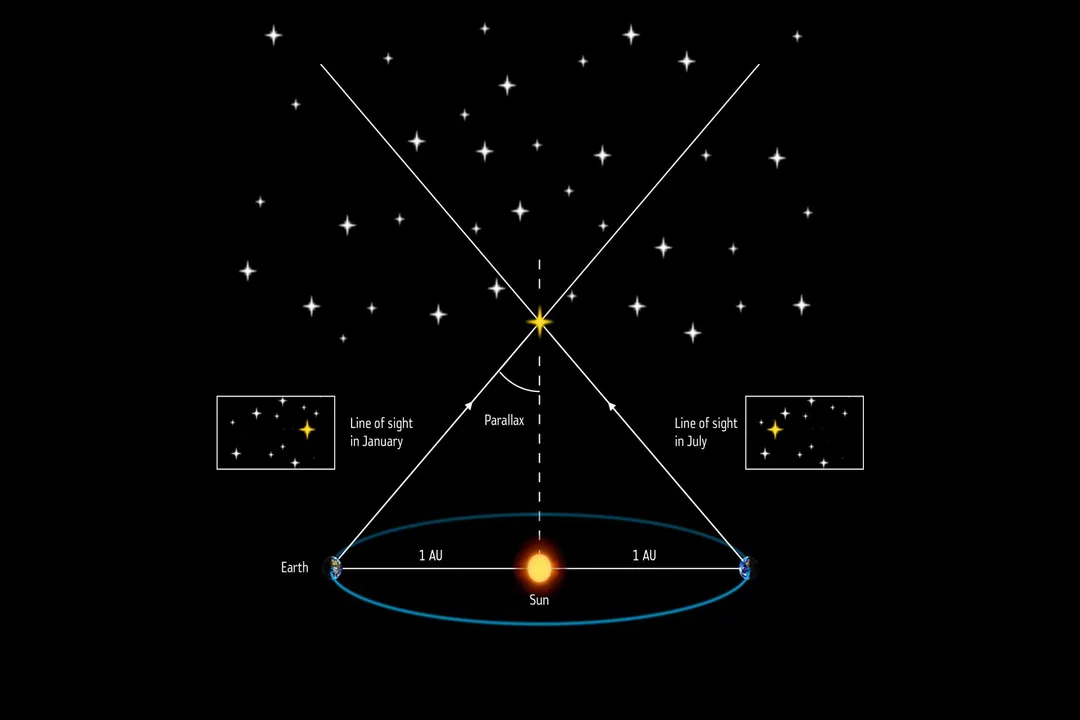
What geometric baseline does stellar parallax utilize for measurement?What is the definition of a parsec based on the parallax angle?Why is the stellar parallax method considered the most reliable measurement yardstick?What intrinsic property allows Cepheid variable stars to function as standard candles?What condition causes a Type Ia supernova to occur?What physical law connects the measured apparent brightness of a standard candle to its true luminosity?What is the primary phenomenon used to determine distances to the most remote cosmic objects?In Hubble’s Law ($v = H_0 d$), what must be precisely measured to calculate the recession velocity ($v$)?What is the inherent weakness of the cosmic distance ladder structure?How does Very Long Baseline Interferometry (VLBI) achieve high precision in angle measurement?