How do scientists find out how far away the stars are?
Determining the distance to a star is one of the most fundamental and challenging tasks in astronomy. Since we cannot simply stretch a measuring tape across the cosmos, scientists have developed several ingenious techniques, each suited for a different range of distance, creating what is known as the cosmic distance ladder. [7][8] The entire structure of our understanding of the universe’s size and age rests on the accuracy of these first steps.
# Stellar Triangulation
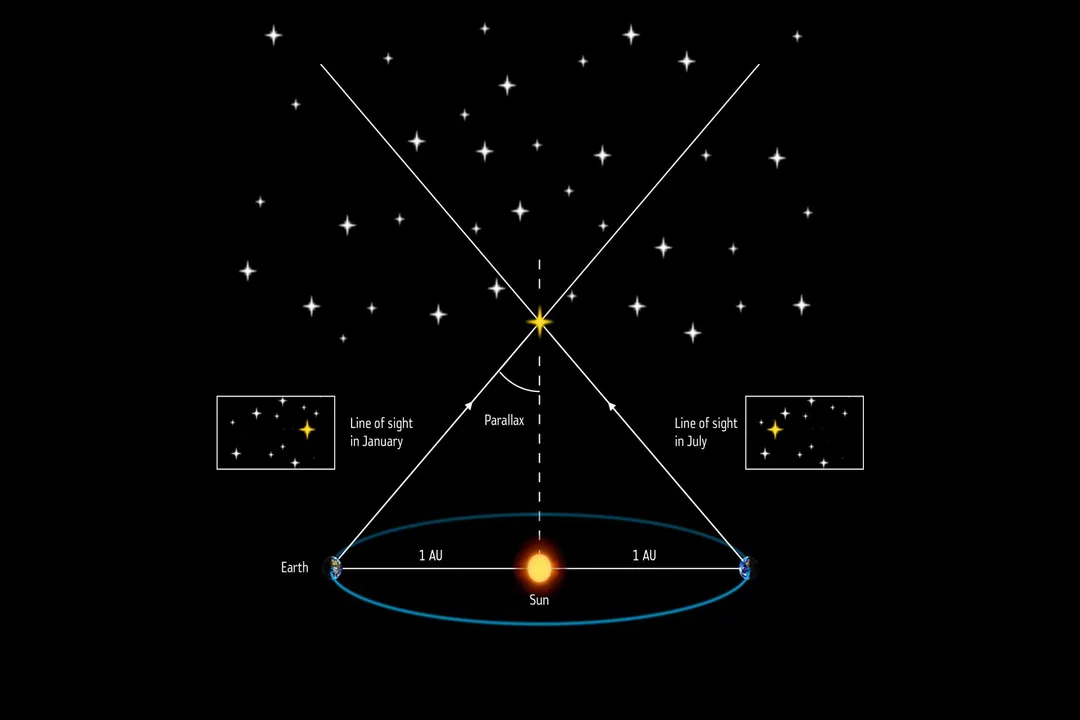
For stars relatively close to us, astronomers employ a geometric technique called stellar parallax. [4][8] This method relies on the basic trigonometry that anyone can understand—triangulation. The technique uses the Earth’s orbit around the Sun as a baseline for measurement. [4]
Imagine holding your thumb out at arm’s length and closing one eye, then the other. Your thumb appears to shift position against the distant background. Stars do the exact same thing from our perspective on Earth. [8] As our planet circles the Sun, a nearby star appears to shift slightly against the backdrop of much more distant stars. [4] The distance between the two observation points—Earth at one side of its orbit and then six months later on the opposite side—creates a baseline of about $300$ million kilometers (the diameter of Earth’s orbit). [4]
The apparent angular shift measured in this way is the parallax angle. [8] The closer the star, the larger this angle appears. [4] Astronomers define distance in terms of this angle; if a star has a parallax shift of exactly one arcsecond (1/3600th of a degree), it is defined as being one parsec away—roughly $3.26$ light-years. [8]
This method is considered the most reliable yardstick because it depends only on geometry, not on assumptions about the star’s internal physics or brightness. [8] However, the shift is incredibly small. For the nearest star system, Alpha Centauri, the parallax angle is still less than one arcsecond. [4] As distances increase, the angle shrinks to near-immeasurable levels, rendering parallax useless for stars beyond a few thousand light-years using older methods. [4] Modern space-based observatories, like the European Space Agency's Gaia mission, have dramatically extended this reach by achieving unprecedented accuracy in measuring these minuscule angles. [4]
# Standard Brightness
When a star is too distant for its parallax shift to be accurately measured, astronomers must turn to intrinsic properties—that is, they need to know how bright the star truly is. [3][7] Stars that serve this purpose are often called standard candles. [7] If you know the actual light output (luminosity) of a celestial object and measure how dim it appears from Earth, you can use the inverse-square law of light to calculate the distance. [7]
One of the most vital types of standard candles is the Cepheid variable star. [3] These stars are notable because their brightness pulsates rhythmically. [3] In the early 1900s, astronomer Henrietta Leavitt discovered a direct, predictable relationship between how long it takes a Cepheid to complete one cycle of brightening and dimming (its period) and its actual, or absolute, luminosity. [3] This relationship is now known as the period-luminosity relation. [3]
Once an astronomer identifies a Cepheid variable in a distant galaxy, they measure its period. Knowing the period immediately tells them its true brightness. Comparing this true brightness to the measured apparent brightness then yields the distance to that star, and by extension, to its host galaxy. [3]

# Galactic Yardsticks
For even greater cosmic distances, Cepheids become too faint to see reliably. Astronomers then turn to a much brighter, albeit rarer, type of standard candle: the Type Ia supernova. [7]
These stellar explosions happen under very specific circumstances. They occur in binary star systems where a white dwarf star gradually pulls matter from a companion star until it hits a critical mass threshold known as the Chandrasekhar limit. [7] Once this limit is reached, the white dwarf collapses and explodes in a runaway thermonuclear reaction. [7] Because the initiating conditions are nearly identical for every Type Ia supernova, the peak absolute brightness achieved during the explosion is remarkably consistent across the universe. [7] This consistent, blinding flash allows these events to be detected across billions of light-years, mapping the structure of the very early universe. [7]
# Cosmic Expansion
When dealing with the most remote objects, even a Type Ia supernova becomes too faint to serve as a reliable standard candle. At this scale, the expansion of the universe itself becomes the primary ruler. [7]
This technique relies on observing the light from distant galaxies, which is nearly always shifted toward the red end of the electromagnetic spectrum—a phenomenon known as redshift. [3][7] This stretching of light waves occurs because the space between the observer (us) and the distant galaxy is expanding as the light travels toward us. [7] The greater the distance, the more the light is stretched, and the greater the redshift. [3]
This observation forms the basis of Hubble’s Law, which mathematically relates a galaxy's velocity of recession () to its distance () through the constant of proportionality, the Hubble Constant (): . [7] By precisely measuring the spectrum of light from a distant galaxy to determine its redshift (), scientists calculate its velocity (), and then use the established value of to solve for the distance (). [7]
If you were to place the nearest star, Proxima Centauri, at the distance of the Sun's orbit (1 Astronomical Unit), a star whose distance was measured by parallax might still be only about 100 meters away from you in that scale model. In contrast, a star whose distance relied on a Cepheid measurement could be thousands of kilometers distant. This illustrates why direct geometric methods hit a physical wall quickly and why the calibration of the next rung in the ladder must be nearly flawless.
# Ladder Calibration
The real power and the inherent weakness of these distance measurements lie in their interconnectedness—the distance ladder. [8] Each rung depends on the accuracy of the rung immediately below it. [8]
- Rung 1 (Parallax): The geometric measurement of nearby stars establishes the exact distances to a sample of nearby Cepheids. [8]
- Rung 2 (Cepheids): The known distances to these nearby Cepheids allow astronomers to calibrate the precise period-luminosity relationship, giving us the absolute magnitude for all Cepheids, regardless of their location. [8]
- Rung 3 (Supernovae): These calibrated Cepheids are then used to measure the distances to galaxies where Type Ia supernovae have occurred, locking down the absolute brightness of the supernova event. [8]
- Rung 4 (Hubble’s Law): Finally, the distances derived from supernovae are used to calibrate the Hubble Constant () used in the redshift equation, allowing us to measure the farthest objects in the observable universe. [7]
This dependence means that any small error in the initial geometric measurement propagates and magnifies up the ladder. For instance, if the parallax measurement for the initial set of Cepheids is off by even one percent, that one percent error doesn't just stay in the first rung; it compounds as it calibrates the supernova brightness, which in turn affects the calculation of the Hubble Constant. [4] This is why missions dedicated to achieving micro-arcsecond accuracy in parallax measurements are not just for cataloging nearby stars; they are fundamental to testing cosmological models of the universe’s expansion rate. [4]
# Measurement Precision
The sheer scale of these measurements demands precision instruments capable of detecting extremely subtle changes. Measuring an angle across interstellar space is akin to trying to measure the thickness of a single human hair from miles away. [4]
Beyond optical telescopes measuring parallax, other techniques offer geometric checks. For certain targets, radio astronomy can provide incredible precision. [5] Techniques like Very Long Baseline Interferometry (VLBI) combine signals from radio telescopes spread across continents to create a virtual telescope larger than the Earth itself. [5] This synthetic aperture allows for angular resolutions down to the micro-arcsecond level, offering an alternative geometric check on distances for specific objects that are bright in the radio spectrum. [5]
Ultimately, measuring the distance to the stars involves moving from direct geometry for the nearest objects to relying on well-understood stellar physics for intermediate distances, and finally relying on the laws governing the expansion of spacetime for the farthest reaches of the cosmos. [7][8] Each technique confirms and refines the others, building our map of the universe one light-year, one parsec, and one billion light-years at a time.
#Videos
How Do We Measure the Distance to Stars? - YouTube
How Scientists Measure The Distance To Stars and Galaxies
Related Questions
#Citations
How are astronomers able to measure how far away a star is?
How can we tell how far away a star is or how old it is? - Reddit
How Do We Measure the Distance to Stars? - YouTube
Stellar Parallax - Las Cumbres Observatory
How Do You Measure the Distance to the Moon, Planets, Stars and ...
How Do We Measure Star Distances? | StarTalk - Facebook
How Do We Know How Far Away the Stars Are? | Britannica
What Is Parallax? - How Astronomers Measure Stellar Distance