If a time zone is standardized to $75^ ext{circ}$ W longitude, and a local measurement shows solar noon occurs 20 minutes later than official clock noon, what is the location's approximate longitude?
Answer
$80^ ext{circ}$ W
Since the Earth rotates $15^ ext{circ}$ per hour, every four minutes corresponds to one degree of longitude. A 20-minute delay means the location is $20 / 4 = 5^ ext{circ}$ west of the standard meridian. Therefore, $75^ ext{circ} ext{ W} + 5^ ext{circ} = 80^ ext{circ} ext{ W}$.
Related Questions
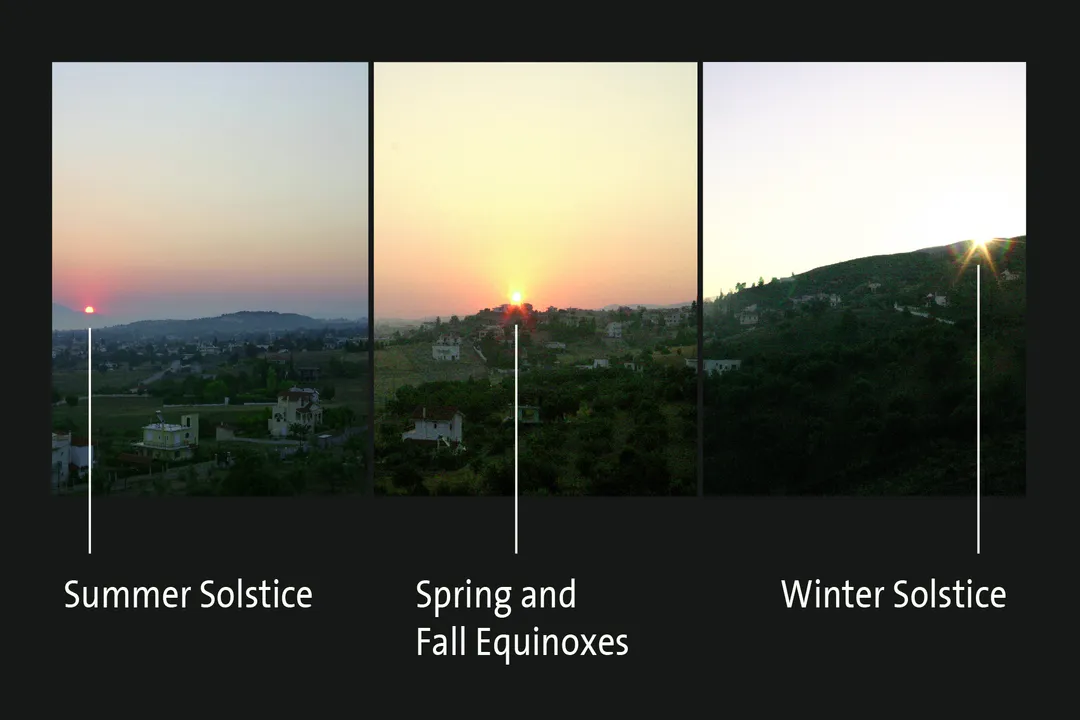
What two primary factors govern the Sun's position in the sky?What measurement defines the angular separation between the Sun and the point directly overhead (the zenith)?What is the primary reason the Sun's path varies so dramatically between summer and winter?What occurs when the Sun's declination reaches its maximum negative value around December 21?How does longitude primarily influence the calculation of the Sun's position?In the Northern Hemisphere, what is the azimuth angle when the Sun reaches its highest point at solar noon?What is true about the Sun's path during the equinoxes (around March 20 and September 22)?How does atmospheric refraction affect the apparent position of the Sun?For a structure in the Northern Hemisphere seeking to maximize passive solar heating during winter, what is the recommended design consideration related to the low winter sun?If a time zone is standardized to $75^ ext{circ}$ W longitude, and a local measurement shows solar noon occurs 20 minutes later than official clock noon, what is the location's approximate longitude?