Which specific feature did the WMAP mission primarily map to determine cosmic geometry?
Answer
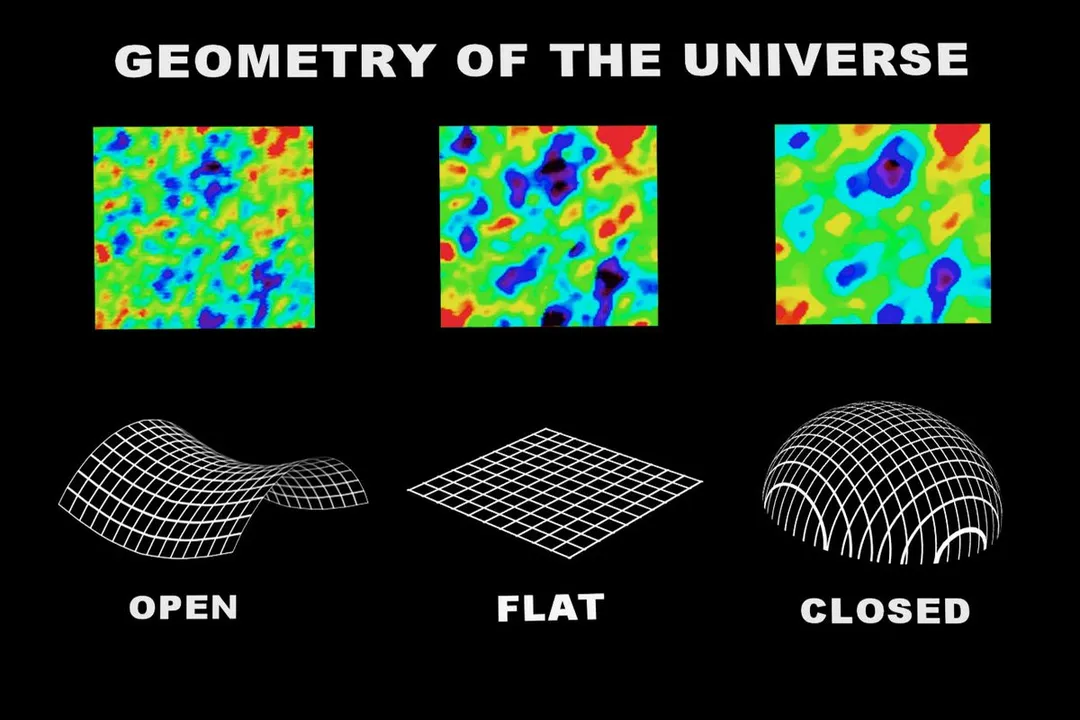
The temperature fluctuations in the Cosmic Microwave Background (CMB).
The Wilkinson Microwave Anisotropy Probe (WMAP) mapped the faint afterglow radiation from the early universe, specifically looking at the pattern of hot and cold spots in the CMB. The apparent size of these spots acts as a cosmic yardstick to measure curvature.
Related Questions
How is the large-scale geometry of the universe fundamentally determined?If the density parameter $\Omega_0$ is greater than 1, what type of curvature describes the universe?Which shape best models a universe with negative curvature ($\Omega_0 < 1$)?What geometric principle holds true on the largest scales in a perfectly flat universe?Which specific feature did the WMAP mission primarily map to determine cosmic geometry?In a hypothetical closed universe, how would the sum of angles in a very large triangle formed by light rays compare to a flat universe?Determining the universe's shape relies on mapping echoes from what ancient cosmic event?What is the required value for the density parameter ($\Omega_0$) that corresponds to a perfectly flat universe?What assumption must scientists make about the universe beyond the observable horizon to conclude the *entire* cosmos is flat based on local measurements?According to the summary table, what is the simplified fate implied by a flat universe ($\Omega_0 = 1$)?