What is the mathematical signature distinguishing a standing wave $y(x, t)$ in a one-dimensional system?
Answer
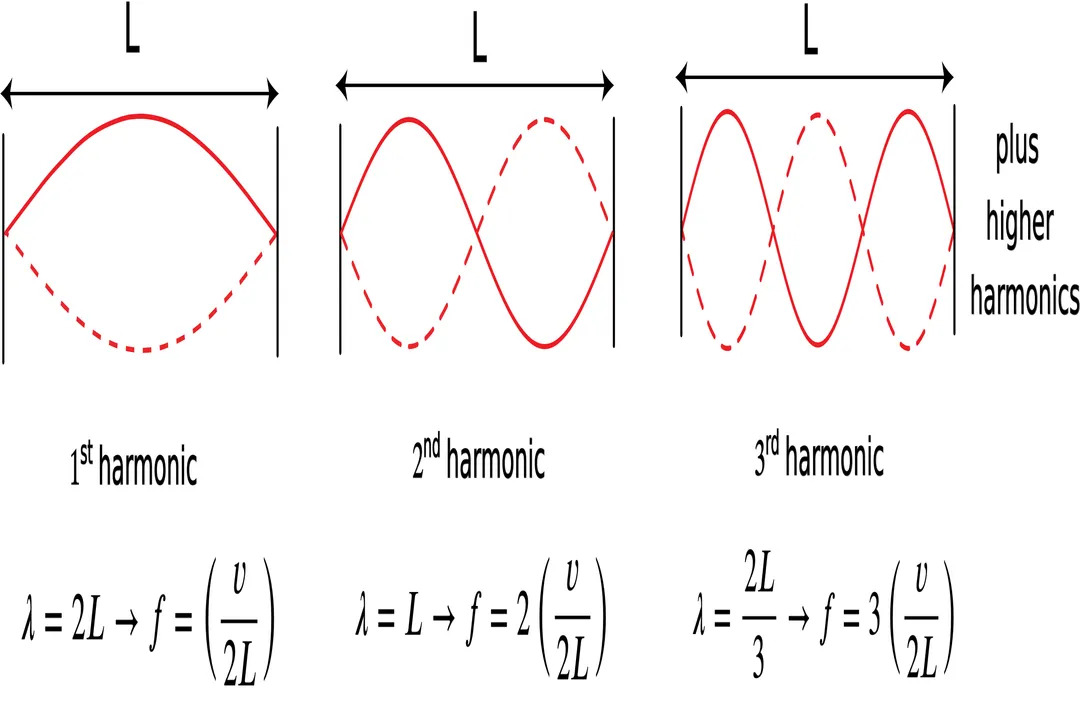
The spatial dependence is independent of the time dependence
In the mathematical description of a standing wave, the spatial term (governing the shape or maximum possible oscillation) is separated and independent of the time term (governing how that maximum oscillation occurs over time).
Related Questions
What type of phenomenon fundamentally characterizes a standing wave?When a pulse traveling down a rope hits a tightly secured (fixed) end, what occurs upon reflection?What principle dictates how the incident and reflected waves combine at any given point in the medium?What is the mathematical signature distinguishing a standing wave $y(x, t)$ in a one-dimensional system?What defines the locations known as nodes on a standing wave?What is the precise distance separating any two adjacent nodes in a standing wave pattern?For a system fixed at both ends (Fixed-Fixed), what condition must the length $L$ satisfy to establish a standing wave?In a system fixed at one end and free at the other (Fixed-Free), what constraint does the length $L$ place on the allowed wavelengths?What concept describes the situation where the reflected wave's amplitude is less than the incident wave's amplitude in reality?For longitudinal sound waves in an air pipe, what condition characterizes a closed end?