How does hearing translate sound waves into impulses?

The journey from a physical vibration in the air to a recognizable sound in your consciousness is one of the most intricate and swift biological processes known. It requires a precise sequence of mechanical conversions, beginning the moment a sound wave strikes your outer ear and culminating in electrical signals being processed by the brain. [1][4] Understanding how this happens reveals a remarkable piece of natural engineering that operates with astonishing speed and sensitivity.
# Pinna Function

The visible part of your ear, known as the pinna or auricle, isn't merely decorative; it acts as a sophisticated collector and funnel for sound energy. [1] Its curves and ridges help gather sound waves traveling through the air and direct them down the narrow passage of the external auditory canal. [1][4] This initial funneling concentrates the sound pressure before it reaches the middle ear structure. [4] At the end of this canal sits the tympanic membrane, commonly called the eardrum, which is a thin piece of tissue stretched tightly across the opening to the middle ear. [3][4] When sound waves hit the eardrum, the energy causes this membrane to vibrate in sympathy with the frequency and intensity of the incoming sound wave. [3][4]
# Ossicles Action
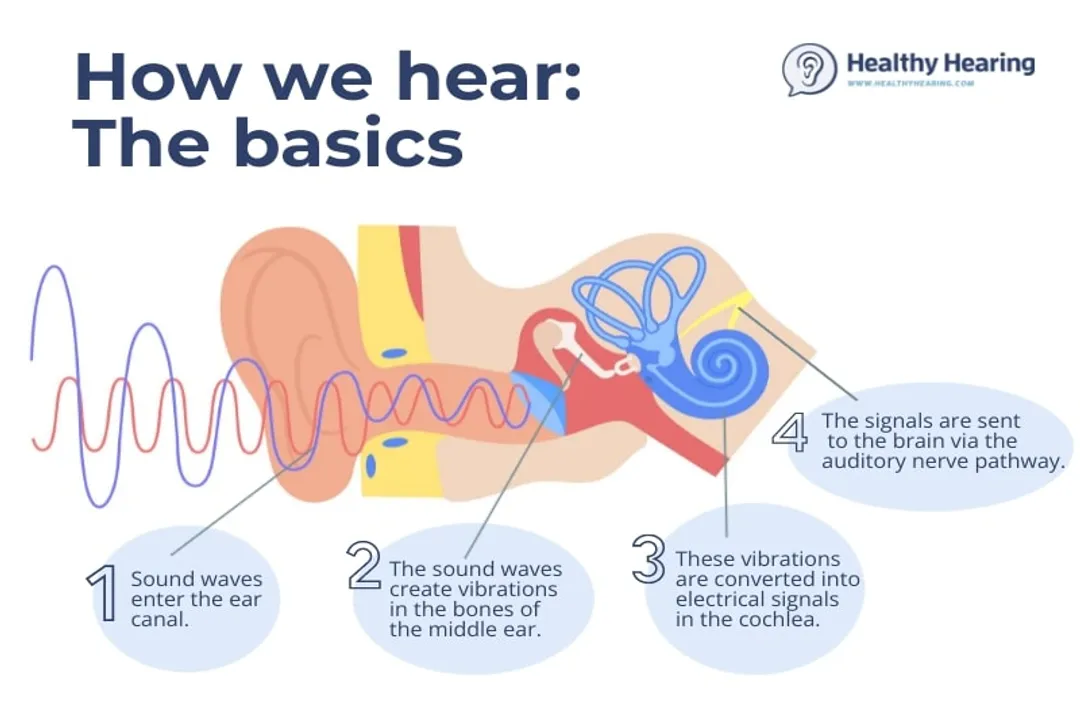
The next stage involves transforming these relatively weak air vibrations into much stronger mechanical movements suitable for stimulating the dense fluid within the inner ear. [5] This happens in the middle ear cavity, which houses the three smallest bones in the human body, collectively known as the ossicles. [2][3]
These bones—the malleus (hammer), incus (anvil), and stapes (stirrup)—form a chain that links the eardrum to the inner ear. [2][3] The malleus attaches directly to the eardrum; when the eardrum vibrates, the malleus moves, which in turn moves the incus, and finally the stapes. [2]
This system performs a vital task called impedance matching. [5] Air offers little resistance to movement, but the fluid inside the cochlea (the hearing organ) is much denser and resists movement significantly more. [5] If the sound waves hit the fluid directly, most of the energy would simply bounce off. The ossicles solve this problem by acting as a powerful mechanical amplifier. [2][5] They achieve this amplification in two ways: by concentrating the force from the large area of the eardrum onto the much smaller surface of the stapes footplate, and through the slight mechanical advantage provided by the lever action of the bones themselves. [5] Imagine trying to make a large, light tablecloth ripple by blowing on it versus trying to make a small, tightly stretched drum skin vibrate—the bone system ensures the energy transfer is efficient enough to overcome the density of the fluid waiting inside. [5]
# Cochlea Mechanics

The stapes presses against a membrane-covered opening leading into the inner ear called the oval window. [4][5] The inner ear is housed within the temporal bone and contains the cochlea, a snail-shaped structure filled with fluid. [4][6] When the stapes pushes inward on the oval window, it creates a pressure wave that travels through the cochlear fluid. [4]
This fluid movement is critical because it initiates the sensory detection mechanism. Inside the spiral chambers of the cochlea, the movement of this fluid causes a thin partition, the basilar membrane, to ripple or vibrate. [6][7] What’s fascinating is the way this membrane responds: different sections of the basilar membrane are tuned to vibrate maximally in response to different sound frequencies. [6] Near the oval window, the membrane responds best to very high frequencies, while sections deeper inside the spiral respond to lower frequencies. [6] This physical arrangement provides a spatial map of sound frequency along the length of the membrane—a principle known as tonotopy. [6]
# Transduction Process
The real magic—the translation of mechanical vibration into an electrical signal—occurs within the Organ of Corti, which sits atop the vibrating basilar membrane. [7] This organ contains thousands of specialized sensory cells called hair cells. [7] Each hair cell possesses many tiny, hair-like projections called stereocilia extending from its top surface. [7]
As the basilar membrane vibrates up and down due to the fluid waves, the base of the hair cells moves, causing the stereocilia to bend sharply against the overlying tectorial membrane. [7] This mechanical shearing or bending is the direct stimulus. When the stereocilia bend in one direction, ion channels on the cell membrane open up. [7] This influx of positive ions causes the hair cell to depolarize, which triggers the release of chemical messengers, or neurotransmitters, into the synapse between the hair cell and the auditory nerve fibers. [7][8] This chemical release is the moment the mechanical energy of the sound wave is successfully converted into the electrical energy of a neural impulse. [7]
This conversion process is known as auditory transduction. [7] It's an all-or-nothing event for the cell itself, but the intensity of the sound dictates how many hair cells fire and how frequently they fire, which the brain interprets as loudness. [7]

# Nerve Transmission
Once the neurotransmitters are released, the specialized neurons of the auditory nerve—also called the cochlear nerve—are activated. [8] These nerve fibers take the electrical impulses generated by the hair cells and carry them away from the inner ear. [8]
This signal does not go directly to the conscious part of your brain. Instead, the auditory nerve transmits the encoded information first to the brainstem. [8] From there, the signals ascend through various relay stations, including the inferior colliculus and the medial geniculate nucleus of the thalamus, where preliminary processing occurs. [8] Finally, the impulses arrive at the auditory cortex located in the temporal lobe of the brain. [8]
It is here, in the auditory cortex, that the pattern of incoming electrical impulses—coded by which hair cells fired, how intensely they fired, and where along the basilar membrane the signal originated—is finally interpreted as meaningful sound: a voice, a musical note, or an alarm. [8] The speed of this entire process, from the initial wave hitting the pinna to perception in the cortex, is nearly instantaneous, which allows us to react to sudden noises in real time. [1]
Related Questions
#Citations
How Do We Hear? - NIDCD - NIH
How Hearing Works - Bozeman, MT - Ennis, MT
How we hear: A step-by-step explanation
Hearing and the cochlea - Health Video
How Does Sound Move Through My Ears?
Hearing Explained: Process of Sound Processing
Auditory transduction and pathways
How You Hear