How do gravitational waves propagate through spacetime?
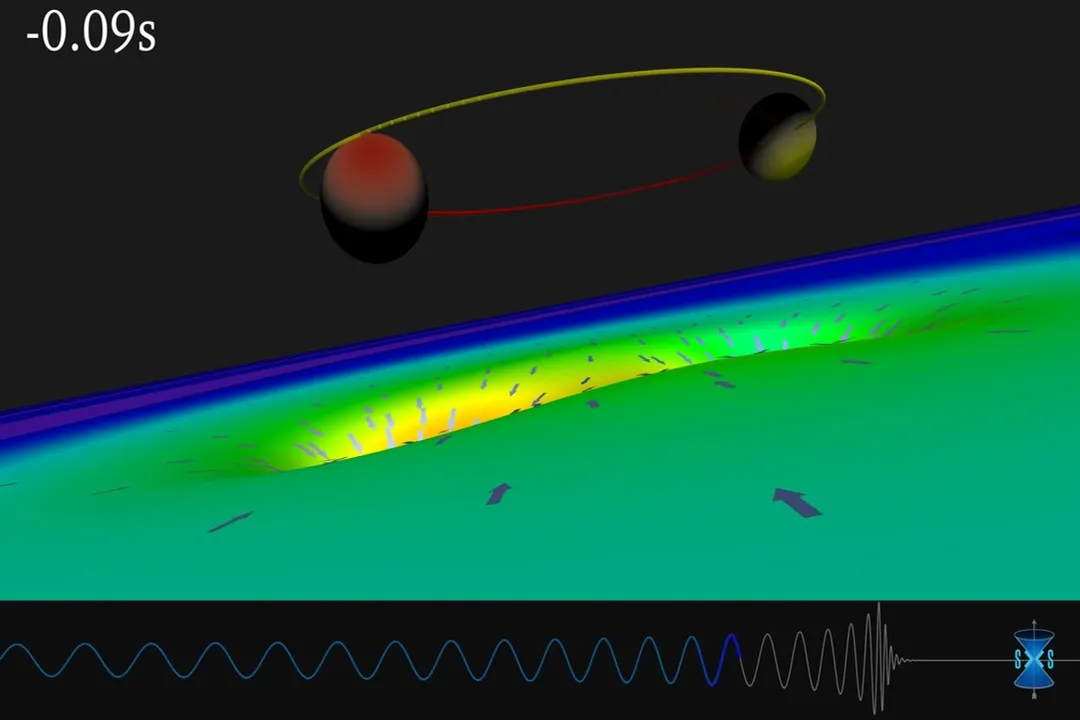
The universe, as described by modern physics, is not merely an empty stage upon which celestial events play out; it is a dynamic, four-dimensional fabric called spacetime, which can bend, warp, and ripple. When incredibly massive objects accelerate—especially during violent cosmic events—they create disturbances that move outward like waves on a pond, but these are distortions in the very geometry of space and time itself. These disturbances are gravitational waves. Understanding how these waves propagate is fundamental to grasping the mechanics of the cosmos at its largest scales, offering a completely new sense for observing the universe that goes beyond light.
# Nature of Ripples
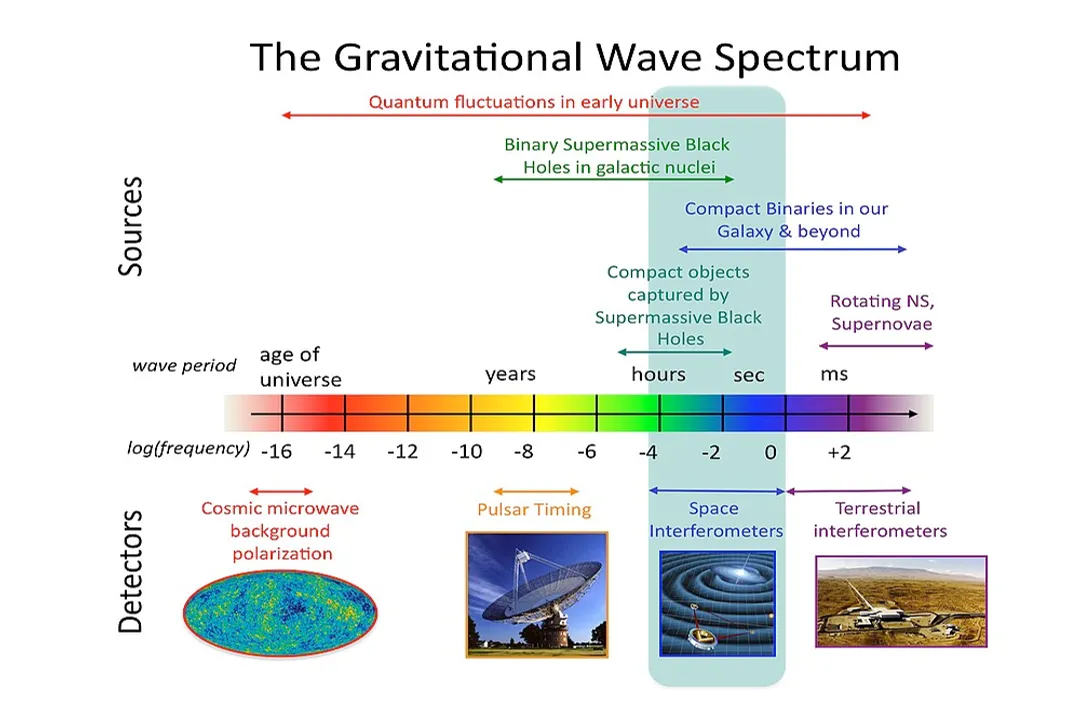
Gravitational waves are fundamentally changes in the metric of spacetime that propagate outward from their source. To visualize this, imagine spacetime as a vast, flexible sheet. Any massive object creates a dip in that sheet, which we perceive as gravity. When two massive objects orbit each other rapidly, or collide, they shake the surrounding spacetime, sending out waves of curvature that travel across the cosmos.
These ripples are not like sound waves, which require a medium like air to travel through. Instead, gravitational waves are the modulation of the medium itself—spacetime. They carry energy away from the source in the form of gravitational radiation. A key feature of their propagation, derived from Einstein's General Theory of Relativity, is that they travel at the speed of light in a vacuum, which is a required condition for any phenomenon that carries energy but does not have mass itself. If they traveled slower or faster than light, it would violate the principles of relativity concerning causality and the structure of spacetime.
# Creation Events
The genesis of these spacetime tremors requires extreme astrophysical scenarios involving rapidly changing quadrupoles of mass, which means the mass distribution must be accelerating non-spherically. Simple spherical expansion or contraction does not generate detectable waves.
The most powerful sources detected so far involve catastrophic events in binary systems:
- Binary Black Hole Mergers: Two black holes spiraling inward until they coalesce represent the most energetic events known to produce gravitational waves. In the final moments before merger, the energy radiated away in gravitational waves can briefly outshine all the light emitted by all the stars in the observable universe combined, though the radiation is entirely non-electromagnetic.
- Neutron Star Mergers (Kilonovae): When two ultra-dense neutron stars collide, they also create significant gravitational waves. These events are often accompanied by a burst of light, allowing astronomers to observe the same event through both gravitational and electromagnetic means, a phenomenon known as multi-messenger astronomy.
- Supernovae: The asymmetric collapse of a massive star at the end of its life can also generate waves, though these are generally harder to detect due to the complex, chaotic nature of the explosion.
If we consider the energy release, the efficiency of gravitational wave emission is tiny compared to the total mass-energy involved in the merger, yet because the masses are so large, the resulting wave is still detectable across billions of light-years.
# How Distortions Travel
The propagation itself is a localized, transient effect moving across the expanse of spacetime. As a gravitational wave passes through any given region of space, it momentarily warps the geometry of that region, causing distances and the flow of time to oscillate.
Imagine a circle of test particles floating freely in space. As a wave passes, those particles will exhibit a rhythmic pattern of movement: they will first be squeezed along one axis while simultaneously being stretched along the axis perpendicular to the first. Then, half a wavelength later, the stretching and squeezing reverse—the axis that was stretched now becomes compressed, and vice-versa. This oscillation is entirely transverse to the direction of the wave’s travel. A wave traveling directly toward us would cause objects to stretch vertically while compressing horizontally, then switch, and repeat, though the actual pattern depends on the wave's orientation relative to the observer.
When considering the propagation, it is illuminating to contrast the wave's action with that of light. An electromagnetic wave, like light, is a disturbance in the electromagnetic field that moves through spacetime. In contrast, a gravitational wave is a disturbance of spacetime itself. This means that while light’s properties are defined by how it interacts with fields within the spacetime structure, the gravitational wave is the structure momentarily changing its shape. A subtle, original way to think about this is that light travels along geodesics (the straightest possible paths) in the local geometry, whereas a gravitational wave temporarily alters those very geodesics as it passes, slightly diverting the path that light would otherwise have taken.
# Speed and Attenuation
The speed of propagation is fixed at the speed of light, , a fundamental constraint derived from Einstein’s field equations. The detection of gravitational waves from binary neutron star mergers has provided extremely tight constraints, showing that these waves travel at virtually the same speed as light, differing by less than one part in . This remarkable agreement confirms that gravity propagates at the speed limit of the universe.
As the wave travels over vast cosmic distances, its amplitude—the amount of stretching and squeezing—decreases inversely with the distance from the source. This is analogous to how the intensity of light diminishes as it spreads out from a bulb, but because the wave is stretching space itself, the effect is extremely diluted by the time it reaches us. For instance, a black hole merger billions of light-years away might cause a change in length equivalent to just one part in over the four-kilometer arms of a detector like LIGO. This rapid attenuation is the primary reason why only the most cataclysmic events can be observed, as the distortion becomes incredibly small very quickly.

# Geometry of the Passage
The wave's passage involves changes not just in spatial dimensions but also in the passage of time, though the spatial stretching/squeezing is usually emphasized when discussing propagation near detectors. The wave front expands spherically outward from the source, carrying its oscillating distortion across the universe.
To better appreciate the scale of this distortion during propagation, consider this analogy: if a gravitational wave passed through the entire diameter of the Earth, it would momentarily change the Earth's diameter by less than the width of a single human hair. The effect is incredibly small precisely because the medium—spacetime—is incredibly rigid on macroscopic scales. It takes the gravitational influence of two solar-mass objects violently merging to create a detectable kink in the structure of space itself across interstellar distances.
An interesting analytical point often overlooked when discussing wave mechanics is the requirement for multipole radiation. Unlike simple electromagnetic waves, which can be generated by oscillating charges (dipoles), gravitational waves cannot be generated by a simple oscillating mass (monopoles) because the total mass-energy of an isolated system is conserved. This conservation law forces the lowest order of gravitational radiation to be quadrupole (like the in-and-out wobble of two orbiting bodies), which mathematically dictates the specific transverse polarization pattern observed during propagation. This constraint on the lowest-order radiation is key to how the wave maintains its structure as it travels through vacuum.
# Observing the Propagation
The direct detection of these ripples, primarily by observatories like LIGO and Virgo, provides empirical validation for the theory of their propagation. When a wave passes, the mirrors in the interferometer arms momentarily move relative to each other due to the spacetime distortion. The pattern of this stretching and squeezing, recorded over time, constitutes the signal that allows scientists to trace the wave back to its violent origin event.
For instance, when observing a merger event, the detected signal—the "chirp"—is a direct manifestation of the wave's propagation characteristics. The frequency and amplitude increase as the objects spiral faster and closer together, right up until the moment of coalescence. This changing waveform over time is a signature of the wave propagating across the light-years separating the source from Earth, allowing us to measure not only the wave's speed but also the physical properties of the objects that generated the initial distortion in spacetime.
The propagation is also characterized by the polarization of the wave. Gravitational waves have two possible polarizations, often referred to as 'plus' (+) and 'cross' (). These describe the two fundamental ways the wave can stretch and squeeze spacetime, both of which are transverse to the direction of travel. When the waves are detected, analyzing the relative strength and timing of these two polarization modes provides insight into the complex, three-dimensional motion of the source objects during their final inspiral.
To further illustrate the mechanism of propagation, imagine you are observing the wave arriving from a source far off to your left, heading right. The wave stretches space vertically while compressing it horizontally. If a second wave arrived exactly perpendicular to the first, traveling toward you from above, it would stretch space horizontally while compressing it vertically. Since spacetime is a unified entity, these distortions combine linearly as they pass through a region, meaning the geometry experiences the sum of all passing wave strains simultaneously. This linear superposition principle is another key aspect of how multiple waves can propagate through the same region without interfering in a destructive or overly complex manner that would obscure the simple geometrical change they induce. This means that the "path" through spacetime is constantly being tweaked by every passing gravitational perturbation, even those far weaker than what we currently detect. The universe is constantly ringing softly from countless events, and these minute changes in the background metric are what define the propagation environment for everything else.
Related Questions
#Citations
Gravitational wave - Wikipedia
What are Gravitational Waves? | LIGO Lab - Caltech
Gravitational wave propagation : r/astrophysics - Reddit
Understanding gravitational waves: Ripples in spacetime explained
Gravitational waves: 'dents' in spacetime - European Space Agency
Gravitational Waves and the Space-Time Continuum
How do gravitational waves travel through time and space? - Quora
Gravitational Waves - Introduction - Imagine the Universe!
All of spacetime is rippling with gravitational waves - Big Think