How does the amplitude of a gravitational wave change as it propagates over vast interstellar distances?
Answer
It decreases inversely with the distance from the source.
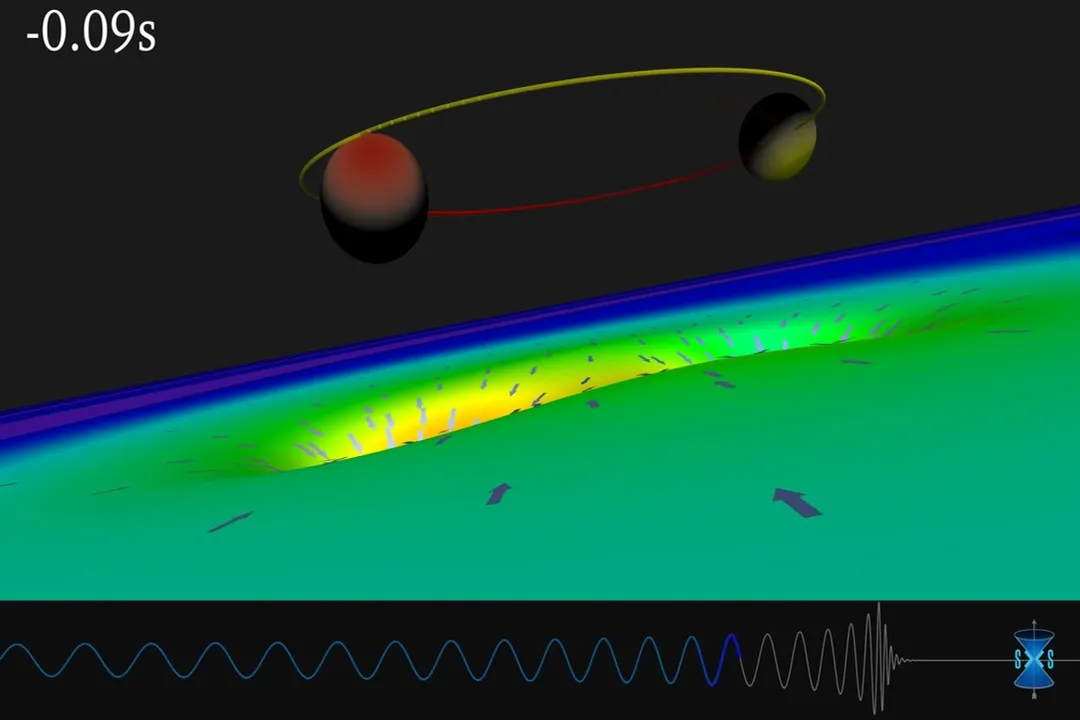
As the wave travels over cosmic distances, its amplitude—the amount of stretching and squeezing—decreases inversely with the distance from the source, leading to rapid dilution.
Related Questions
What are gravitational waves fundamentally described as?At what speed do gravitational waves travel in a vacuum?What condition is necessary for the generation of detectable gravitational waves?Which catastrophic event represents the most energetic source known for producing gravitational waves?How does the propagation of gravitational waves contrast with sound waves?What is the observational phenomenon when a neutron star merger is seen via both light and gravitational waves?What geometrical effect do gravitational waves cause on a circle of freely floating test particles as they pass?What distinguishes the propagation of a gravitational wave from that of light (an electromagnetic wave)?Why must gravitational radiation be at least quadrupole radiation, unlike electromagnetic waves?How does the amplitude of a gravitational wave change as it propagates over vast interstellar distances?What are the two possible polarizations that describe how a gravitational wave can stretch and squeeze spacetime?