How do you describe a globular form?

Describing something as having a globular form immediately conjures an image of roundness—it suggests a shape akin to a ball or a sphere. While the dictionary definition is straightforward, when applied to the grand structures of the cosmos, like the famous globular clusters, the term takes on profound depth, describing not just an outline but an entire architecture of extreme density and antiquity. A globular cluster, for instance, is not just a fuzzy ball of light; it is an ancient, tightly bound collection of hundreds of thousands to millions of stars, all concentrated into a relatively small volume of space.
# Spherical Appearance
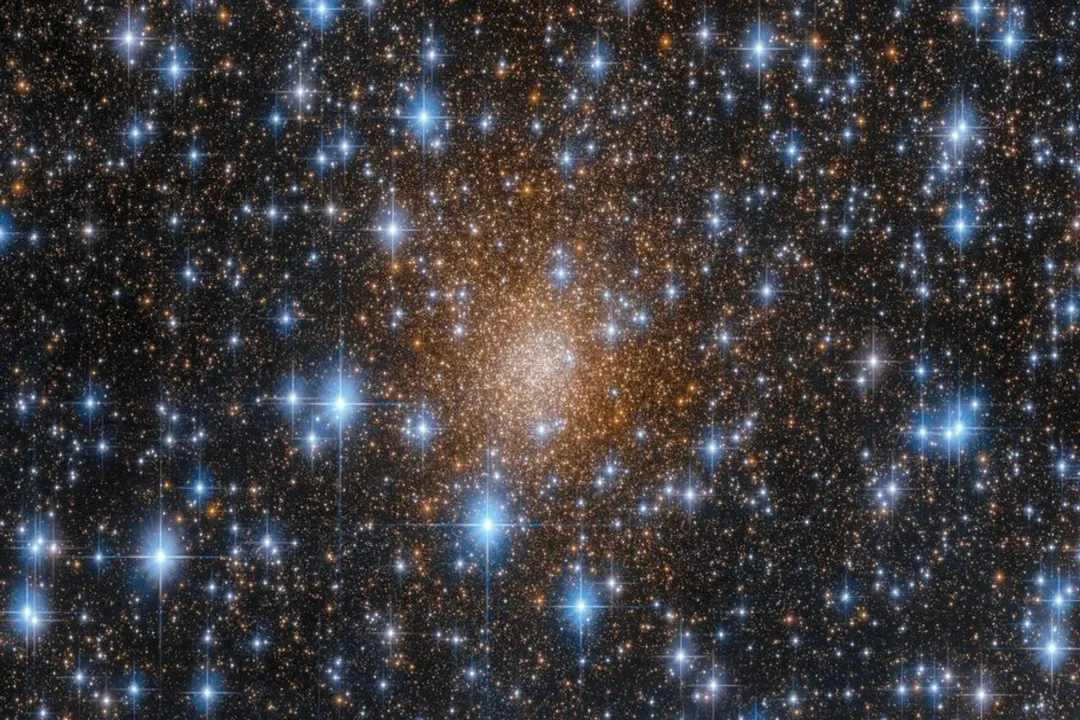
The fundamental descriptor for any globular object is its near-perfect symmetry. In the astronomical sense, a globular cluster presents itself as a distinct, compact, and roughly spherical arrangement of stars. This shape contrasts sharply with the more sprawling, irregular forms of other star groupings, like open clusters, which are generally younger and less densely packed. When viewed through a powerful telescope, the concentration of light towards the center defines the globular character, creating a visual gradient from bright core to a fainter, more diffuse outer edge.
The descriptive power of "globular" lies in this visual gradient. Imagine a field of data points, where the center is so saturated with points that individual resolution is lost, fading gradually as you move outward. In the context of these stellar systems, this density gradient is a defining feature. An interesting way to mentally map this is to consider the stellar population in relation to the cluster's center. For a typical cluster, one might find that a significant fraction of its total stellar mass is contained within the innermost few light-years, illustrating a concentration far exceeding what one might casually associate with a group of stars.
# Internal Density
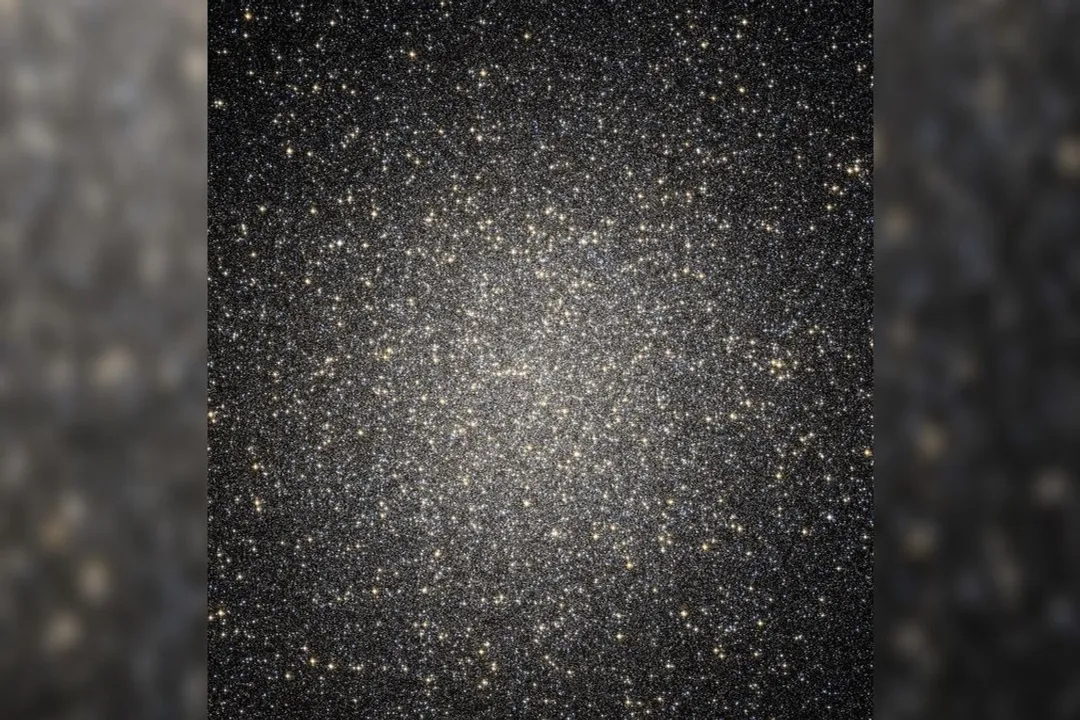
The description of a globular form requires acknowledging the incredible density concentrated within that spherical boundary. These systems are remarkably dense, especially near their cores. While the term "globular" speaks to the overall visible shape, the reality inside is one of extreme proximity. Globular clusters are bound together by gravity, holding these immense populations in check.
The structure is often described as having a bright, stellar nucleus or core, surrounded by a more extended, less bright region called the envelope or halo. The stars in the core are packed so tightly that stellar encounters—where two stars pass close enough to gravitationally interact—are far more frequent than in other parts of the galaxy. This internal condition gives rise to unusual stellar evolution pathways, sometimes resulting in blue stragglers, which appear younger than the cluster's actual age.
This internal arrangement creates a descriptive contrast: the form is simple—a sphere—but the content is extraordinarily complex and concentrated. If we look at the texture of this form, as in materials science where a globular texture is described as one composed of small, rounded masses, the analogy holds. In the cluster, the "masses" are individual stars, and their collective boundary creates the macro-globular shape.
# Immense Scale
To truly describe the scale of a globular form, one must look at its age and size. Globular clusters are some of the oldest objects in the universe, often dating back over ten billion years, meaning they formed early in the life of their host galaxy. Describing the form is also describing deep time.
These stellar collections span considerable distances. While they are often contained within a diameter of just a few tens of light-years, that space holds stars numbering in the hundred thousands up to ten million. For instance, some large clusters contain over a million stars within a region perhaps only fifty light-years across. To put this sheer volume of bodies into perspective, consider that the entire Milky Way galaxy contains perhaps 200 to 400 billion stars, spread out over hundreds of thousands of light-years. A globular cluster packs a fraction of that stellar population into a volume so small that its density measurement can exceed that of the central bulge of its host galaxy.
When articulating the description, remember that the perception of the shape is distance-dependent. From millions of light-years away, it appears as a single, perfect sphere of light—a textbook globular form. Up close, it resolves into the intricate gravitational dance of its components.
# Galactic Placement
The location of these globular forms further helps in their description. They are not randomly scattered throughout a galaxy but tend to occupy specific, predictable regions, which contributes to our understanding of their nature. In large spiral galaxies like our own Milky Way, globular clusters are predominantly found orbiting in the vast, roughly spherical halo surrounding the main galactic disk.
For the Milky Way, the general distribution of these clusters is concentrated far above and below the plane where the spiral arms reside. Studies of their distribution reveal that they orbit the galaxy's center on highly elongated, random paths, much different from the relatively flat, circular orbits of the younger, open clusters found within the disk. Mapping their positions is crucial for understanding galactic formation history, as these ancient structures are relics from the galaxy's earliest assembly phases. Thus, describing a globular cluster is also placing it as an ancient sentinel outside the main body of its stellar home.
# Defining Criteria
To summarize the descriptive elements that define a globular form, especially when referencing these star systems, one can look at a few key characteristics.
Here is a mental checklist one might use to confirm the description, synthesizing the characteristics mentioned:
- Overall Shape: Is the outer boundary recognizably spherical or very close to it?
- Internal Gradient: Is there a distinct concentration or brightening toward the center, indicating a rapid drop in density moving outward?
- Stellar Population: Does the object contain a high number of stars (hundreds of thousands or more) packed into a relatively small volume?
- Age Context: Is the object significantly older than the main stellar population of its environment, suggesting a primordial origin?
If the answer to these questions leans heavily toward "yes," the term globular is an accurate descriptor of the structure being observed. The difference between a 'globular cluster' and a 'galaxy' itself, for instance, often boils down to the binding mechanism and the sheer concentration of mass relative to size; galaxies are far larger and have a less pronounced, uniform central density gradient in the same way a cluster does.
# Beyond Stars
While the astronomical context provides the most dramatic illustration of the globular form, the term itself is broader. The concept of something being "globular" appears wherever compact, spherical aggregates of matter or material occur. For example, in geology or materials science, a globular texture implies a material structure composed of many small, rounded, often interconnected particles or grains. This is a microscopic description of a form, but the underlying geometric principle remains the same: maximizing volume containment around a central point with minimal exterior surface area, resulting in a sphere-like appearance.
It is important to note that perfection is rare in nature, even in the best examples. A globular cluster is rarely perfectly spherical; tidal forces from the host galaxy can stretch or distort them slightly over eons, introducing asymmetries. Therefore, the descriptive term implies near-spherical or approaching a perfect sphere, a nuance often found when applying geometric terms to vast, dynamically evolving physical systems.
To truly appreciate the descriptor, one must hold both the simple geometry and the complex physics in mind. The description "globular" is a shorthand for a place where gravity has won decisively, binding enormous numbers of disparate components into the most space-efficient shape possible.
Related Questions
#Citations
Globular cluster - Wikipedia
Globular cluster - ESA/Hubble
GLOBULAR Definition & Meaning - Merriam-Webster
globular | Definition from the Shapes, patterns topic - Longman
What is the difference between orbicular, spherical, globular, ball ...
The Distribution of Globular Clusters | Center for Astrophysics
What are globular clusters? - Space
Globular texture | geology - Britannica
Glossary term: Globular Cluster - IAU Office of Astronomy for Education