How do emission nebulae generally appear to an observer looking through a small telescope eyepiece?
Answer
Faint, greenish-gray smudges.
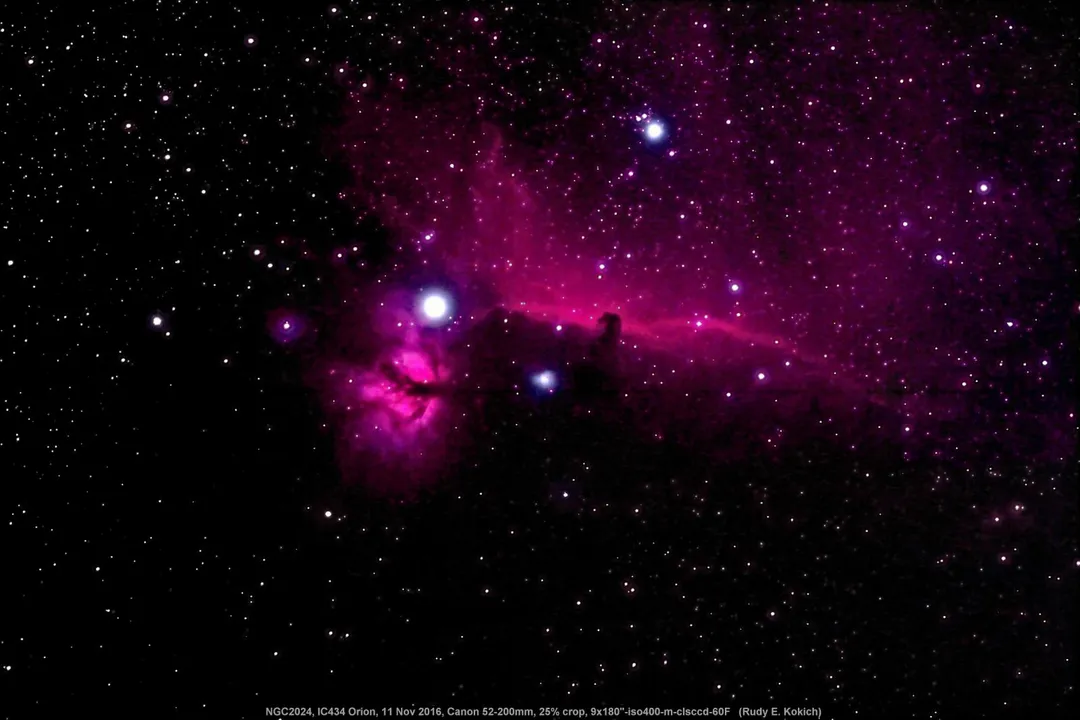
Through a standard eyepiece, the integrated signal appears muted; the human eye's low-light vision is relatively insensitive to the deep red light from hydrogen, causing the faint blue-green oxygen lines to seem more prominent, blending into a perceived muted green or gray.
#Videos
Why Are Emission Nebulae Different Colors? - Physics Frontier
What Makes Emission Nebulae Glow In Distinct Colors? - YouTube
Related Questions
What is the essential prerequisite for an emission nebula’s glow?What is the process called when a freed electron is captured back into an orbit around the positive nucleus?Which element is responsible for the most prominent deep red color in most emission nebulae?What color is typically associated with the emission from doubly ionized oxygen ($ ext{O}^{++}$)?How do emission nebulae generate their luminosity, unlike dust clouds that merely reflect light?What determines the specific color of the light photon emitted when an electron drops energy levels?What is the primary purpose of using techniques like the Hubble Palette in processing nebula images?What causes the appearance of dark filaments or 'shadows' within the bright gas of a nebula?In terms of physical conditions, what does a strong blue-green (oxygen) signal relative to the red (hydrogen) suggest?How do emission nebulae generally appear to an observer looking through a small telescope eyepiece?