Would a dead body decay on Mars?

The prospect of leaving organic matter on the Martian surface immediately raises questions about decomposition, but the reality is starkly different from what happens on Earth. Instead of the soft, putrefied remains we associate with biological decay, a human body exposed on Mars would undergo a drastic process of preservation through desiccation, essentially becoming a freeze-dried artifact. The critical components needed for rot—liquid water and abundant microbial life—are fundamentally absent in the ambient conditions of the Red Planet.
# Atmosphere Temperature

The Martian environment itself is the primary guard against traditional decomposition. The atmospheric pressure on Mars is incredibly slight, registering at less than $1%$ of Earth's sea-level pressure. This near-vacuum is the first major barrier to biological activity. On Earth, liquid water is necessary for the enzymatic processes of decay; on Mars, the low pressure prevents water from existing in a liquid state on the surface. Any free water within the body, or even exposed to the atmosphere, would quickly bypass the liquid phase entirely, either boiling away or sublimating directly into gas, depending on the exact temperature.
Temperatures add a second, formidable obstacle. While Mars experiences warm spells near the equator during the summer day, averaging around (), the overall global average hovers around a frigid (). This intense, pervasive cold dramatically slows down the kinetics of all chemical reactions, effectively putting any potential decomposition on pause. The combination of near-vacuum and deep cold ensures that the complex chemical breakdown pathways that define decomposition on our home world simply cannot proceed.
# Drying Mummification
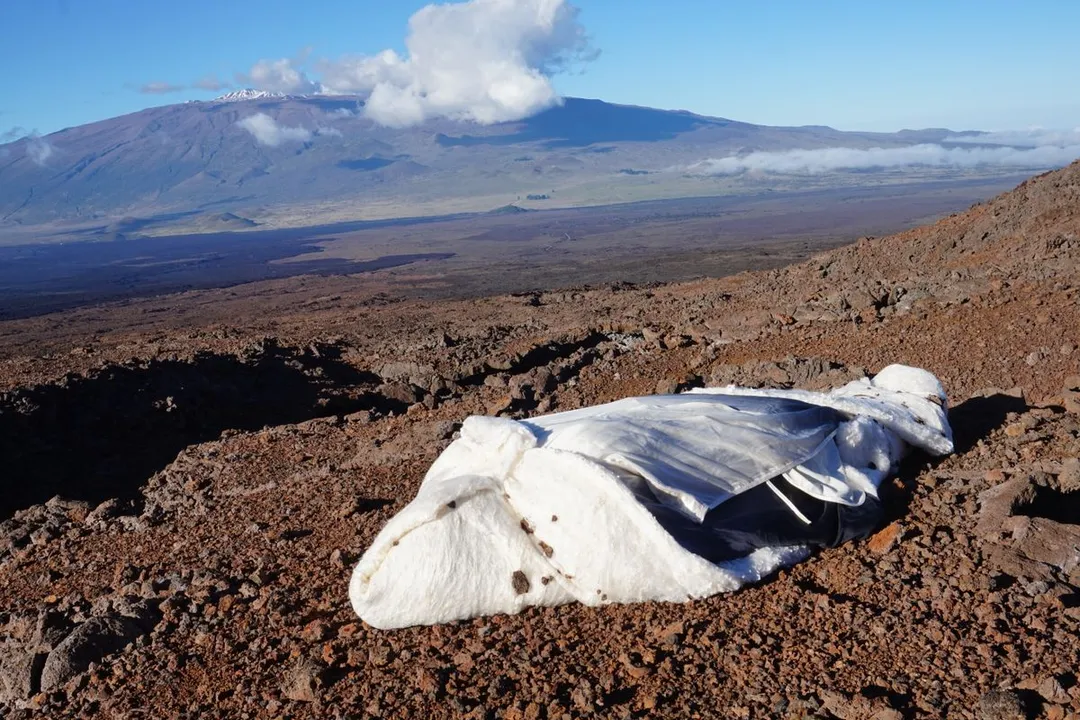
The dominant process affecting a body on Mars is not biological consumption but physical drying. The low pressure drives rapid water loss through sublimation. This is similar to the process that creates mummies in extremely arid environments on Earth, but on Mars, the speed is dramatically increased because the "air" is a vacuum pulling the moisture out of the tissues.
The result would be a severe and rapid desiccation of all soft tissues. The skin, muscles, and internal organs would shrink dramatically as their water content is stripped away, leaving behind a shriveled, leather-like husk tightly adhered to the underlying bone structure. Imagine the state of a fruit left in a powerful dehydrator—the cellular structures remain, but all the fluid that allows for softness and microbial growth is gone.
If we consider a standard human body containing approximately of water, the Martian environment would work quickly to remove this volume through sublimation. What remains would be the dry organic matter—fats, proteins, and connective tissues—which might only constitute $5%$ to $10%$ of the original total mass. This process preserves the structure of the body indefinitely, provided no other destructive forces intervene.
# No Biology
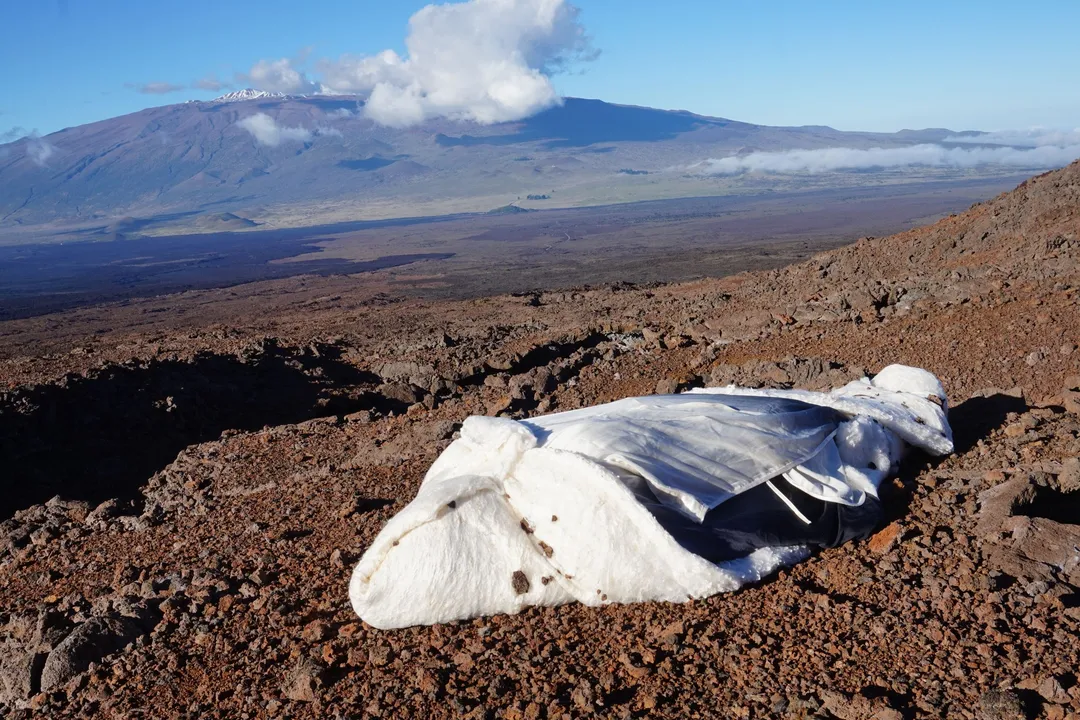
Earthly decay is fundamentally a biological process. Once death occurs, bacteria, fungi, and invertebrate scavengers begin consuming the body's tissues, recycling organic material back into the ecosystem. Mars harbors none of the necessary agents for this cascade. The surface environment is sterile, or at least far too hostile for terrestrial microbes to survive and thrive, let alone flourish in the large numbers required for decomposition.
Without this biological cleanup crew, the physical structure remains intact long after the body has dried out. There are no maggots to consume tissue, no bacteria to generate the gases of putrefaction, and no fungi to colonize the moist environments that typically form inside a corpse. The lack of biological agents means that the body would not decompose into a recognizable "rotting" mass; rather, it would remain structurally identifiable in its desiccated form for a potentially very long time.
# Surface Breakdown
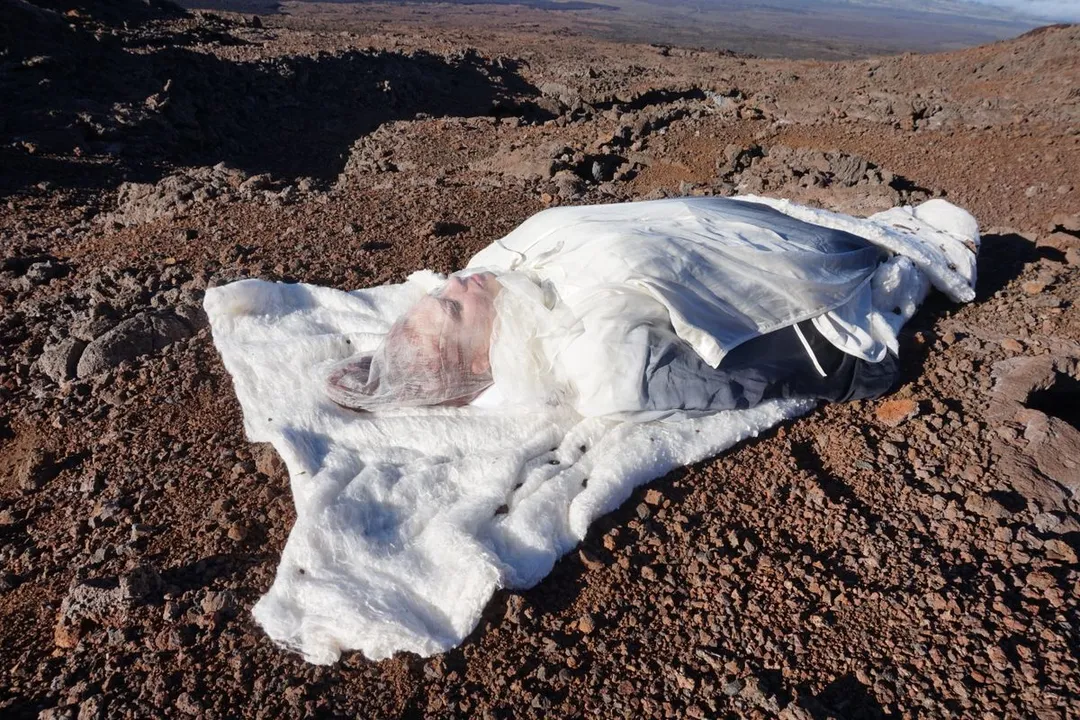
While biological decay is halted, the body is not immune to physical degradation imposed by the Martian environment over geological timescales. The surface of Mars is exposed to intense radiation due to the planet's thin atmosphere and the lack of a global magnetic field like Earth's.
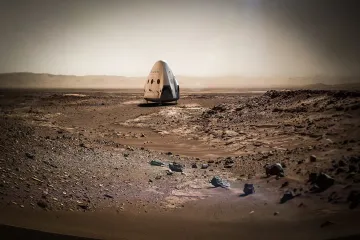
Solar ultraviolet (UV) radiation, which is strongly filtered by Earth’s atmosphere, bombards the Martian surface unimpeded. This high-energy radiation causes photodegradation, slowly breaking down complex organic molecules like and proteins into simpler chemical components. Over millions of years, this constant exposure would cause the dried tissues to become brittle, leading to mechanical disintegration. Furthermore, large diurnal (day/night) temperature swings—though the overall temperature is low—can cause materials to expand and contract repeatedly, contributing to cracking and eventual fragmentation of the dried remains. Micrometeorite impacts, though infrequent, also contribute to churning the surface material, scattering the dust that was once organic matter. The body would degrade physically, turning into fine dust mixed with the iron-oxide rich regolith, but it would not rot.
# Future Findings
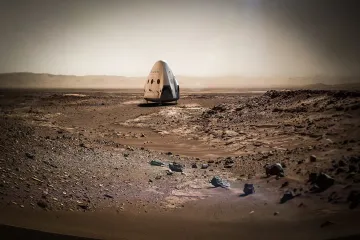
If future human explorers were to locate remains left on the surface from an early mission, what would they observe? The desiccated remains would likely be highly fragmented after centuries or millennia, but a body shielded from the worst of the direct sunlight might remain remarkably recognizable, perhaps presenting as a skeleton surrounded by darkened, brittle organic sheeting. Compared to a body buried underground on Earth—which might be reduced to bone within a century depending on soil acidity—the Martian artifact could persist in a recognizable state for far longer, limited only by radiation and thermal stress.
This preservation differential suggests an interesting context for any potential future ethical or historical recovery missions. If the goal were to retrieve artifacts, the best preservation would not be found on the open plains. Instead, areas that offer maximum shielding would be most promising. For instance, remains deposited deep inside sheltered lava tubes or beneath large, stable overhangs would benefit immensely. These locations would shield the corpse from direct solar radiation, which is the most aggressive agent of chemical breakdown on the surface, and mitigate the most extreme thermal cycling. An artifact preserved in such a shadowed cavity could potentially maintain structural integrity for timescales far exceeding those left exposed to the full force of the Martian elements.
#Videos
What Happens to Your Body If You Die on Mars? - YouTube
Related Questions
#Citations
How would humans decompose on Mars? - Astronomy Magazine
A dead body left on Mars would dry out and mummify so ... - Reddit
If Someone Died On Mars, What Would Happen To Their Body?
If a person were to die on the Moon or Mars, would the body ...
What Happens If Someone Dies on Mars? - Atlas Obscura
What happens to a human body on Mars after death? - Facebook
Would a body decay on Mars? - Quora
What Happens to Your Body If You Die on Mars? - YouTube
Funeral - Marspedia
How to die on Mars | Space