What would a magnetar do to a human?
The reality of standing near a magnetar is not just a matter of being pulled toward a giant cosmic magnet; it is an encounter with forces that actively dismantle the rules of chemistry that govern human existence. These are not merely large stars; they are the hyper-dense, magnetically charged remnants of massive stellar collapses, representing perhaps the most extreme objects in the known universe next to a black hole.
# Stellar Remnants
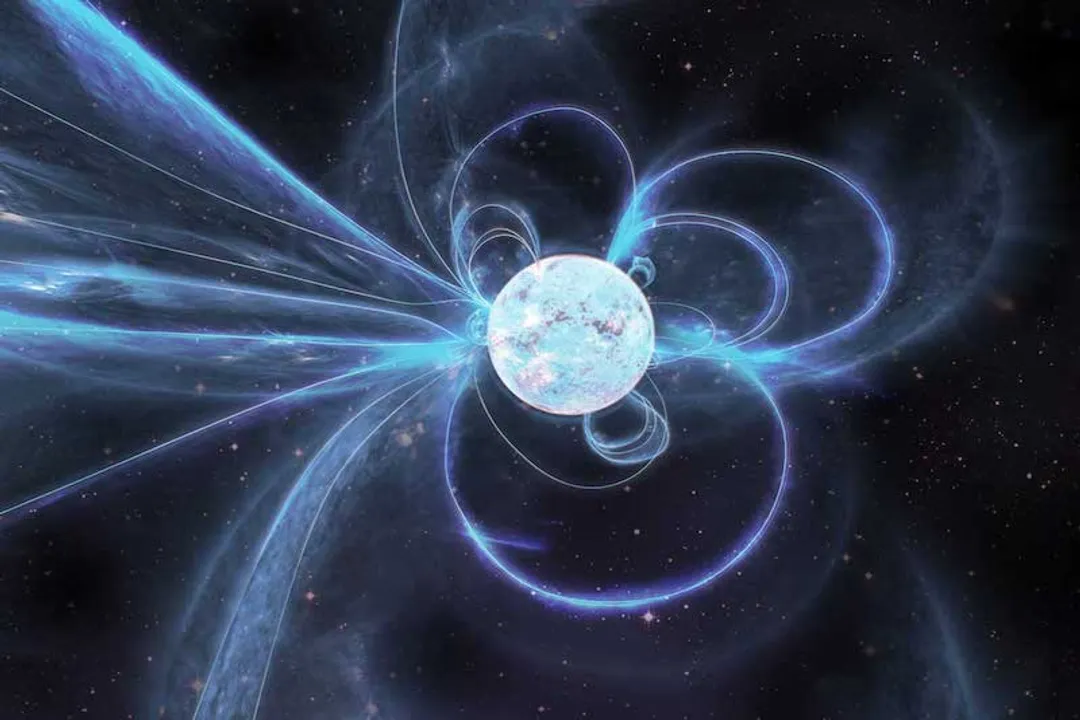
A magnetar is a specific breed of neutron star. Neutron stars themselves are already extreme, packing more than the mass of our Sun into a sphere only about 20 kilometers (or 12 miles) in diameter. A mere tablespoon of this incredibly dense material would weigh over 100 million tons. Magnetars take this density and amplify the magnetic field to incomprehensible levels. Their defining characteristic is a magnetic field measured between $10^9$ and Tesla. To put this into perspective, a typical hospital MRI machine operates in the 1.5 to 3 Tesla range, and even a powerful, rare-earth neodymium magnet only reaches about 1.25 Tesla. The Earth’s own magnetic field is a mere 30–60 microteslas.
These objects are created when a massive star, roughly 10 to 25 times the mass of the Sun, collapses in a supernova explosion. This collapse dramatically strengthens the existing magnetic field through the conservation of magnetic flux, sometimes boosting fields already as high as $10^8$ Tesla up to the magnetar range. This extraordinary magnetism is thought to be powered by the magnetic field's decay, which drives the emission of high-energy radiation like X-rays and gamma rays. The active life of a magnetar, however, is brief in cosmic terms, lasting only about 10,000 years before its powerful field subsides.
# Magnetic Death Zone
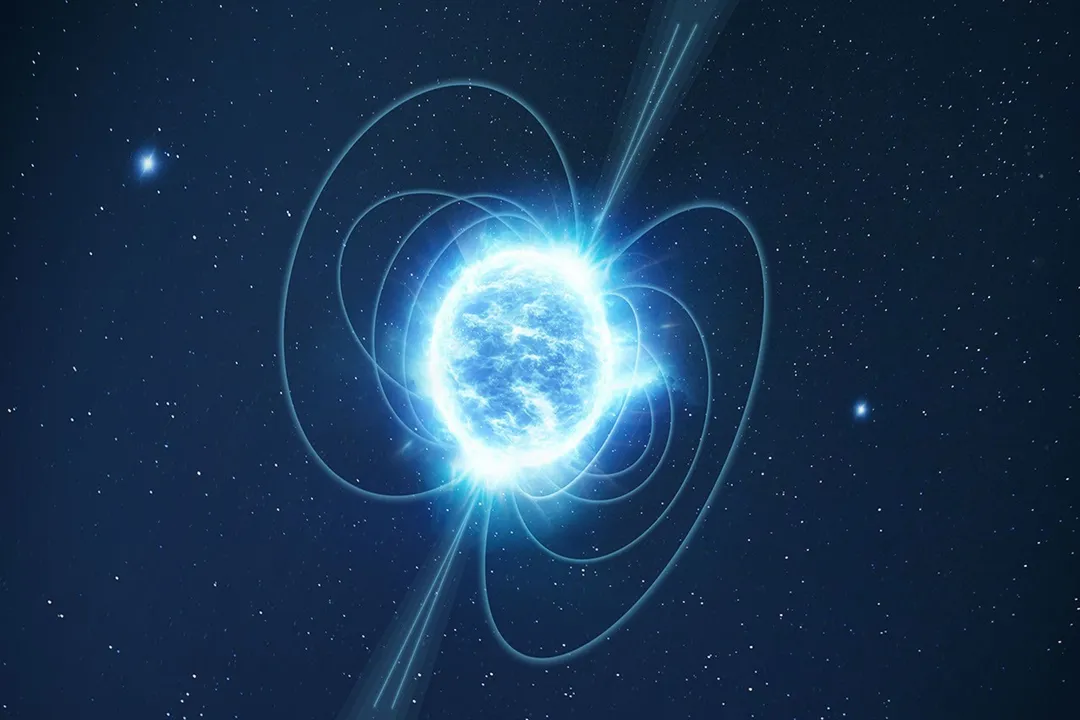
The threat posed by a magnetar is multi-layered, but the magnetic field itself establishes an astonishingly large personal "death zone". Theoretical estimates place the distance at which this static magnetic field becomes instantly lethal to a human at around 1,000 kilometers (or 600 miles). This is far beyond the distance of the Moon from the Earth.
The lethality at this range is not about a simple pull or a static shock; it is an outright assault on the fundamental forces that construct matter. Within this field strength, the magnetic influence is so dominant that it distorts the electron clouds surrounding atoms. This distortion compresses the electron clouds into elongated, rod-like, or cigar shapes, with the long axis aligned with the external field. For instance, a hydrogen atom might be stretched to 200 times its normal diameter in a field of Teslas.
When this happens, the chemistry of life becomes fundamentally impossible. Chemical bonds rely on predictable electron interactions, and when these orbitals are radically deformed, those bonds cannot be sustained. A human body, which is a complex sequence of electrochemical reactions, would cease to function because the very architecture of its molecules would fail. At this boundary, you would be disintegrated at the atomic level into a cloud of monatomic ions—single atoms stripped of their electrons—along with all your surrounding technology.
It is worth noting that the magnetic force drops off much more quickly with distance than gravity. While gravity follows an inverse square law (), the magnetic field often follows an inverse cube law () over large distances because electric charges tend to cancel out in space, unlike mass, which does not have a negative counterpart to shield its effect. This suggests that the barrier represents the point where the static field’s direct atomic interference overpowers the electromagnetic attraction that binds matter, despite the rapid fall-off.
Thinking about how far away this zone actually is, consider a hypothetical scenario: if a magnetar passed Earth at half the distance to the Moon (roughly ), its field is powerful enough to erase the magnetic stripes on every credit card on the planet. This highlights how the energy density of the field, rather than just the field itself, is the measure of its destructive potential. The energy density of a Tesla field is over 10,000 times that of lead when converted to mass-energy equivalence (). Even a spacecraft attempting to approach this region would face overwhelming forces long before the atomic disruption phase began.

# Competing Catastrophes
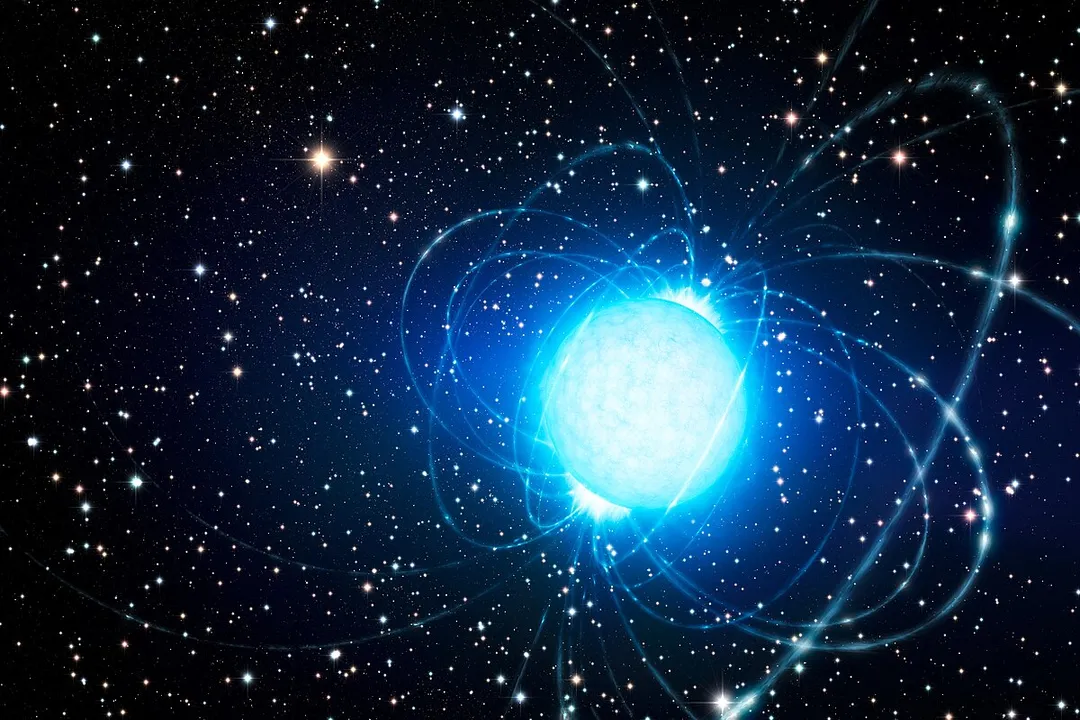
While the static magnetic field tearing apart your atomic structure at is a terrifying prospect, it might not be the first thing to kill you if you were on an unwary trajectory toward a magnetar. The energy a magnetar emits across the electromagnetic spectrum presents dangers that operate across vastly greater distances.
The first issue would be the sheer volume of high-energy radiation. Magnetars are known for powerful X-ray and gamma-ray flares. These bursts are so energetic that a flare from the magnetar SGR $1806-20$, located approximately $50,000$ light-years away, was powerful enough to temporarily compress the Earth's magnetic field. If a similar burst struck Earth from only 10 light-years away, it would be sufficient to cause a mass extinction event, irrespective of any atmospheric shielding a spacecraft might carry. This means the radiation-safe zone is many orders of magnitude larger than the static magnetic death zone.
Furthermore, a magnetar is still a neutron star, meaning it has incredible gravitational forces. Tidal forces near such a dense object would become extreme very quickly, potentially "spaghettifying" a ship and its occupants well before the mark is reached.
Finally, there is the thermal danger. At short distances, the energy flux—including X-rays and any induced electrical currents in the hull—would generate immense heat. One assessment suggests that at , the heat alone could vaporize a nearby craft.
This leads to an original consideration regarding the nature of extreme hazard: When contemplating approaching a magnetar, the danger transitions from one dominated by the magnetic field's unique quantum effects (atomic deformation) to one dominated by conventional, albeit colossal, electromagnetic and gravitational phenomena (radiation and tidal forces). In essence, the static magnetic field’s unique ability to rewrite chemistry is only a concern if you somehow manage to survive the initial, multi-light-year-spanning blast of gamma radiation and the intense heat and tidal effects closer in.
# Navigating the Void
Given that the nearest confirmed magnetar is estimated to be 9,000 light-years away, any human mission encountering one is, for the time being, a thought experiment relegated to science fiction. Space is overwhelmingly empty; the chance of a rogue star system collision is minute, as a comparison suggests that if the Sun were the size of a golf ball, the next nearest star would be over 700 miles away.
However, if interstellar travel becomes common, avoiding or detecting these objects is a key concern. One possibility for mitigating the magnetic field danger, though perhaps not the radiation, is to surround a vessel with highly effective shielding, such as a thick layer of water, which provides protection against normal cosmic radiation. Yet, the sheer mass required for a one-meter water jacket around a ship would necessitate an enormous launch mass, requiring perhaps three or more next-generation heavy-lift rockets just for the shielding. Another theoretical defense involves lining the craft with superconductors designed to expel magnetic fields, although such technology is far from current use.
A more immediate defense against the magnetic threat involves detection. Since magnetic fields drop off rapidly with distance, a highly sensitive magnetic force detector or even a simple compass might sense the dangerous field long before the threshold is breached, allowing for course correction. The challenge here is that magnetars are not constantly flaring, and tracking their faint infrared glow or weaker magnetic output across interstellar distances is difficult, though this is precisely the kind of work instruments like the Hubble Space Telescope are being used for to track known objects.
This brings up a second consideration: the effect of speed on the interaction. A hypothetical starship traveling near the speed of light experiences far greater forces from magnetic fields than one moving slowly. This relativistic effect means that a rapid approach could significantly reduce the safe standoff distance calculated for a stationary object, as the field’s impact would be amplified by the ship's velocity and the resulting induced currents.
# Cosmic Extremes
Magnetars are phenomenal reminders of the sheer energy possible within the universe. They can sometimes double as pulsars, the swiftly rotating neutron stars that sweep the sky with radio beams, acting as cosmic lighthouses. They are also strongly implicated in causing mysterious, powerful, millisecond-long flashes of radio waves known as Fast Radio Bursts (FRBs).
Encountering a magnetar remains the realm of the impossible for now. The confluence of extreme gravity, intense heat, lethal ionizing radiation, and a magnetic field strong enough to rewrite molecular bonds guarantees that anything that crosses the line, or even the radiation horizon measured in the millions of kilometers, would be instantly and irrevocably annihilated by physics operating at its most fundamental and violent limits.
#Videos
What Would Happen If You Fell Into A Magnetar? | Random Thursday
What if a Magnetar Came Close to Earth? - YouTube
Related Questions
#Citations
How lethal is flying by a magnetar? : r/space - Reddit
Magnetar - Wikipedia
What Would Happen If You Fell Into A Magnetar? | Random Thursday
NASA's Hubble Tracks a Roaming Magnetar of Unknown Origin
Is it possible to kill a human with a powerful magnet?
What is a magnetar? - EarthSky