Why was Galileo's theory rejected?

The rejection of Galileo Galilei’s astronomical findings was never a simple case of science versus religion, though that narrative persists widely. Instead, it was a complex entanglement of established philosophy, theological interpretation, political maneuvering within the Church, and the very nature of scientific proof in the early 17th century. [2][7] To understand the resistance, one must first appreciate the bedrock upon which European thought rested: the Ptolemaic system. [8]
# Old View World
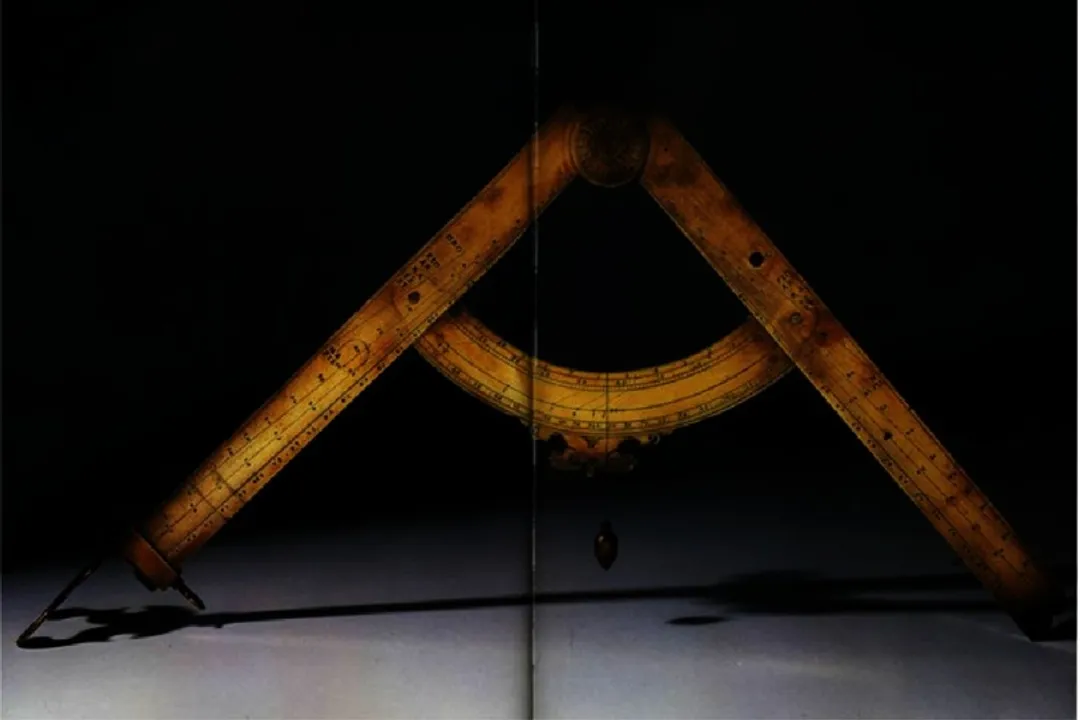
For over a millennium, the dominant cosmic model, inherited from thinkers like Aristotle and Ptolemy, placed the Earth firmly at the center of the universe—a concept known as geocentrism. [8] This view was not merely a historical curiosity; it was deeply integrated into the scientific, philosophical, and religious understanding of the cosmos. The idea that the Earth was stationary and the heavens revolved around it seemed intuitively obvious, matching everyday sensory experience. [6] Furthermore, this geocentric structure provided a neat theological framework, positioning humanity, and by extension, God’s direct focus, at the universe’s heart. [3] The sheer intellectual weight of this established structure meant that any proposed alternative required an overwhelming, undeniable body of evidence to even merit serious consideration, let alone acceptance. [4]
# Copernicus Shift
Galileo’s defense was centered on the heliocentric model, first seriously proposed by Nicolaus Copernicus. [8] This theory moved the Sun to the center, positioning the Earth as just another planet orbiting it. [1] When Galileo turned his newly improved telescope skyward, he found observations that strongly supported Copernicus. He saw the phases of Venus, which, like the Moon, suggested it orbited the Sun, not the Earth. [2][8] He also observed moons orbiting Jupiter, providing a miniature system where not everything circled the Earth. [1] These findings were deeply troubling to the old order. [5]
However, the resistance wasn't solely due to the idea itself; it was about the method of persuasion. While Galileo’s observations were compelling, they weren't the airtight, mathematical proof that the contemporary academic framework demanded to overturn Aristotle and Ptolemy entirely. [4] In an era where physics—specifically Aristotelian mechanics—held that a moving Earth would create disruptive effects like objects flying off or the atmosphere being left behind, merely seeing the orbits wasn't enough to dismiss centuries of accepted natural philosophy. [6] It strikes an observer today, accustomed to instantaneous global communication of data, how difficult it must have been for Galileo to argue that what he saw through an instrument was truer than what everyone felt and what all established texts declared. [4] This situation created an early, critical hurdle: the empirical evidence, while suggestive, did not immediately nullify the entire established physics that supported a stationary Earth. [3]
# Scriptural Reading
The conflict escalated rapidly because the implications of heliocentrism were immediately mapped onto religious doctrine. Certain passages in the Bible appeared to describe the Sun moving or the Earth being fixed. [5][7] For example, Joshua famously commanded the Sun, not the Earth, to stand still. [7] The prevailing theological stance, supported by influential figures like St. Augustine, held that when Scripture spoke of natural matters, it should be interpreted literally unless context demanded otherwise. [5] The Church maintained that its role included interpreting Scripture, and allowing a lay scientist to dictate a literal reading contrary to accepted science could undermine its spiritual authority. [2][3]
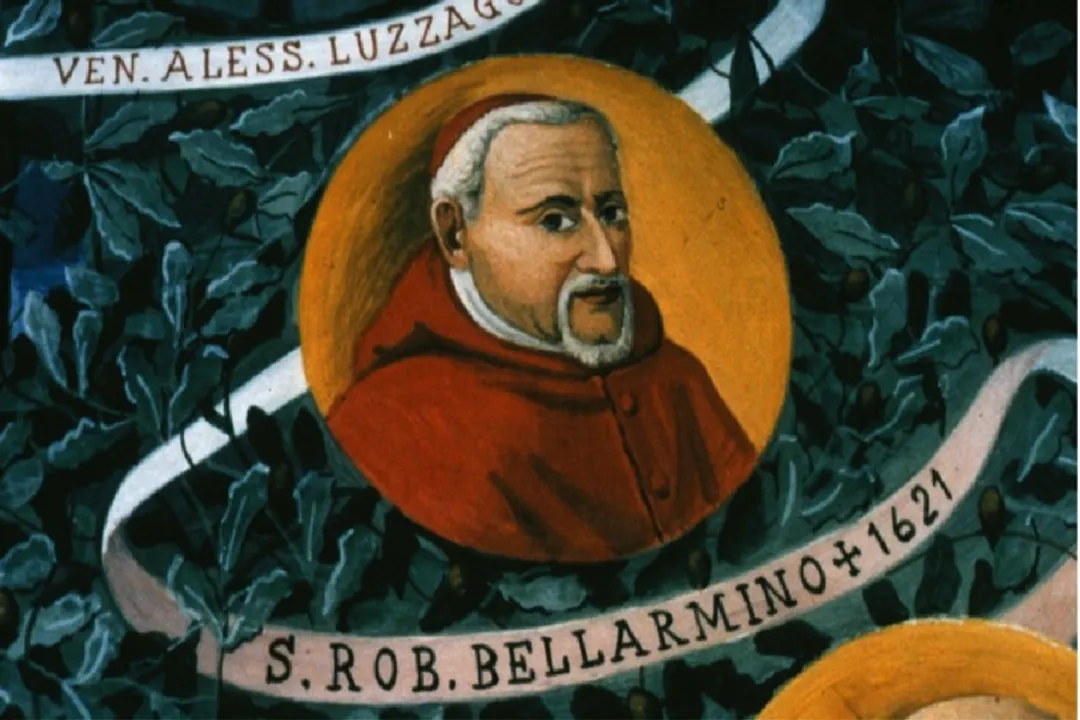
Galileo, himself a devout Catholic, argued that the Bible taught how to go to heaven, not how the heavens go. [7] He believed Scripture was inspired by God but written in terms accessible to the common person, not as a textbook on astronomy. [5] He advocated for interpreting the difficult passages metaphorically, suggesting that the heavens' movements were described in common language for clarity. [2] This was an argument for separating scientific inquiry from theological decree, a separation the authorities were deeply unwilling to permit at that moment in history. [1] The powerful theologian Cardinal Robert Bellarmine, for instance, had already warned Galileo in 1616 that he could discuss heliocentrism as a hypothesis but not as established fact. [1][5]
# Church Authority
The institutional response was driven by a concern for order and the perceived threat to the Church's teaching monopoly. The Church feared that overturning the established cosmology would destabilize the faith of the common people and open the door to widespread dissent, much like the Protestant Reformation had recently done. [3] The conflict involved key figures within the Catholic hierarchy, making it a high-stakes affair. [1]
Galileo’s major blunder, which turned a scientific debate into a full-blown affair, was the publication of Dialogue Concerning the Two Chief World Systems in 1632. [1][5] Although he attempted to follow the 1616 injunction by presenting both the Ptolemaic and Copernican views, the character representing the defenders of the established view, named Simplicio, was widely perceived as a caricature of Pope Urban VIII’s own arguments. [2][5] This perceived mockery of the Pope, combined with Galileo's perceived arrogance in the scientific realm, alienated his powerful patron and ensured severe repercussions. [1][7] It’s important to recognize that the rejection was not purely intellectual; it was also a matter of decorum and obedience to the ecclesiastical power structure. [3] Galileo was accused not just of holding a false opinion but of disobeying a direct order from the Holy Office. [1]
Here is a brief summary of the procedural evolution of the conflict:
| Year | Event | Significance | Reference Point |
|---|---|---|---|
| 1616 | Holy Office declares Copernicanism "formally heretical." | Galileo is privately warned not to hold or defend the theory. [1] | Theological/Doctrinal Caution |
| 1632 | Publication of the Dialogue. | Breaks the understanding by presenting heliocentrism too strongly, offending the Pope. [2] | Disobedience/Insult |
| 1633 | Trial before the Inquisition. | Galileo is found vehemently suspect of heresy for holding and believing Copernicanism. [1] | Judicial Outcome |
My second point of analysis centers on this distinction between the 1616 warning and the 1633 conviction. The initial scientific/theological conflict was managed with a prohibition on teaching heliocentrism as truth. [5] Galileo’s personal undoing, however, was the failure of obedience demonstrated in the Dialogue, which was widely seen as a political insult wrapped in a philosophical text. [2][3] Had he adhered strictly to the "hypothetical" presentation, the outcome might have remained confined to academic circles, similar to how Copernicus’s work was treated for decades after his death. [7]
# Trial Events
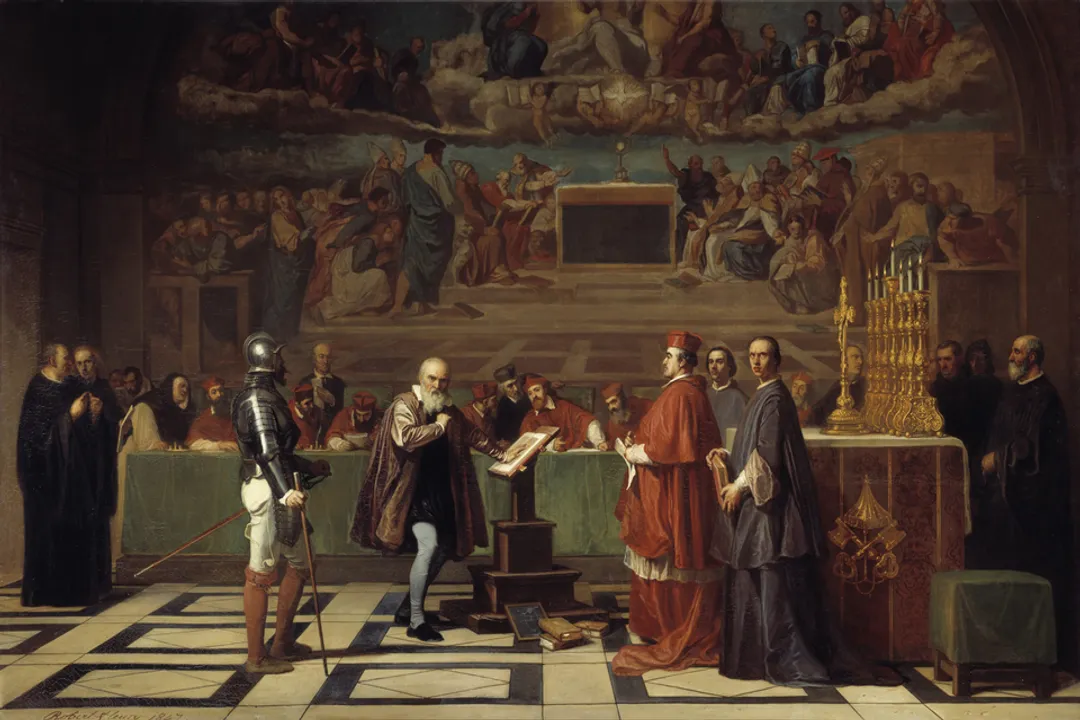
The ensuing trial in 1633 was the culmination of years of friction. [1] Galileo was summoned to Rome and ultimately forced to formally abjure (renounce) his belief in the moving Earth before the Inquisition. [5] Under threat of torture, and being an older man in poor health, he submitted to the Church's judgment. [1] His sentence included formal imprisonment (though this was quickly commuted to house arrest) and the requirement to recite the seven penitential Psalms weekly for three years. [1]
It is a persistent myth that Galileo famously muttered "And yet it moves" (Eppur si muove) after his abjuration. [7] This phrase, while dramatic, is unsubstantiated by historical records related to the trial itself. [7] The reality of the submission—an elderly, brilliant man forced to publicly deny his best scientific conclusions under duress—is a far more poignant demonstration of the power dynamics at play than any legendary utterance. [4] The Church secured its immediate objective: public reaffirmation of geocentrism and the silencing of its most vocal proponent. [1]
# Aftermath Legacy
Following his condemnation, Galileo spent the remainder of his life under house arrest at his villa near Florence. [1] While his physical freedom was curtailed, the ideas he championed could not be entirely suppressed. The scientific evidence he gathered was too compelling for future generations of astronomers who, armed with better instrumentation and mathematics, would later confirm the heliocentric picture beyond reasonable doubt. [8]
The story of Galileo’s rejection has become an archetype, often simplified into a cautionary tale about the dangers of questioning established dogma. [2] While the episode certainly involved the Church reacting defensively to a perceived threat against its authority and scriptural interpretation, it also serves as a complex case study in the relationship between empirical science and institutional power. [5][3] In the subsequent centuries, the Catholic Church gradually softened its stance on the matter, culminating in Pope John Paul II acknowledging the Church’s error in condemning Galileo in 1992. [1] The resistance Galileo faced was rooted in a powerful convergence: the intellectual inertia of Aristotelian physics, a literalist approach to certain scriptural passages, and the very real political need for the Church to maintain doctrinal unity in a turbulent age. [6][2] Galileo’s rejection was not a singular event but a clash between two worldviews attempting to occupy the same intellectual space in early modern Europe. [4]
Related Questions
#Citations
Galileo affair - Wikipedia
The truth about Galileo and his conflict with the Catholic Church
Why was the vatican against Galileo's belief that the earth rotates ...
Galileo Galilei: Science vs. faith - PMC - NIH
The Galileo Controversy | Catholic Answers Tract
Why was there such resistance to Galileo's findings? - Quora
The Enduring Lesson of the Galileo Myth - The Gospel Coalition
The Roman Catholic Church officially prohibited Galileo Galilei from
Galileo and Heliocentrism | Research Starters - EBSCO