Why was Galileo Galilei's discovery so important?

The importance of Galileo Galilei’s discoveries cannot be overstated; they represent not merely the addition of new celestial facts, but a fundamental paradigm shift in how humanity understood its place in the universe and, perhaps more significantly, how it ought to seek knowledge in the first place. [5][9] His work provided the critical empirical evidence that shattered the long-held geocentric model, forcing a move toward the Sun-centered view proposed earlier by Nicolaus Copernicus. [2][8] Yet, the true weight of his contribution lies in the methodology he championed: the rigorous application of observation and mathematics to the physical world, effectively laying groundwork for modern science. [4][9]
# Telescope Refinement

Galileo did not invent the telescope, but he certainly revolutionized it. [5][7] When he first heard reports of a Dutch optical device around 1609, he immediately set about improving it. [1][3] While initial instruments magnified objects perhaps three times, Galileo quickly managed to create telescopes that magnified up to twenty times, and later, up to thirty times their normal size. [1][2] This refinement was crucial because the existing, weak versions were only good enough for novelty; Galileo’s powerful versions were instruments of genuine scientific inquiry. [7]
This transformation from a curious novelty to a serious astronomical tool is often overlooked when discussing his legacy. It highlights an early, yet critical, element of his genius: recognizing the potential of new technology to unlock previously inaccessible truths. [1] By increasing the magnification and clarity, he turned an abstract philosophical debate—whether the heavens were perfect or flawed—into an observable question answerable with physical evidence. [3]
# Imperfect Heavens
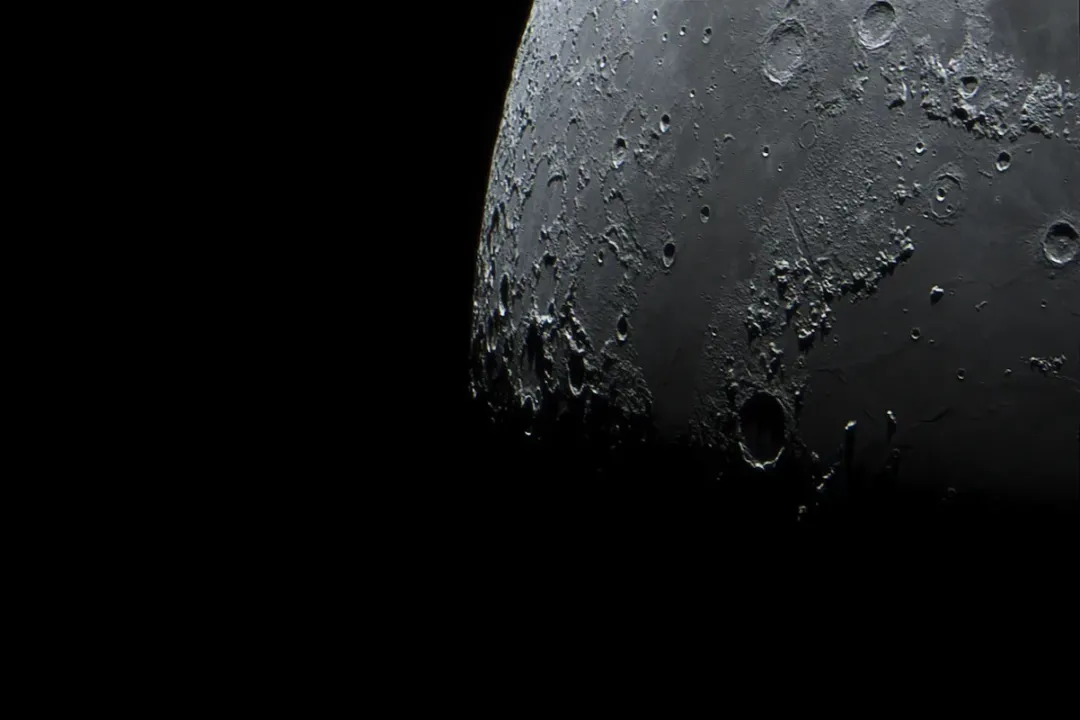
One of the earliest shocks Galileo delivered upon pointing his improved instrument skyward was his observation of the Moon. [2][3] For centuries, following the ancient Greek tradition, the celestial bodies were considered perfect, smooth spheres made of an incorruptible substance, a stark contrast to the marred and changing Earth. [4] What Galileo saw was profoundly different. He documented that the Moon was not a flawless orb but was instead covered in mountains and valleys, much like Earth. [1][3]
This observation served as the first tangible proof that the heavens were not fundamentally different from the terrestrial realm in composition or condition. [4] If the Moon was imperfect, perhaps the rest of the heavens were subject to the same physical laws as Earth, dissolving the rigid division between the corruptible sublunary world and the unchanging superlunary realm. [9] It was a philosophical demolition accomplished simply by looking carefully. Imagine the prevailing worldview: everything beyond the Earth was considered eternal and flawless, made of a fifth element. Galileo’s sketches showing shadows cast by lunar mountains provided visual evidence that the heavens were physical and malleable, rather than purely ideal forms. [3] This realization stripped away the philosophical purity that had underpinned the entire Aristotelian structure of the cosmos for millennia. [4][9]
# New Orbits Found
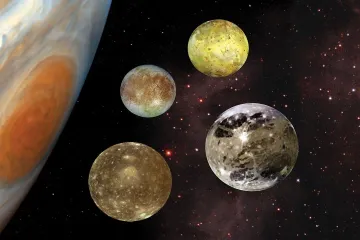
Perhaps the most direct refutation of the Earth-centric cosmos came from his observations of Jupiter. [7][8] In early 1610, Galileo discovered four small "stars" orbiting the planet Jupiter. [1][8] He meticulously tracked their movements, concluding they were, in fact, moons orbiting Jupiter itself. [2][6] He named them the Medicean stars, but today they are known as the Galilean moons: Io, Europa, Ganymede, and Callisto. [1][8]
This finding was devastating to the Ptolemaic system because that model required everything in the heavens to orbit the Earth. [7] If Jupiter possessed its own satellites, it demonstrated unequivocally that there were celestial bodies whose motion did not center on our planet. [2][8] It was empirical proof that the Earth was not the unique, solitary center of all celestial motion. [6][7] While Copernicus had already provided a mathematical framework for a Sun-centered universe, the moons of Jupiter provided a concrete, observable, local example of a sub-system revolving around a primary body other than Earth, lending powerful credibility to the heliocentric hypothesis. [6][8]
# Venusian Testimony

Further confirming the Copernican structure was Galileo’s observation of the phases of the planet Venus. [3][7] Much like the Moon goes through phases (new, crescent, gibbous, full), Galileo observed that Venus also exhibited a full cycle of phases when viewed through his telescope. [7]
In the Earth-centered (Ptolemaic) system, Venus was always situated between the Earth and the Sun, meaning an observer on Earth should only ever see Venus as a crescent or a new phase; it should never appear fully illuminated or significantly gibbous. [7] However, Galileo did observe Venus appearing fully illuminated when it was on the opposite side of the Sun from Earth, a phenomenon only possible if Venus orbited the Sun. [1][3] This single observation was virtually impossible to reconcile with the established geocentric view, offering compelling visual confirmation for the rival model. [7] It meant that the spatial arrangement of the planets relative to the Sun was dictated by the orbital mechanics of a heliocentric arrangement. [9]
# Motion Defined
Galileo’s importance extends well beyond simply mapping the heavens; his work fundamentally reshaped physics and the understanding of motion. [5] He began to rigorously investigate terrestrial mechanics, a departure from the purely astronomical focus of many of his contemporaries. [4] He moved away from the Aristotelian physics which dominated thought, which held that objects required continuous force to keep moving and that heavier objects fell faster than lighter ones. [4]
Through inclined plane experiments and careful mathematical description, Galileo began to develop concepts that prefigured the laws of inertia. [4][9] He correctly reasoned that if friction were removed, a body in motion would continue in motion indefinitely, a profound shift from the idea that stasis was the natural state of an object. [4] This work in kinematics—the description of motion without reference to its cause—was vital groundwork for Isaac Newton’s later formulation of the laws of motion and universal gravitation. [9] The importance here is recognizing that how things move on Earth became as important to understanding the cosmos as what moved where. [4]
# Empirical Science
The greatest enduring legacy of Galileo might be the establishment of the primacy of empirical evidence in scientific investigation. [4][5] His approach synthesized observation, mathematical analysis, and experimentation in a way that was revolutionary. [9] He insisted that nature must be understood through the language of mathematics, famously stating that the book of nature "is written in the language of mathematics". [4]
This commitment to measurement and proof over adherence to ancient texts marked the beginning of the Scientific Revolution in earnest. [4] Prior to this, knowledge accumulation often involved referencing established authorities like Aristotle or Ptolemy. Galileo prioritized what the senses, augmented by carefully calibrated instruments, revealed. [5] The impact of this methodological shift is hard to overstate; it’s comparable in scope to the invention of the printing press for disseminating ideas, but for generating reliable new ideas. [1] Thinking about the history of discovery, we often see a pattern where a new tool opens a previously barred door. Consider how the microscope later revealed the world of microorganisms. Galileo’s telescope functioned similarly, opening the macro-cosmos to the same level of scrutiny previously reserved only for terrestrial matters. This created a new standard: if you make a claim about the physical world, you must be prepared to back it up with repeatable, observable evidence. [4]
# Clash of Worlds
The importance of Galileo’s findings was amplified by the dramatic conflict they generated with the established religious and political authority of his time. [5] His open advocacy for the Copernican system, especially in his Dialogue Concerning the Two Chief World Systems (1632), brought him into direct conflict with the Catholic Church, which favored the geocentric model rooted in scripture and accepted philosophy. [2][6]
This conflict culminated in his trial by the Roman Inquisition in 1633, where he was forced to recant his views and spent the remainder of his life under house arrest. [5][9] While this episode is often framed as a simple battle between science and religion, it was more accurately a clash between two emerging epistemologies—one based on divine revelation and textual authority, and the other on mathematical, observational proof. [9] Galileo’s fate, though tragic for him personally, cemented his status as a martyr for intellectual freedom and scientific inquiry. [5] His insistence on following the evidence, even when it led to officially sanctioned heresy, underscored the essential independence required for scientific progress. [9] The reverberations of this trial established a crucial, if continually negotiated, boundary between scientific investigation and theological doctrine in the Western world. [2][5]
Related Questions
#Citations
Galileo | Biography, Discoveries, Inventions, & Facts - Britannica
Galileo Galilei - New Mexico Museum of Space History
What did Galileo discover? | Royal Museums Greenwich
Galileo Galilei: Science vs. faith - PMC - NIH
Galileo Galilei - Wikipedia
Galileo First Hears About the Telescope - American Physical Society
Galileo and the Telescope | Modeling the Cosmos | Digital Collections
Galileo Discovers Jupiter's Moons - National Geographic Education
Galileo Galilei - Stanford Encyclopedia of Philosophy