What is the major discovery of Galileo Galilei?
The major contribution of Galileo Galilei to science wasn't a single finding, but rather the revolutionary accumulation of empirical evidence, gathered using an improved optical instrument, which systematically dismantled the millennia-old, Earth-centered view of the cosmos. While his work spanned mechanics and the laws of motion, his most profound impact stemmed from what he saw when he turned his modified telescope toward the sky starting around 1609. This act transitioned astronomy from a largely theoretical and mathematical pursuit into an observational science, providing the first tangible proof that the Aristotelian-Ptolemaic model, which placed Earth immovably at the universe's center, could not be correct.
# Telescope Refinement
Galileo did not invent the telescope; the device had been conceived in the Netherlands shortly before his famous work began. However, upon hearing reports of the instrument, Galileo swiftly refined it. He made significant improvements to its magnification power, taking a crude spyglass and transforming it into a true scientific tool capable of discerning details previously invisible to the naked eye. He was able to produce instruments magnifying objects up to about 30 times. This technical proficiency was the essential first step; without a reliable, powerful telescope, his subsequent discoveries would have remained purely speculative.
# Jupiter's Satellites

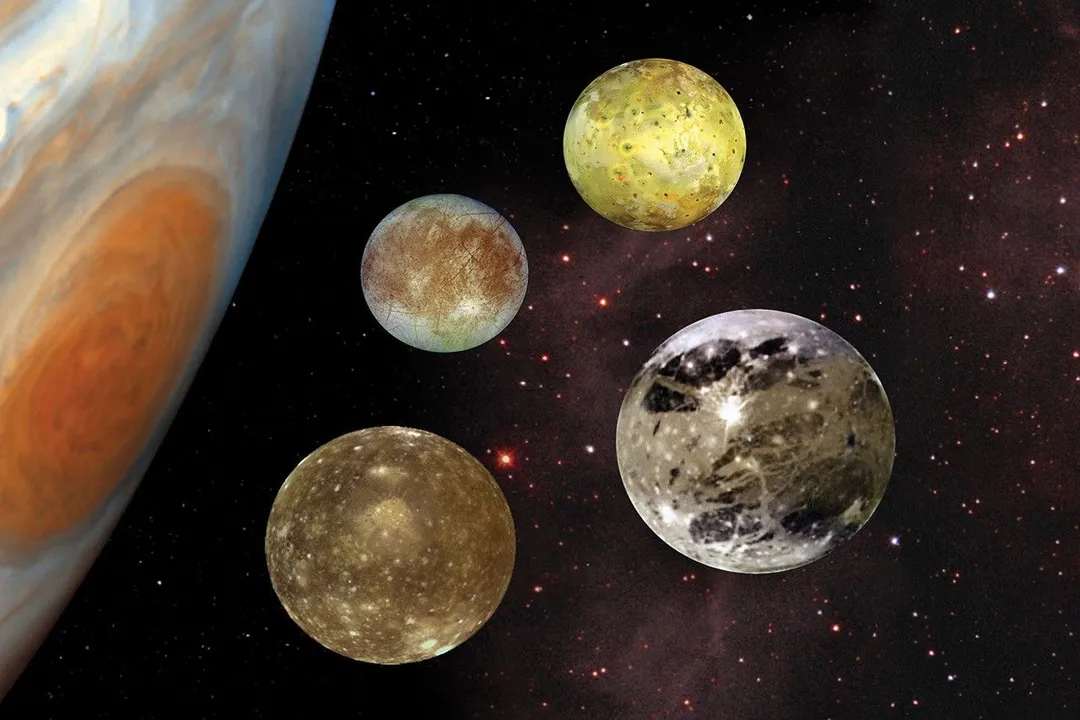
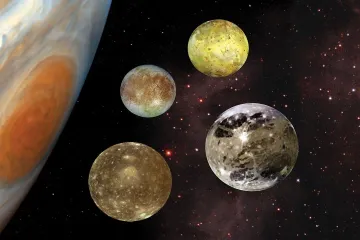
The most immediate and arguably most stunning discovery was made in January 1610: the observation of four small stars circling the planet Jupiter. Galileo named these objects the Medicean Stars, though they are now known as the Galilean moons: Io, Europa, Ganymede, and Callisto. He meticulously tracked their movement over several nights, confirming they were orbiting Jupiter, not the Earth. This observation directly contradicted the central tenet of the prevailing cosmology, which insisted that everything in the heavens revolved around our planet. Imagine the intellectual shock: for the first time, observers were presented with a clear, undeniable model showing celestial bodies orbiting a center other than the Earth. While philosophers argued over the mathematical elegance of Copernicus's mathematics for decades, seeing four new worlds revolving around Jupiter offered an immediate, physical refutation of the old system. This was observational evidence that was difficult, if not impossible, to dismiss using the old framework.
# Moon Imperfections
Before Galileo, the prevailing belief, inherited from Aristotle, held that the celestial realm consisted of perfect, smooth, and unchanging spheres, while the Earth was imperfect and subject to change. When Galileo turned his telescope to the Moon, he shattered this dogma. He saw mountains, valleys, and craters—topography startlingly similar to Earth's own surface. He observed shadows cast by these lunar features and even noted bright spots where sunlight first struck mountain peaks just before illuminating the lower areas, allowing him to estimate the height of some lunar mountains. The Moon was not a perfect, ethereal orb; it was a world, scarred and structured like our own. This finding effectively destroyed the ancient physical division between the corruptible terrestrial realm and the unchanging celestial realm, suggesting that the laws governing the heavens might be the same as those governing Earth.
# Venus Orbit
If the moons of Jupiter provided strong circumstantial evidence for heliocentrism, the observations Galileo made of the planet Venus provided the clincher. Using his telescope, Galileo observed that Venus went through a complete set of phases, much like the Earth's Moon—crescent, gibbous, and full. In the older Ptolemaic system, Venus was always situated between the Earth and the Sun; consequently, observers on Earth should only ever see it as a crescent or a new phase, never approaching a full disk. The only model that explained seeing Venus as fully illuminated (or nearly so) was the Copernican model, where Venus orbits the Sun, and we see varying amounts of its sunlit face as it moves around the Sun relative to Earth. This was the empirical confirmation that the Sun, not the Earth, was the center of their known planetary arrangement.
# Sunspots Seen
Galileo also turned his improved vision toward the Sun itself, a body long considered flawless and immutable. He observed dark spots—sunspots—moving across the solar disk. By tracking these spots over time, he concluded that they were features on the Sun, not objects passing in front of it. Crucially, he noted that as the spots moved, the Sun itself appeared to rotate on its axis. This demonstrated that celestial bodies were not eternally changeless and pristine; they were dynamic, rotating objects, just like Earth. Furthermore, the very existence of sunspots forced a new understanding of how light and shadow behaved in the heavens, adding another layer to the dismantling of Aristotelian physics.
# Experimental Physics
The major discovery extends beyond just the skies because Galileo was simultaneously pioneering a new way of doing science on Earth. While his astronomical observations gave the public the most dramatic proof for the new cosmos, his work on motion and mechanics established the foundation for modern physics. He rejected relying solely on ancient texts and instead championed observation combined with systematic experimentation. For example, in his studies of falling bodies and acceleration, he famously designed thought experiments and physical demonstrations to test hypotheses about inertia and gravity. It is fascinating to consider that while the celestial observations were what brought him into direct conflict with religious authority, it was this experimental methodology, detailed in works like Two New Sciences, that cemented his long-term scientific legacy.
| Observation Area | Key Finding | Implication for Cosmology |
|---|---|---|
| Jupiter | Four orbiting satellites (moons) | Proof that not everything orbits Earth. |
| Moon | Craters, mountains, surface texture | Celestial bodies are imperfect and Earth-like. |
| Venus | Complete set of phases (crescent to full) | Direct evidence that Venus orbits the Sun. |
| Sun | Dark spots (sunspots) and rotation | Celestial objects are dynamic and imperfect. |
# Cosmic Shift
The cumulative effect of these empirical findings—Jupiter's moons, the Moon's imperfect surface, the phases of Venus, and the rotation of the Sun—was the definitive establishment of the Copernican model in the scientific community. The major discovery, therefore, wasn't just seeing these things, but proving that the Earth was not the center of the universe. This realization carried enormous philosophical weight. Galileo's empirical success showed that the physical world could be understood through observation and mathematics, independent of purely theological or ancient philosophical dogma. This intellectual separation proved crucial for the development of the scientific revolution that followed, establishing a precedent where physical reality, demonstrated through repeatable observation, held precedence in matters of nature. His insistence on empirical proof over established tradition is perhaps the deepest legacy of his discoveries.
#Videos
Galileo's Revolutionary Observation - YouTube
Related Questions
#Citations
Galileo Galilei - Wikipedia
Galileo | Biography, Discoveries, Inventions, & Facts - Britannica
Galileo's Observations of the Moon, Jupiter, Venus and the Sun
Galileo and the Telescope | Modeling the Cosmos | Digital Collections
Galileo Galilei - New Mexico Museum of Space History
Galileo Galilei: Science vs. faith - PMC - NIH
Galileo's Revolutionary Observation - YouTube
Galileo Discovers Jupiter's Moons - National Geographic Education
Galileo - Stanford Solar Center