What is Galileo's first discovery?

The story of Galileo Galilei’s scientific breakthroughs is often framed by the dramatic pronouncements he made about the heavens, yet to understand what stands as his first major discovery, one must first appreciate the tool that made seeing possible. It was not a sudden, singular flash of insight in a vacuum, but rather the application of a vastly improved instrument that immediately began to dismantle centuries of accepted knowledge about the universe. While others before him had tinkered with early spyglasses, Galileo’s true genius lay in turning that simple magnification device into a powerful astronomical tool and then meticulously documenting what he saw through it. [6][9]
# Instrument Refinement
The invention of the telescope itself is generally credited to Dutch spectacle makers around . [9] However, when Galileo first heard reports of this device in , he didn't wait for a superior model to arrive; he immediately set about recreating and, critically, improving it. [6] He understood the practical potential of such an instrument for maritime navigation and military signaling, things that brought immediate, tangible benefit to his patrons. [9] He managed to create instruments that offered magnifications of around twenty or thirty times, far surpassing the initial power of the original Dutch versions. [6][9] This act of refinement—taking an existing concept and pushing its capabilities—is the crucial precondition for his later astronomical work. Without this superior magnification and clarity, his subsequent "first discovery" might have remained unseen or dismissed as mere visual trickery. For an astronomer, the difference between a instrument and a instrument is the difference between looking at a blur and resolving actual features on a distant object. [4]
# Lunar Surface

If we define the first discovery as the very first significant observation he made with his improved telescope that directly contradicted established cosmology, then the prize belongs to the Moon. [2][7] Before Galileo, the prevailing Aristotelian view, which dominated Western thought, dictated that the celestial bodies—the heavens—were composed of a perfect, immutable substance called aether. [2] This meant the Moon, being heavenly, had to be a perfectly smooth, flawless sphere, like a polished crystal ball. [7]
When Galileo turned his enhanced telescope toward the Moon in late , this perfect image shattered. [2][7] He observed rough, uneven features: mountains, valleys, and deep shadows that indicated topographical variation. [2] He noticed that the light catching the edges of the lunar surface as the terminator (the line between light and shadow) advanced resembled the rising or setting of the sun on Earth. [7] This provided undeniable evidence that the Moon was not a perfect, ethereal orb, but a world much like our own—a terrestrial body suspended in the sky. [2][7] This single observation was revolutionary because it blurred the hard line between the corruptible Earth and the perfect, unchanging heavens, a foundational pillar of the old view of the cosmos. [5]
This initial mapping of the lunar surface set a standard. Instead of simply recording what he saw, Galileo immediately applied mathematical reasoning to his observations. For instance, by noting how long it took for sunlight to illuminate specific peaks near the terminator, he could estimate the height of those lunar mountains, effectively applying terrestrial geometry to a heavenly body. [7]
Here is a quick comparison illustrating the profound shift Galileo introduced:
| Feature | Aristotelian/Ptolemaic Expectation | Galileo's Telescopic Observation |
|---|---|---|
| Moon's Surface | Perfectly smooth, crystalline, ethereal | Covered in mountains, valleys, and craters [2][7] |
| Stars | Fixed number, points of light | Countless numbers, Milky Way is resolved starlight [2] |
| Jupiter | Uniform, singular body | Orbited by four distinct, moving companions [7] |
# Jovian Companions
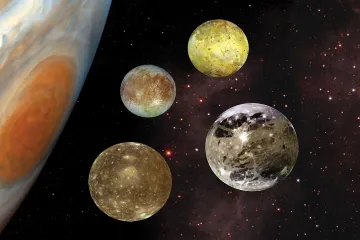
While the Moon showed that heavenly bodies were imperfect, Galileo's next major set of observations demonstrated that the Earth was not the sole center of motion in the universe. This discovery, made shortly after his lunar work, involved the planet Jupiter. [2][7] Around January , Galileo began observing Jupiter and noticed three tiny, bright "stars" close to it. Crucially, he noticed over the next few nights that the positions of these "stars" relative to Jupiter were changing. [7] He realized these were not background stars but satellites orbiting Jupiter. [2][7]
This was arguably the most damning evidence against the established Ptolemaic system. The geocentric model required everything in the cosmos to orbit the Earth. [2] If Jupiter had objects visibly orbiting it, then the Earth could not be the singular, unmoving center of all celestial motion. [7] This observation provided direct, empirical proof that other centers of motion existed in the heavens. [2]
Galileo named these objects the Medicean Stars in honor of his patron, Cosimo II de’ Medici, Grand Duke of Tuscany. [3][7] He published these findings in his short treatise, Sidereus Nuncius (Starry Messenger), in , which brought him immediate fame across Europe. [3][5]
Thinking about the initial reaction to this discovery offers an interesting perspective on scientific acceptance. While the evidence was observable, many scholars refused to even look through the telescope, preferring to rely on ancient authority rather than their own senses. [8] It speaks to a deep institutional resistance to paradigm shifts. Imagine the intellectual challenge: if Jupiter has moons, what else might the supposedly perfect heavens contain that we simply haven't seen yet because we lack the proper tools or the willingness to question Aristotle? This isn't just about astronomy; it’s about the nature of scientific evidence itself, where seeing is no longer strictly believing if what you see violates deeply held philosophical tenets.
# Stellar Views
Following his work on the Moon and Jupiter, Galileo also turned his instrument toward other familiar celestial objects. He observed that what appeared as single, fixed points of light to the naked eye were, through the telescope, revealed to be distant suns—meaning the universe was vastly larger than previously imagined. [2] Furthermore, he resolved the Milky Way. [2] For centuries, the Milky Way had been described as a nebulous cloud or atmospheric phenomenon. Galileo demonstrated that it was, in fact, composed of an immense, uncountable number of individual stars packed so densely together that the eye could not resolve them without magnification. [2]
# Venusian Phases
The final piece of Galileo's initial triumvirate of telescopic discoveries involved the planet Venus. [2][3] As he continued to track the planets over several months in , he observed that Venus exhibited a full cycle of phases, similar to the Moon (from crescent to gibbous to nearly full). [2]
This observation was catastrophic for the Ptolemaic system. In the Ptolemaic model, Venus orbits the Earth inside the orbit of the Sun, meaning an observer on Earth should only ever see Venus as a crescent or, at best, fully illuminated when it was on the far side of the Sun (and thus hard to see). [3] The observation of a full Venus phase was only possible if Venus orbited the Sun, placing the Sun between the Earth and Venus at certain points in its orbit. [2][3] This phase pattern strongly confirmed the predictions of the Sun-centered, or Copernican, model of the solar system. [6]
Galileo’s systematic recording of these phases provided empirical, repeatable evidence supporting Copernicus, something that had previously existed mostly as a mathematical curiosity debated by scholars. [2] He kept this specific observation somewhat secret initially, fearing immediate persecution, but the evidence was undeniable to those who later followed his lead. [3]
# Scientific Authority
Galileo’s first major discovery, the rugged surface of the Moon, was quickly followed by discoveries concerning Jupiter and Venus that together dismantled the ancient cosmological structure. [7] His methodology itself represented a new form of scientific inquiry. He didn't just theorize or debate; he observed, recorded data, and then used mathematical reasoning to draw conclusions. [8]
His approach contrasted sharply with the preceding centuries where authority rested primarily in the written works of Aristotle and Ptolemy. [8] When Galileo stated the Moon had mountains, he wasn't quoting a text; he was reporting what he saw through an instrument that gave humanity a new sensory experience of the cosmos. [7] This insistence on empirical observation as the ultimate arbiter of truth is arguably Galileo’s most enduring "first discovery"—the establishment of the primacy of direct observation in natural philosophy, which paved the way for modern science. [5] He didn't invent the telescope, but he effectively invented the modern astronomical method through his disciplined recording and interpretation of what his improved lenses revealed in the skies over a period of just a few months. [4] The initial sight of the Moon's imperfect face was the crack in the dam; the moons of Jupiter were the flood that followed.
Related Questions
#Citations
Galileo Galilei - Wikipedia
Galileo's Observations of the Moon, Jupiter, Venus and the Sun
Galileo | Biography, Discoveries, Inventions, & Facts - Britannica
400 Years: Observing Galileo's Telescope - Caltech Library
Galileo First Hears About the Telescope - American Physical Society
Galileo and the Telescope | Modeling the Cosmos | Digital Collections
Galileo: Discovering Jupiter's Moons | PBS LearningMedia
Scientific Discovery | galileo - The Middlebury Sites Network
The Galileo Telescope: A Journey Of Discovery With MOVA Globes