What protoplanet collided with Earth?
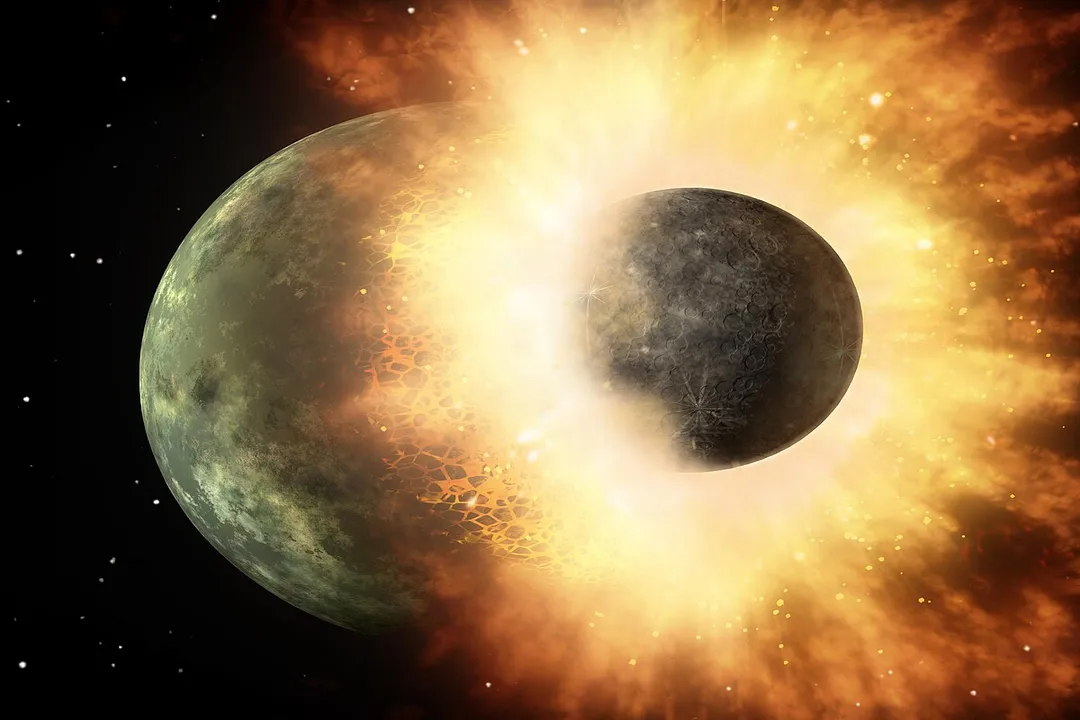
The most widely accepted scientific explanation for the origin of our Moon involves a colossal smash-up early in the Solar System’s history—a collision so energetic it fundamentally reshaped our planet. The object responsible for this monumental event is known by the evocative name Theia, a hypothetical protoplanet whose existence we infer from the aftermath it left behind: the Moon itself. [1][4][5]
# Theia's Identity
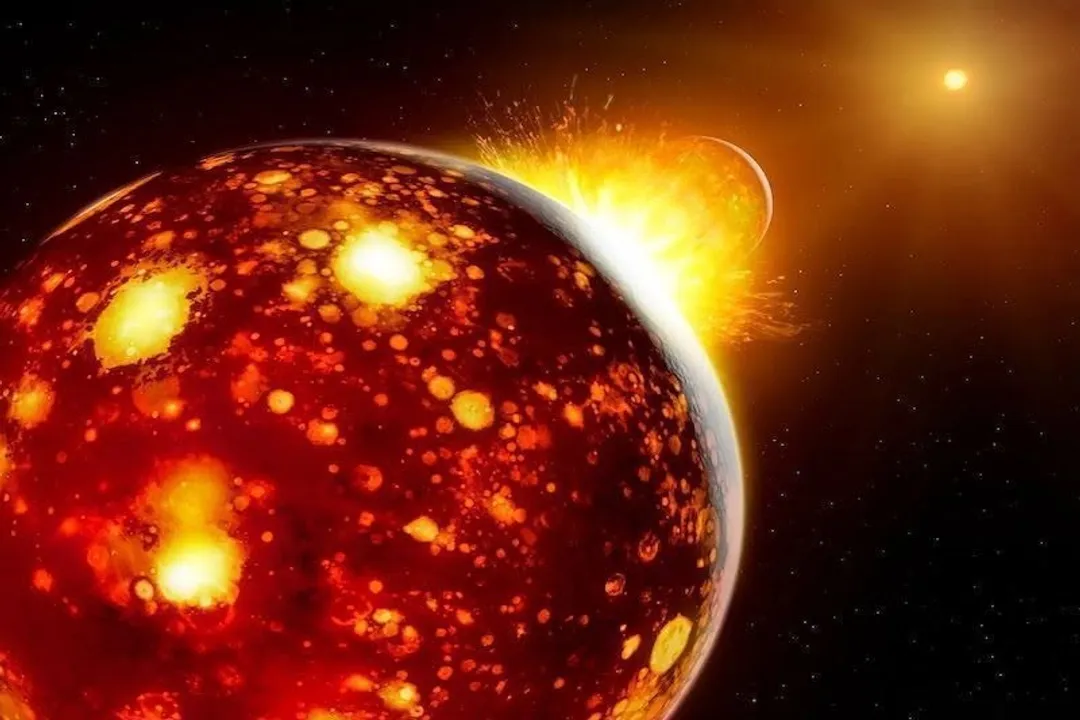
The name Theia originates from Greek mythology, where she was the Titaness mother of the Moon goddess, Selene. [1] While this impactor is a hypothetical body, it is the centerpiece of the leading model, the Giant Impact Hypothesis, which describes the cataclysmic event that occurred roughly 4.5 billion years ago. [4][5] This impactor was not some small asteroid; evidence suggests Theia was a significant body, likely comparable in size to present-day Mars. [1][4]
# Size and Trajectory Estimates
Estimates for Theia's mass vary, but putting it in context helps visualize the scale of the collision. If Mars is roughly 10 percent of Earth’s mass, a Mars-sized impactor colliding with the proto-Earth represents an almost unimaginably violent merger. [1][4] Early models assumed Theia struck Earth glancingly, meaning the impactor came in at a shallow angle, allowing much of its material to be thrown into orbit, forming the Moon. [1]
However, the precise composition of the Moon has since forced scientists to reconsider the impact geometry. The Moon shares a surprisingly similar isotopic signature with Earth’s mantle, meaning a substantial portion of the Moon must have originated from the Earth itself, rather than just the impactor. [1][7] This similarity has led to evolving theories. One suggestion is that the impact was more head-on, or that Theia was composed of materials very similar to Earth’s mantle. [1]
# Origin Location Debate
A major area of scientific distinction revolves around where Theia came from within the young Solar System. [8] For decades, the standard model favored Theia originating from the outer Solar System, perhaps being a transient object captured temporarily into an orbit around the Sun near Earth before destabilizing and striking. [1][8]
More recent research, however, strongly suggests a different source region: the inner Solar System. [8][9] Studies analyzing the isotopic evidence imply that Theia was likely a "native" resident of the inner system, perhaps one of the many planetesimals that jostled for position alongside the forming Earth. [8][9] This scenario, sometimes called the "Synestia" model or a highly energetic impact, suggests Theia was gravitationally flung into Earth or merged violently with it, providing the necessary energy to mix the materials thoroughly and explain the Moon’s geochemical makeup. [8] If Theia originated in the inner system, it implies that the early planetary building blocks were chemically similar across the region, which is an important constraint for understanding planet formation in general. [8]
# The Cataclysmic Moment
The actual collision, often termed the "Giant Impact," was not a slow, grinding event but a nearly instantaneous catastrophe. [10] Simulations suggest that the material forming the Moon could have been assembled into orbit in a matter of hours, a timescale that drastically shortens our previous conceptions of lunar formation. [10]
# Impact Dynamics
The velocity of the impact is a crucial variable. If Theia struck Earth at a low velocity, the resulting debris disk would have been less mixed, potentially explaining why the Moon is depleted in iron relative to Earth (as Theia's metallic core might have sunk into the Earth's core). [1] Conversely, a higher-velocity impact, perhaps from an object originating further out, would have been more energetic, potentially ejecting more material and leading to a more thorough mixing of both bodies' mantles. [1]
The sheer energy released would have vaporized vast quantities of rock from both Earth and Theia, creating a massive, superheated disk of vaporized rock orbiting the proto-Earth. [1]
From a sheer energetics perspective, thinking about the impact as a process that lasts "hours" is almost nonsensical; the initial kinetic energy transfer would have been nearly instantaneous on a geological scale, transforming the surface of both bodies into plasma within minutes, with the subsequent disk aggregation taking the longer portion of that short timescale. [10]
# Aftermath and Lunar Birth
The immediate aftermath of the collision created a massive, orbiting ring of incandescent material—a planetary ring system composed of vaporized rock and magma—around the Earth. [1] Over a relatively short period, likely months to years, this material began to accrete gravitationally. [1] This accretion process formed the Moon. [1][5]
The Moon formed from the debris, which explains why it lacks a large iron core compared to Earth; most of the iron from Theia's core likely sank into the Earth’s core during or immediately following the merger. [1] This differential composition is one of the key pieces of evidence supporting the Giant Impact Hypothesis over other theories, such as the capture model. [4]
# Geochemical Fingerprints
The most compelling support for Theia's existence comes not from direct observation—Theia is, after all, long gone—but from the chemical "fingerprints" left on Earth and the Moon. [7]
# Isotopic Symmetry
As mentioned, the Moon and Earth share nearly identical stable isotope ratios of elements like oxygen, titanium, and tungsten. [1][7] This near-perfect match is difficult to explain if the Moon formed from a completely separate body originating far away in the Solar System. [1][8] It strongly implies that the material that formed the Moon was thoroughly homogenized with Earth’s mantle material during the impact. [7]
If Theia had been, for example, a body from the asteroid belt or the outer reaches of the system, its isotopic signature should have been markedly different from Earth's, much like Mars's are different from Earth's. [7] The fact that they are so similar points back to an origin of Theia close to or within Earth’s own building block region. [8]
# Earth's Hidden Mantle Layers
One fascinating potential consequence of this massive impact might be observable today, deep within the Earth itself. [7] Scientists have identified two massive, mysterious blobs of material located deep beneath the mantle, beneath Africa and the Pacific Ocean, known as Large Low-Shear-Velocity Provinces (LLSVPs). [7] These regions are chemically and thermally distinct from the surrounding mantle rock. [7]
Some researchers speculate that these LLSVPs might be the chemically distinct, surviving remnants of Theia itself, incorporated into the Earth’s interior but never fully assimilated into the bulk mantle. [7] If this hypothesis holds, these blobs are literally the ancient core/mantle material of the impactor, sitting deep beneath our feet, offering a direct, albeit submerged, connection to the ancient protoplanet. [7] This geological detective work provides an ongoing, albeit indirect, line of evidence regarding the nature of the collision. [7]
# Comparing Formation Models
When considering the impact, it is helpful to map out the major theoretical possibilities for how Theia might have hit to produce the Moon we observe today, especially as new data refines the models. [1]
| Impact Scenario | Approximate Angle | Material Mixing | Key Implication |
|---|---|---|---|
| Shallow Glancing Blow | Low angle () | Limited, favors ejecting Theia's mantle | Explains Moon's lack of iron core, but struggles with isotopic similarity [1] |
| High-Energy Head-On | High angle () | Thorough mixing of Earth and Theia mantles | Best explains isotopic similarities [1][7] |
| Synestia Model | Variable/Energetic Merger | Vaporization and re-condensation into a doughnut-shaped object | Explains rapid formation and high angular momentum [8] |
The shift in understanding from a simple glancing blow to a high-energy, more thorough merger is key. It requires a more powerful collision than initially assumed to explain the isotopic homogeneity. [7] An interesting thought experiment arises when considering the aftermath of a high-energy collision: the Earth-Moon system may have briefly existed as a Synestia—a massive, rapidly spinning, doughnut-shaped mass of vaporized rock—before settling into the two distinct bodies we see now. [8] This intense heat and mixing would completely erase any previous chemical differentiation between the two impactors, making the resulting Moon look exactly like Earth's own material, which aligns with the observed oxygen isotope ratios. [8]
The speed of the merger also has implications for planetary differentiation elsewhere. If the Moon formed in hours, as some simulations suggest, it implies that rapid energy release and material cycling were more common in the early stages of terrestrial planet formation than models based on slower cooling and settling would predict. [10]
# The Unanswered Details
While Theia explains the Moon, the specific details of its existence remain elusive, a common occurrence when dealing with events billions of years in the past. [4] We don't have Theia's 'fossil record' because the collision was so violent it destroyed the evidence, incorporating most of it into the Earth-Moon system. [4] We are studying an aftermath, not the cause itself. [4]
One challenge for the scientific community is reconciling the composition. If Theia came from the inner Solar System, it should have been highly differentiated, meaning it should have had a dense iron core and a lighter silicate mantle. [8] A standard impact should have left Earth with more of the impactor's core material than what appears to be present in the Moon. [1] The fact that the Moon is so depleted in iron suggests that Theia's core was either substantially smaller than expected, or, more likely, that the impact was so energetic that the vast majority of Theia's core sank directly into Earth's already formed core, mixing very little with the ejected mantle material that eventually coalesced into the Moon. [1]
For those of us looking up at the Moon tonight, it is humbling to realize that every one of those craters, maria, and highlands is a direct result of a cosmic accident involving a missing sibling world named Theia. It reminds us that the current, stable configuration of our Solar System is the result of incredibly violent, early-stage violence, where the creation of one celestial body was contingent upon the total destruction of another. [5] This event wasn't just about making the Moon; it was about setting the final mass, spin, and tilt of the Earth that allowed life to later take hold.
# Tracing Theia's Legacy
The ongoing search for Theia's remnants serves as a compelling example of how geology and astrophysics intersect to tell deep time stories. [7] While the impactor itself is gone, the planet it struck is imprinted with its history. [7] Modern observational techniques, like seismic studies detecting those deep mantle anomalies, offer tantalizing possibilities that a piece of that ancient protoplanet might still reside deep inside Earth, a silent monument to the collision that forged our closest celestial neighbor. [7] The name Theia, therefore, is more than just a mythological placeholder; it represents a missing piece of the Solar System's early architecture, a planet whose entire existence culminated in the creation of the Moon and the stabilization of the world we inhabit. [5] The evidence, scattered across light-years of space and billions of years of time, continues to point back to that single, defining collision. [6]
#Videos
What was Theia like? - YouTube
Related Questions
#Citations
Theia (hypothetical planet) - Wikipedia
I was just reading up on the ancient Theia planet that supposedly ...
What was Theia like? - YouTube
Theia (planet) | Research Starters - EBSCO
Did you know? The leading theory for how #Earth got its moon is ...
Theia slammed into Earth, left marks and then formed the Moon ...
Hints of an Ancient Protoplanet Inside of Earth | American Scientist
The Lost Planet That Created the Moon Came from the Inner Solar ...
Planet that collided with Earth likely from our solar system; study finds
Collision May Have Formed the Moon in Mere Hours, Simulations ...