What key piece of evidence forced scientists to evolve theories beyond the simple glancing blow model?
Answer
The Moon shares a surprisingly similar isotopic signature with Earth’s mantle.
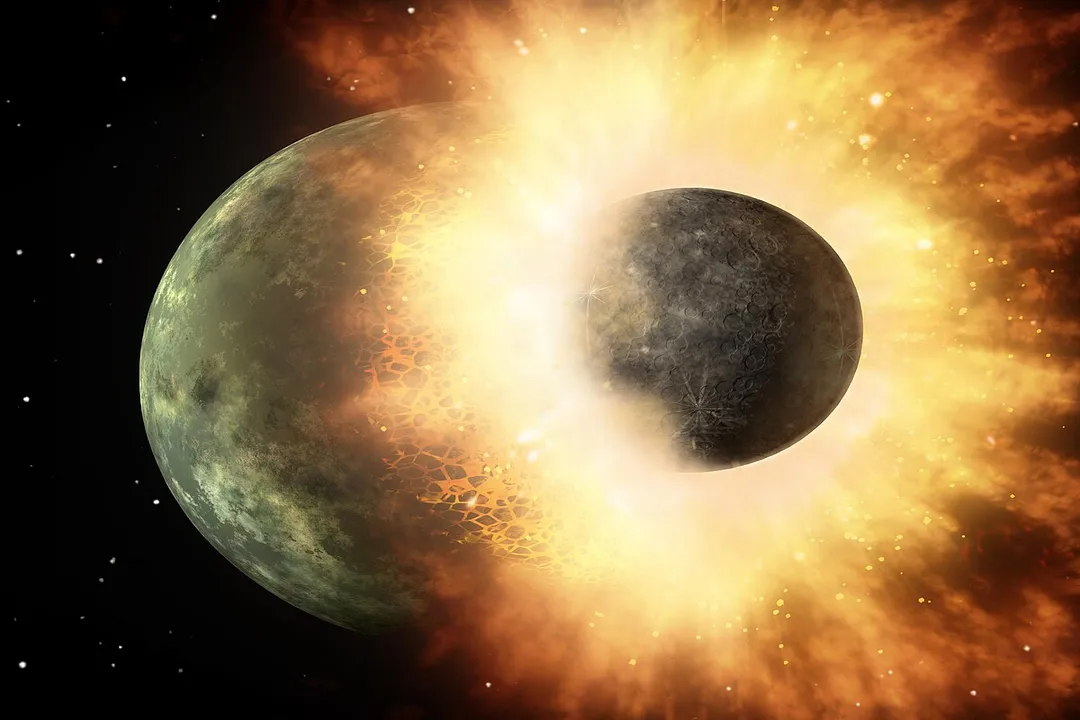
The near-identical stable isotope ratios found on the Moon and Earth's mantle suggest that a substantial portion of the Moon originated from Earth itself, necessitating a more thorough mixing than a shallow glancing blow would produce.
#Videos
What was Theia like? - YouTube
Related Questions
What is the name given to the hypothetical protoplanet responsible for the impact that formed the Moon?Theia is hypothesized to have been comparable in size to which present-day solar system body?What type of impact geometry did the earliest models of the Giant Impact Hypothesis assume?What key piece of evidence forced scientists to evolve theories beyond the simple glancing blow model?Where do more recent isotopic evidence studies suggest Theia most likely originated within the young Solar System?According to simulations, approximately how quickly could the material forming the Moon have assembled into orbit after the impact?What is the term for the massive, rapidly spinning, doughnut-shaped mass of vaporized rock that the Earth-Moon system may have briefly existed as after the collision?What is the primary explanation for why the Moon lacks a large iron core compared to Earth?What specific geological features deep beneath the mantle are speculated to be chemically distinct, surviving remnants of Theia?If Theia had originated from far outside Earth's formation region, what would we expect its isotopic signature to be compared to Earth’s?