When considering the Earth-Sun system as an isolated entity, how is the local ordering of life sustained?
Answer
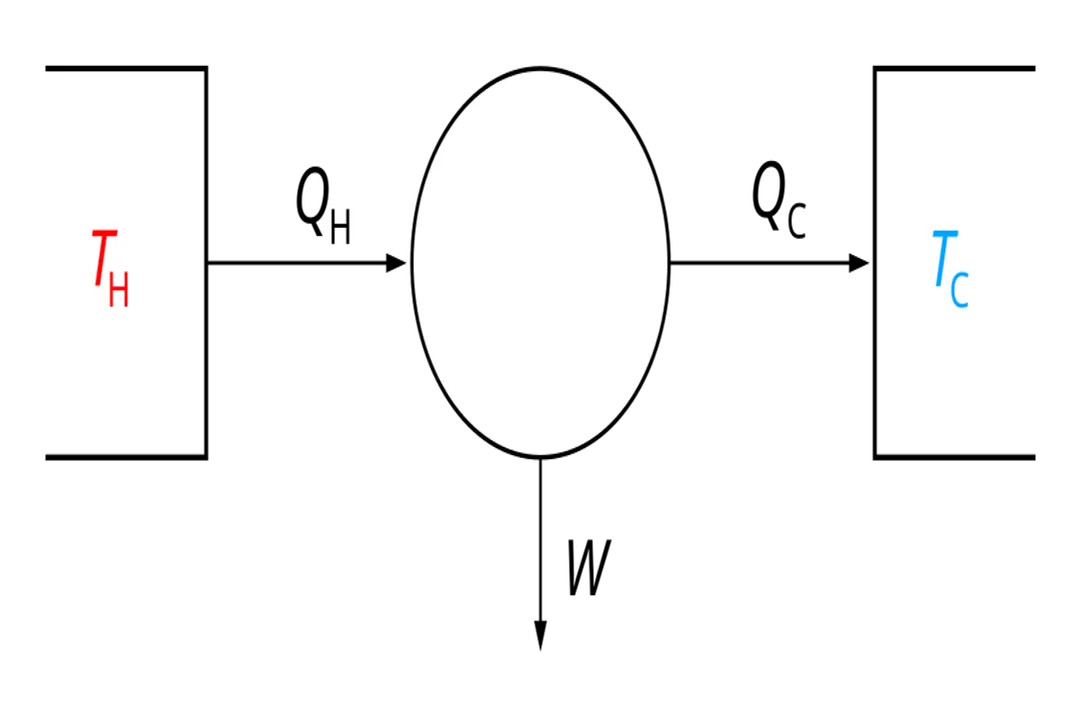
The local decrease in entropy on Earth is paid for by a vastly larger increase in entropy generated by the Sun.
The Sun generates entropy through fusion and radiative cooling, releasing high-entropy energy. The low-entropy energy arriving at Earth sustains local order (life) at the expense of a much greater overall entropy production in the Sun.
Related Questions
What condition must the total entropy of an isolated system meet over time according to the Second Law of Thermodynamics?Which type of system is defined as one that exchanges energy but prohibits the exchange of mass with its surroundings?What physical concept is fundamentally provided by the Second Law of Thermodynamics?If entropy decreases locally in a non-isolated system, what consequence must hold true regarding the total entropy?According to statistical mechanics, what quantity does entropy ($S$) mathematically relate to via Boltzmann's formula ($S = k \ln \Omega$)?Why does a gas spread out to fill an entire container when a divider is removed, rather than staying clumped on one side?How does the dispersal of energy (increase in entropy) affect the usefulness of that energy for performing work?What defines a reversible process in the context of the Second Law?When considering the Earth-Sun system as an isolated entity, how is the local ordering of life sustained?What term describes the theoretical final state of the universe if the unidirectional increase in entropy continues indefinitely?