What causes the solar system to stay together?
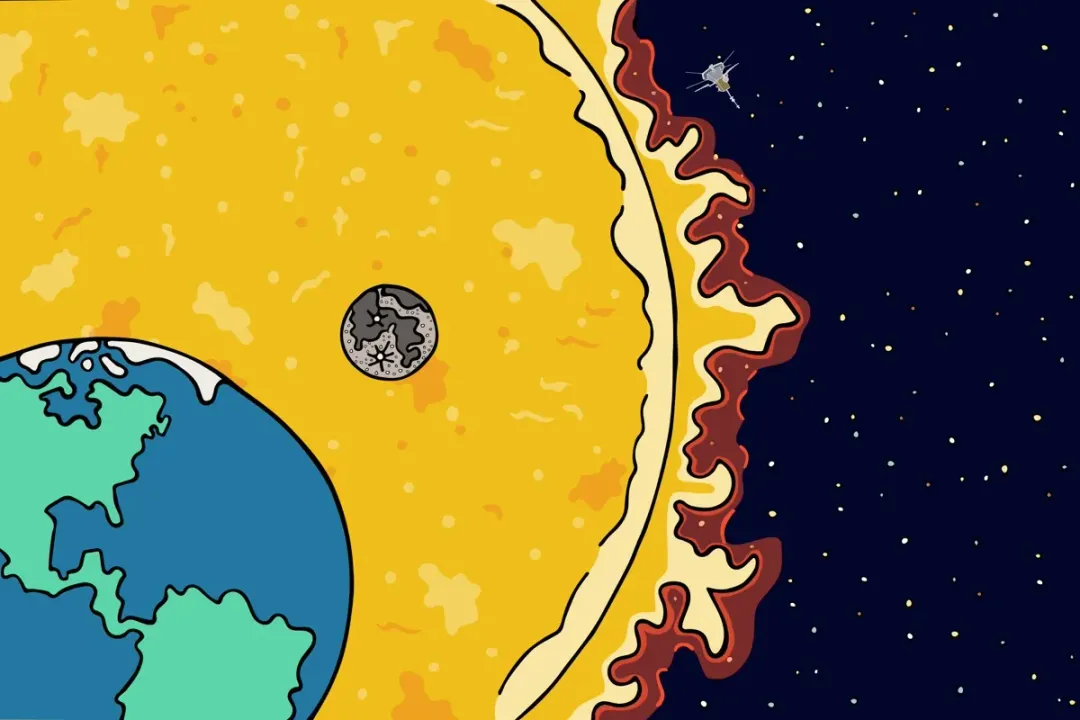
The cosmos appears ordered, a collection of worlds moving with predictable grace around a central star, yet the very question of what causes this arrangement to persist against the vacuum of space is fascinating. It is not simply one object holding another still; rather, it is a meticulously maintained, dynamic balance between opposing physical tendencies, a balance that has held for billions of years since the Sun ignited and the leftover debris began its celestial dance. [2][5]
# Central Anchor
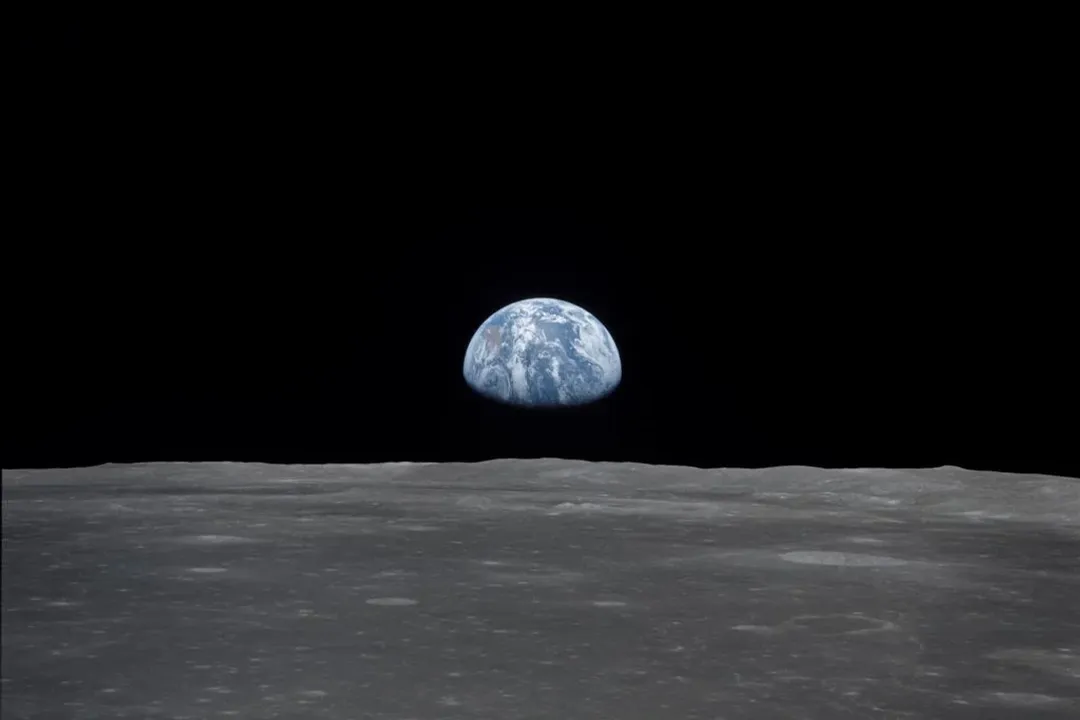
The undisputed master of the solar system is the Sun. Being the most massive object by an enormous margin, it exerts the strongest gravitational force, acting as the central anchor that prevents everything else from flying off into interstellar space. [2][5] Gravity, the fundamental push or pull between any two objects with mass, is what governs the overall structure. [2][4] A planet’s ability to remain in orbit stems directly from this continuous pull toward the Sun’s center of mass. [2]
However, the pull of gravity is complicated by distance, following an inverse square law: as distance increases, the force weakens rapidly. [3] This leads to some counterintuitive relationships, especially in the inner system. Consider our own Moon: surprisingly, the Sun’s gravitational pull on the Moon is significantly stronger—perhaps even twice as strong—as the Earth’s pull on the Moon. [3] If gravity were the only factor, the Moon should follow the Sun more directly. Yet, the Moon remains tightly bound to Earth. This is because the Earth and Moon are incredibly close to each other relative to their shared distance from the Sun. [3] They are essentially two dancers holding hands while moving around a much larger partner; the local gravitational bond between the two small dancers is strong enough to keep their combined path slightly wobbly as they circle the larger partner, but the dominant shared path is dictated by the Sun. [3]
To better grasp the scale of gravitational influence, one can see that even on Earth, we are pulled by the massive Sun, but we feel the Earth’s gravity more strongly because we are so much closer to it. [2] This principle applies throughout the system: proximity matters immensely when evaluating the net gravitational effect between bodies. [3]
# Necessary Speed
If the Sun is constantly pulling everything inward, why don't the planets simply spiral in and fall? The answer lies in inertia. Inertia is the tendency of an object in motion to keep moving in a straight line at a constant speed unless a force acts upon it. [2] When the solar system first formed from a collapsing cloud of gas and dust, the initial motions imparted upon the forming planets dictated that straight-line trajectory. [2]
The stable solar system is therefore a product of this ongoing cosmic negotiation: the Sun’s gravity pulls inward, while the planet’s inertia tries to carry it outward in a straight line. [2] The resolution of this "tug-of-war" is centripetal force, which causes the net motion to curve around the Sun, resulting in the established elliptical orbits. [2] This balance dictates specific speeds for specific distances. A planet like Mercury, being close to the Sun and thus strongly pulled inward, must maintain a very high orbital velocity to counteract that intense gravity. [2] Conversely, a distant giant like Jupiter can move at a comparatively slower speed and still maintain a stable path due to the lower gravitational influence from the distant Sun. [2]
A helpful way to see this balance is by observing objects in free fall, like dropping two objects of different masses from the same height. [2] Although the more massive object is attracted slightly more by gravity, it also possesses proportionally more inertia, meaning it requires more force to accelerate. [2] In a vacuum, these two effects cancel out perfectly, meaning both objects accelerate at the same constant rate and land simultaneously. [2] This same principle governs the orbital balance: the planet’s inherent resistance to changing direction (inertia) perfectly matches the force required to bend its path (gravity) into an ellipse. [2]
# Coherent Plane
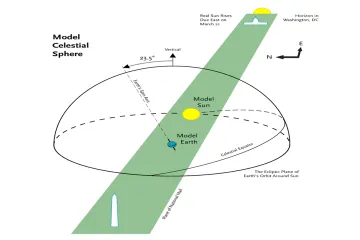
While gravity and inertia explain why objects orbit, they don't fully explain how they manage to orbit so neatly together. The vast majority of major solar system bodies orbit the Sun in a relatively narrow band, close to a single plane known as the ecliptic. This structural characteristic is a fossil of the system's birth.
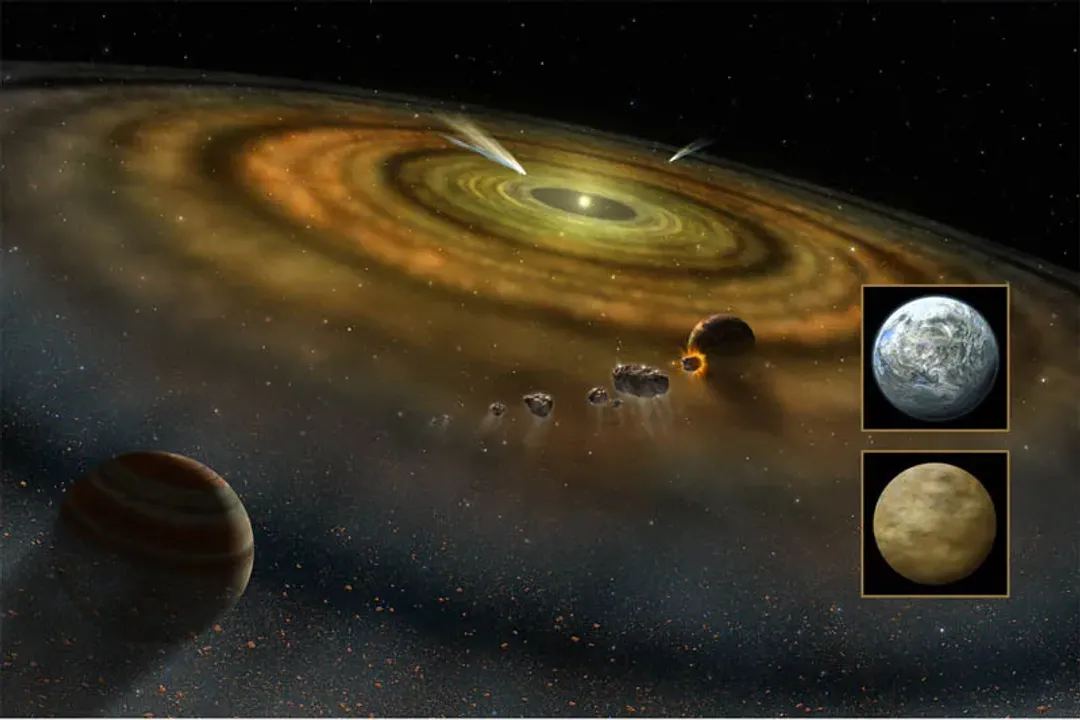
The solar system originated from a large, spinning cloud of gas and dust, a nebula. [2] As gravity pulled this immense cloud inward to form the Sun, the law of conservation of angular momentum came into play. [3] Think of a spinning ice skater pulling their arms in; they speed up, but their overall rotational momentum is conserved. [3] In the case of the nebula, the collapsing cloud flattened into a spinning disk, or accretion disk, because particles moving perpendicular to the spin plane constantly collided and canceled out their vertical velocity components. Eventually, the system settled into a state where virtually all the material was confined to that flattened plane of rotation. The planets subsequently condensed from the dust and gas within that disk, inheriting this collective angular momentum, which is why they all follow similar, nearly planar orbits around the central star. [3]
# Subtle Forces
For the large, gravitationally dominant planets, the story of cohesion is largely a two-sided equation of inertia and Sun-gravity. [1] However, for smaller components—asteroids, comets, and dust—other, non-gravitational forces can impart noticeable shifts over time. [4]
One of the most significant non-gravitational effects comes from comets and asteroids containing ice. [4] When these objects approach the Sun, the ice instantly turns to gas—a process called sublimation—rather than melting. [4] As this gas rushes away, it carries momentum, exerting a recoil force on the icy body, much like the opposite effect of a bullet leaving a gun. [4] This can nudge a comet slightly off its predictable orbital path. [4]
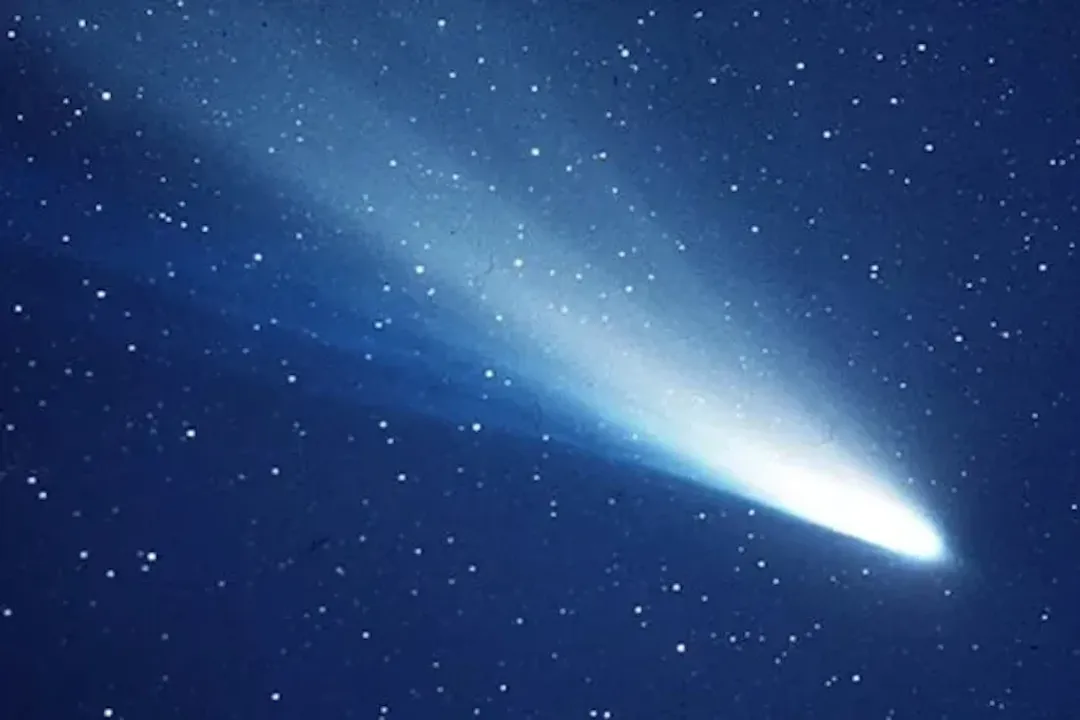
Another subtle push comes from radiation pressure. Photons streaming from the Sun transfer their momentum when they strike particles, pushing them slightly away from the Sun. [4] While this effect is minor for large planets, it is strong enough to shape the tails of comets and cause a gradual alteration in the orbits of very small dust particles. [4]
Even the physics of Einstein plays a small part in maintaining order. For Mercury, the planet closest to the Sun, gravitational forces are so extreme that effects described by General Relativity (G.R.) are measurable. [1] Simulations show that without accounting for G.R., the rate at which Mercury’s orbit becomes unstable would be drastically higher. [1] In essence, relativistic effects help dampen some of the chaotic tugs between the inner planets, extending the effective stability of Mercury’s orbit. [1]
# Chaotic Future
When we discuss the solar system staying together, we must differentiate between "stable on human timescales" and "eternally stable." Astronomers have searched for proofs of stability since Newton, but modeling the system is the classic -body problem, which is generally unsolvable except through numerical simulation. [1]
The conclusion reached through modern computation is that the solar system is chaotic in the mathematical sense. [1] This chaos means that the planets’ orbits are subject to subtle, cumulative gravitational perturbations from one another that grow over time. [1] The system possesses a Lyapunov time, which has been estimated to be in the range of 2 to 230 million years. [1] This is the point at which tiny initial uncertainties—even errors of just a meter or less in measuring a planet's position today—magnify to the point where predicting its exact location becomes impossible. [1] Over these timescales, the eccentricity (how elliptical) of orbits can change dramatically. [1]
The most famous potential instability involves Mercury and Jupiter. [1] Due to a near-coincidence in their orbital precession rates, Jupiter’s gravitational nudges could theoretically accumulate over billions of years to potentially eject Mercury from the solar system or send it careening into another planet, like Earth or Venus. [1] However, on the scale of the next few billion years—the timeframe relevant to Earth’s habitability—the system is considered dynamically safe. [1]
This leads to a profound realization about celestial mechanics that goes beyond simply listing the forces. Because the system is chaotic, our understanding of its long-term future must be statistical rather than deterministic. [1] For example, by simulating thousands of possible futures with slightly varied starting conditions, researchers can determine that in a small percentage of cases (like 20 out of 2,501 simulations), Mercury ends up on a collision course. [1] We can say there is a chance of disaster in billion years, but we cannot state with certainty which path our specific system will take. [1] The stability we observe today is real and immense, but it is confined to a predictable window imposed by the inherent sensitivity of the equations governing gravity between multiple large masses. [1] The solar system stays together now because its initial conditions gave it enough momentum and stability to survive that initial chaotic phase, and it remains in a temporary, predictable equilibrium sustained by the fundamental interplay of mass, velocity, and conservation laws. [2][3]
#Videos
The Solar System - What Holds It All Together? - YouTube
Related Questions
#Citations
The Solar System - What Holds It All Together? - YouTube
How does the Sun's gravity hold the entire solar system together, but ...
Gravity And Centripetal Force In Our Solar System - Science Friday
There's More Than Just Gravity at Work in the Solar System
Stability of the Solar System - Wikipedia
Why do the planets in our solar system orbit in the same plane?
Sun - NASA Science