How do noise-canceling systems work?
The desire for quiet in an increasingly loud world has driven remarkable technological advancements, leading to the creation of sophisticated systems designed to neutralize unwanted sound. These technologies generally fall under the umbrella of Active Noise Control (ANC), a process that actively counters incoming sound waves rather than just blocking them physically. [4][7]
# Control Methods

Noise reduction in audio devices usually involves one of two primary methods: passive isolation or active cancellation. [3] Passive noise isolation relies on physical barriers. This includes using dense materials in the earcups or ensuring the ear tips fit snugly in the ear canal to create a strong seal, which physically prevents sound energy from reaching the eardrum. [3]
Active noise cancellation, conversely, is an electronic process that works to eliminate noise rather than merely attenuate it. [7] It is a specialized form of Active Noise Control (ANC). [4] A third related technique is noise masking, which introduces a steady, often pleasant background sound, such as white or pink noise, specifically to cover up unpredictable or irritating external sounds, though the original noise is still physically present. [3]
# Wave Physics
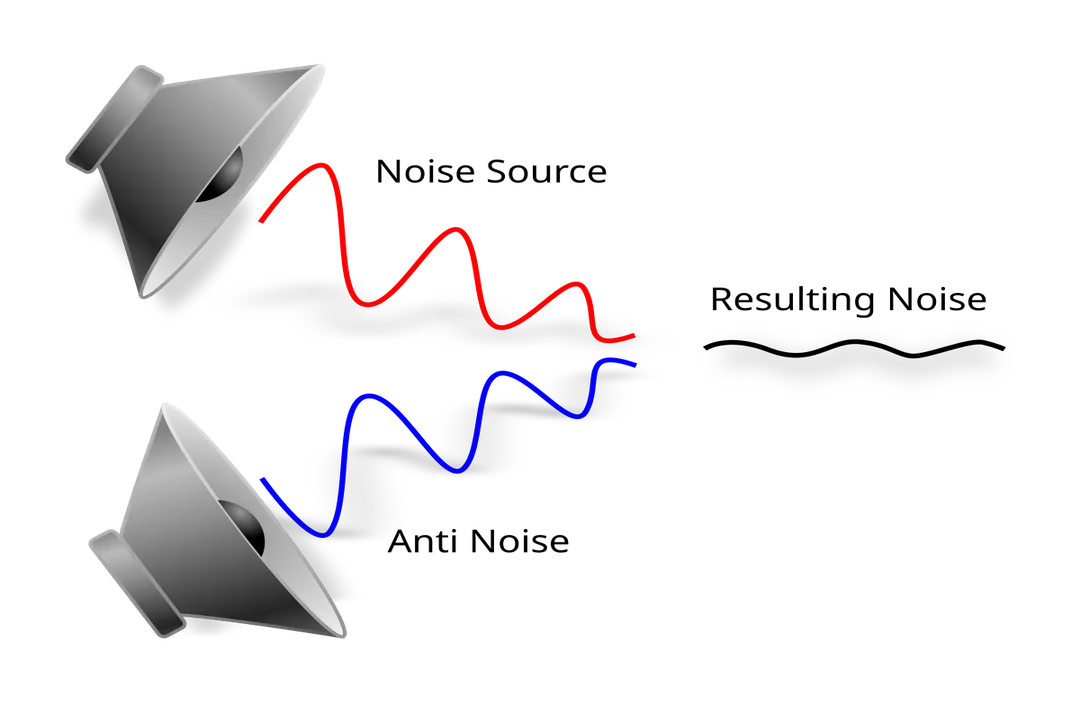
To understand how ANC functions, one must grasp the nature of sound itself. Sound travels as a wave, characterized by crests (peaks) and troughs (valleys). [1] When two sound waves meet, they interact. If the crest of one wave meets the trough of another wave of the exact same frequency and amplitude, they effectively cancel each other out; this effect is known as destructive interference. [4]
This principle is the foundation of active noise cancellation. [1][5] The system’s goal is not to stop the incoming sound, but to generate a new sound wave—an anti-noise signal—that is precisely 180 degrees out of phase with the external noise. [1][5] When the original, unwanted sound wave meets this freshly generated inverse wave inside the ear canal, they negate each other, resulting in silence for that specific frequency component. [1]

# Device Structure
Implementing this cancellation requires a finely tuned set of hardware components working in rapid succession. [2][7] At its most basic, an ANC setup must include a microphone to detect the external noise. [2] This captured sound signal is then routed to a processing unit, which can be a dedicated chip or an integrated circuit within the device. [7] The final essential piece is a speaker or driver responsible for playing the calculated inverse sound wave directly toward the user’s ear. [2][8]
The sophistication often dictates the quality of the cancellation. Better systems use higher-quality microphones and faster processors to manage the complex calculations needed for accurate phase inversion. [7]
# Operational Flow
The process of creating silence is a high-speed balancing act. First, an external microphone placed on the outside of the headphone housing captures the ambient noise from the surrounding environment. [2] The onboard chip then immediately analyzes the captured signal, determining its frequency and amplitude characteristics. [7] Based on this analysis, the chip calculates the precise signal required to create the inverse wave—a mirror image of the unwanted sound. [2][8] This newly calculated "anti-noise" signal is then sent to the headphone’s internal speaker, which projects it into the listener’s ear canal. [2]
The entire sequence, from sound detection to anti-noise emission, must occur within milliseconds for the cancellation to be effective before the original sound wave has completely passed by the user’s ear. [7]
# Placement Strategies
Manufacturers employ different microphone placements to optimize noise capture, which results in varying levels of performance depending on the environment. [2]
- Feedforward ANC: In this setup, the microphone is positioned outside the earcup, facing the environment. [2] It listens for the noise before it reaches the ear. While effective at targeting predictable, steady noises, it relies purely on the accuracy of the initial sound capture and processing speed. [2]
- Feedback ANC: This method uses a microphone placed inside the earcup, very close to the ear itself. [2] This microphone monitors the sound that the user is actually hearing, allowing the system to correct for any noise that managed to leak past the cancellation process or any inaccuracies caused by the headphones’ internal acoustics. [2]
- Hybrid ANC: As the name suggests, hybrid systems combine both feedforward and feedback microphones. This layered approach generally provides the best overall performance because the external mic catches the initial sound while the internal mic refines the output for accuracy. [2]
The effectiveness hinges on the speed and accuracy of the signal processing. [7] Since the process involves physical travel time for sound waves and electronic processing latency, ANC excels primarily at low-frequency, continuous sounds like the drone of an airplane engine or the hum of an HVAC unit. [1][4] Higher, sharper sounds, such as sudden speech or a slammed door, have shorter wavelengths and faster onset; the system often cannot generate the inverted wave quickly enough before the original sound has already passed the microphone. [1]
Consider the trade-offs when selecting a device for a specific setting. For long-haul airline travel where the primary annoyance is consistent, low-frequency engine rumble, a feedforward system might provide ample noise reduction while potentially offering better battery efficiency. [2] However, for use in a busy, unpredictable office environment where sudden keyboard clicks, coughs, or nearby conversations occur frequently, a feedback or hybrid design is significantly superior because of its ability to self-correct the immediate noise perceived by the wearer in real-time. [2]
# Comparison to Masking
It is important to clearly distinguish active cancellation from noise masking. [3] While ANC attempts to nullify the offending sound wave entirely through destructive interference, noise masking simply introduces a competing, controlled sound. [3]
| Feature | Active Noise Cancellation (ANC) | Noise Masking |
|---|---|---|
| Mechanism | Electronic phase inversion and destructive interference [1][4] | Introduction of a steady background sound [3] |
| Result on Target Noise | The targeted noise wave is theoretically eliminated or greatly reduced [4] | The targeted noise remains present but is less perceptible [3] |
| Primary Application | Low-frequency, constant sounds (e.g., engines, fans) [1] | General ambient noise reduction where silence isn't the goal [3] |
| Complexity | High; requires microphones, processing chips, and speakers [2] | Low; typically requires only a sound generator [3] |
Ultimately, achieving true silence requires a combination of methods. Even the best ANC headphones rely on the passive isolation from the physical seal of the earcup to block high-frequency sounds that the electronic cancellation cannot catch effectively. [3] The synergy between the physical barrier and the electronic counter-wave provides the quiet experience users seek. [7]
Related Questions
#Citations
ELI5 how does active noise cancellation works and is it ... - Reddit
What is Noise Cancellation and what can I expect? - Sony UK
How Do Noise Cancelling Headphones Work? - Bose
Active noise control - Wikipedia
Here's a quick explainer of how ANC, or active noise cancellation ...
What exactly does "noise canceling" mean? - Bogleheads.org
How Do Noise-Canceling Headphones Work? | Sonos Blog
How Does Noise Cancelling Work? | LG STORY
Noise Cancellation Explained: How It Silences Unwanted Sounds