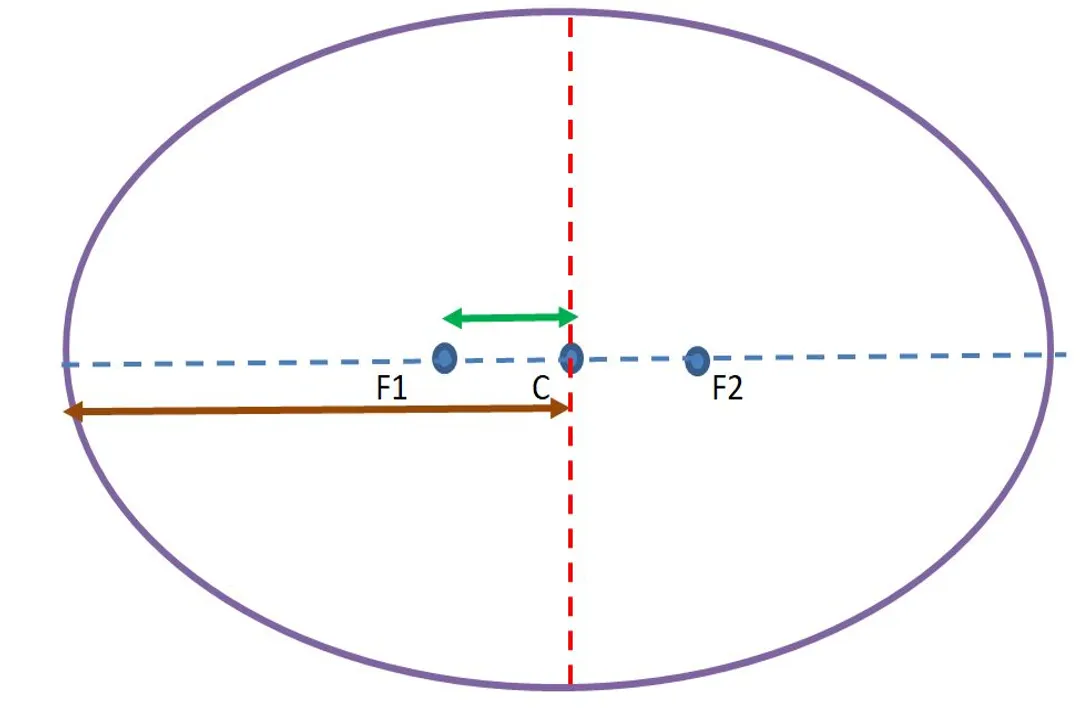
What geometric shape did Kepler ultimately conclude defined the true path of the planets?
Answer
Ellipse
Kepler's work in *Astronomia Nova* discarded the circular dogma, concluding that the true path of the planets was an ellipse.
Related Questions
What celestial body was positioned at the center of the Ptolemaic system?How did the Copernican model naturally account for retrograde motion?To align with existing observations, what geometric concept did Copernicus largely retain from older models?In Tycho Brahe's hybrid system, what remained the static center of the universe?Which specific astronomical data was crucial for Kepler to eventually derive his elliptical orbits?How large was the persistent deviation Kepler found when fitting Tycho's Mars data to circular orbits?What geometric shape did Kepler ultimately conclude defined the true path of the planets?Where is the Sun located in Kepler's established elliptical orbital model?Kepler's Second Law, the Law of Areas, explains what aspect of planetary movement?What long-held aesthetic bias did Kepler have to discard to embrace the ellipse?Kepler's model was mathematically distinct from Copernicus's primarily due to the use of what geometry?What concept, hinted at by Kepler's model, was entirely absent from purely geometric models like Ptolemy's?