What describes the sun's apparent path during summer in the Northern Hemisphere?
Answer
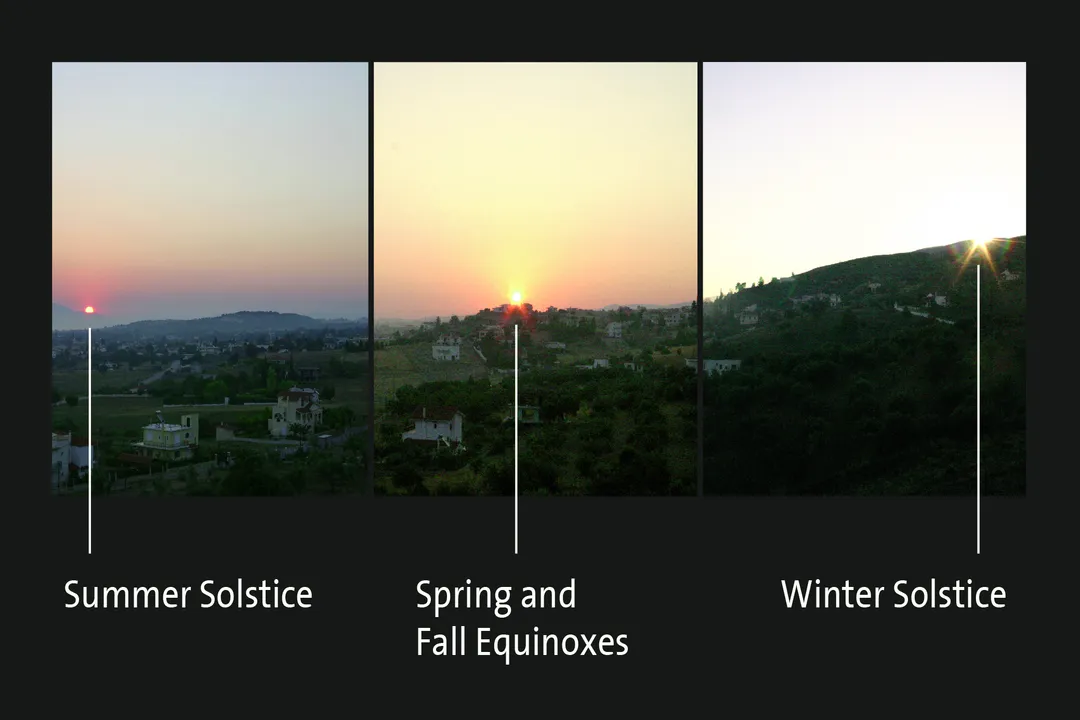
The path is significantly higher and longer, rising north of true east and setting north of true west
When the Northern Hemisphere experiences summer, the North Pole is tilted toward the sun, resulting in a higher, longer arc across the sky and movement of the rising and setting points toward the north.
Related Questions
What two primary variables dictate the precise location of the sun in the sky?On which two specific days of the year does the sun rise precisely due east and set precisely due west everywhere on the globe?What causes the variation in the exact point on the horizon where the sun appears or disappears outside of the equinoxes?What describes the sun's apparent path during summer in the Northern Hemisphere?How is the solar azimuth angle measured?If the sun has an altitude of $90^ $, what is its position relative to the observer?What defines the moment of solar noon?When viewing the sun at solar noon from a location in the Southern Hemisphere, what direction is it located?What atmospheric phenomenon causes the sun to appear slightly higher than its actual geometric position when near the horizon?How does the general path of the sun in the Southern Hemisphere during their summer compare to the Northern Hemisphere?What happens to the sunrise azimuth benchmark over the course of several weeks when moving away from a solstice toward an equinox?Solar noon depends on the observer's exact longitude relative to what feature to explain discrepancies with $12:00$ PM clock time?