What is our sun's true color?

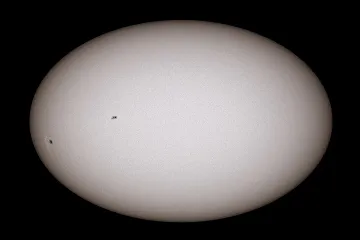
The celestial body hanging overhead every day is frequently depicted in art and media as a brilliant yellow orb, sometimes a fiery orange, but scientifically speaking, the Sun’s true color is actually white. [5][6][7] This common misrepresentation stems not from an error in physics but from an effect of our own atmosphere, which acts as a constant, selective filter on the light before it reaches our eyes. [9] To truly understand the Sun’s native hue, we have to look beyond the blue sky and consider the light it actually radiates into space. [7]
# Actual Color

The light emitted by the Sun is a composite of all the colors within the visible spectrum—red, orange, yellow, green, blue, and violet. [1][5] When all these colors are present in roughly equal measure, the resulting combination is perceived by the human eye as pure white light. [5][7] This is why astronauts viewing the Sun from space, where there is no intervening atmosphere to scatter the light, see it as dazzlingly white. [5][7][8] The white light you see when looking at the Sun through a high-altitude balloon or from the International Space Station is the untainted, full-spectrum output of our star. [8]
# Peak Emission
While the Sun produces a blend that looks white, its energy output isn't perfectly flat across the spectrum; it has a peak wavelength. [3] When scientists analyze the solar spectrum, they find that the maximum amount of energy is radiated at a wavelength that falls squarely within the green part of the visible spectrum. [1][3] This is often a surprising finding, as most people expect the peak to align with the color they typically see, yellow or orange. [1]
When we consider the Sun emits light across the whole visible spectrum, the fact that its peak intensity falls squarely in the green region is fascinating. It suggests that if the Sun were slightly cooler or hotter, its "white" light, once filtered by Earth's atmosphere, might shift toward a more noticeable orange or pale blue tint even at noon, rather than the standard mild yellow we observe. The near-perfect balance of all the other colors is what overcomes the single green peak to create the perception of white light. [1][7]
# Sky Filter

The reason we perceive the Sun as yellow when we look up from Earth during the day involves a phenomenon called Rayleigh scattering. [5][7] The Earth's atmosphere is composed of tiny gas molecules—primarily nitrogen and oxygen—that are more effective at scattering shorter wavelengths of light than longer ones. [5][7] Blue and violet light, having shorter wavelengths, are scattered in all directions across the sky, which is precisely why the sky appears blue. [5][7]
Because the blue light is scattered away from the direct beam traveling toward your eye, the light that remains—the light coming straight from the Sun—has a deficit of blue wavelengths. [5][9] Removing some blue from white light shifts the perceived color toward the longer wavelengths, making the Sun appear distinctly yellow or sometimes slightly orange. [5][9] The lower the Sun is on the horizon, the more atmosphere the light must travel through, leading to significantly more scattering of blue and green light, which is why sunrises and sunsets appear deep red or orange. [5][7]
# Viewing Conditions
The apparent color of the Sun is entirely dependent on the medium through which we view it. [7] Consider the difference between noon and twilight. At noon, the Sun is high, and its light travels through the least amount of atmosphere, resulting in a bright, slightly yellowish-white appearance. [5] As evening approaches, the path lengthens, scattering out more color, resulting in the familiar rich orange and deep red hues seen near the horizon. [5][7]
If you were to set up a simple spectroscope or use a high-quality digital camera with a neutral white balance pointed directly at the Sun from a location with no atmosphere—say, on the Moon—the resulting image would be starkly white, likely appearing completely saturated or overexposed to the human eye unless properly filtered. This contrasts sharply with how digital sensors often automatically "correct" for the yellow bias introduced by our atmosphere when taking daytime photos on Earth. The atmosphere's effect is so pervasive that our brains are essentially calibrated to expect this filtered, yellow appearance. [9]
# Color Testing
Because looking directly at the Sun is dangerous, performing a direct visual experiment requires specialized, safe equipment. [2] However, one method to confirm the white nature of the light involves projecting the Sun's image through a prism or diffraction grating onto a screen—again, only safely, perhaps by projecting an image of the Sun that has already been heavily filtered. [1][3] When you analyze the spectrum produced, you see an almost continuous rainbow, confirming it emits across the entire spectrum, which mixes to white. [1]
Another way to think about this is by comparing it to a digital camera sensor. A camera sensor captures the light intensity for each color channel (Red, Green, Blue) independently. [3] If the Sun were truly yellow, the Green channel reading would be significantly higher than the Red and Blue channels, but in space, the readings across the visible spectrum are so high and balanced that the resulting synthesized image is white. [5][8] When atmospheric filtering occurs, the Blue channel reading drops significantly relative to the others, pushing the color balance away from pure white toward yellow. [5]
# Summary Observation
In summary, the Sun is a G-type main-sequence star that shines white because it radiates across the entire visible spectrum, and our eyes interpret that blend as white. [5][8] The yellow, orange, and red colors we commonly associate with it are atmospheric illusions created by the scattering of blue light overhead. [7][9] The true, unfiltered color of our star is intense, neutral white light. [7]
Related Questions
#Citations
What's the true color of the sun? : r/askscience - Reddit
What's the True Color of the Sun? - YouTube
What Color do YOU think the Sun is? - Stanford Solar Center
The fascinating science behind the Sun's true color ... - Instagram
Sun - Wikipedia
The sun isn't yellow — it's actually white. The sun is often portrayed ...
What is the color of the sun? - West Texas A&M University
Our Sun: Facts - NASA Science
If the Color of the Sun Is White, Then Why Does it Appear Yellow?