Will the Craters of the Moon erupt again?
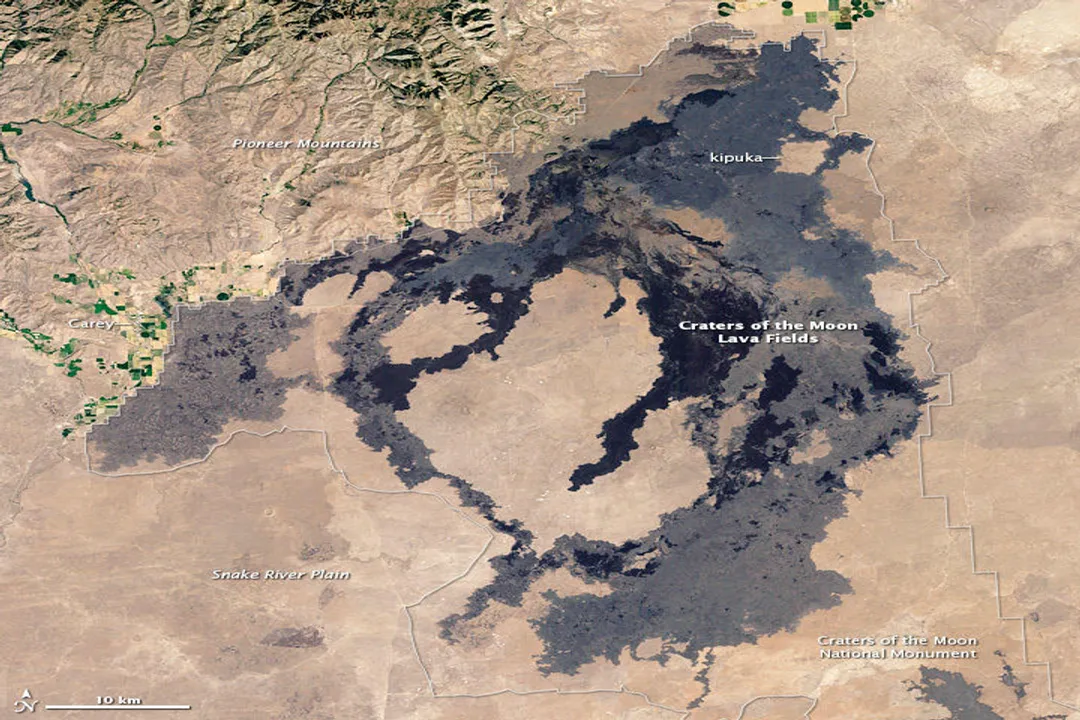
The vast, dark expanse of the Craters of the Moon National Monument and Preserve in Idaho presents a landscape so alien that NASA once used it to train Apollo astronauts. [3][6] It is a relatively young landscape, molded by fire, yet the question that lingers for visitors, geologists, and residents nearby is whether this recent activity signals a temporary pause or a long sleep for this volcanic field. The geological record shows that magma has repeatedly pushed its way to the surface here over the last half-million years, creating a sprawling system of lava flows, cinder cones, and massive fissures. [4][8]
# Volcanic History
The Craters of the Moon volcanic field covers over 750 square miles in the Snake River Plain of Idaho. [1][4] Its formation is tied to the Snake River Plain-Yellowstone hotspot track, which has created immense volcanic features across southern Idaho. [8] The activity at Craters of the Moon began around half a million years ago. [4][8] The youngest surface features in the field, such as the basaltic flows that formed Inferno Cone, date to approximately 2,000 years ago. [1][4][8] This means that the landscape we see today is geologically very recent, having formed within the span of human civilization. [1]
The field's eruptive history involves a complex series of eruptive cycles, which scientists study to understand patterns. [2] The eruptions generally take the form of fissure eruptions, where lava pours out along long cracks in the Earth's crust, building up cinder cones along these lines of weakness. [1] Compared to massive, explosive composite volcanoes, Craters of the Moon primarily produces basaltic lava, which is typically fluid and less viscous, leading to flows rather than towering ash clouds. [9]
# Future Activity Potential
When assessing the future, scientists look closely at the pattern of past eruptions. The available data suggests that the Craters of the Moon volcanic field is not extinct; rather, it is considered an active system that is currently quiet. [1][2][8] The most recent activity occurred about 2,000 years ago, which, in geological time, is just a blink of an eye. [4][8] Geologists estimate that a new eruption could occur at any time, though the probability of an eruption happening next week, next year, or even within the next century is exceedingly low. [1][9]
The USGS has calculated that, based on the history of activity over the last 2,000 years, the overall probability of an eruption occurring in the next few hundred years remains small. [2] However, looking at the long-term trend, the field has shown multiple eruptive cycles over its lifespan, indicating that future activity is the expected geological outcome rather than an impossibility. [9]
One way to frame this is by considering the typical recurrence interval. While short-term forecasts are difficult, the pattern over the last 2,000 years suggests a potential for future events, even if the timing remains unpredictable. [1] If a community like Carey, Idaho, situated near the monument, [7] were to consider its long-term infrastructure planning, understanding that the system has remained active over millennia—even with a 2,000-year gap since the last flow—provides a crucial perspective. This is a geologic hazard to respect over the scale of centuries or millennia, not a short-term danger like an earthquake forecast. [1]

# Eruption Style Comparison
It is useful to compare the eruptive tempo of Craters of the Moon (CoM) with other well-known volcanic systems to grasp the timeframe involved. Systems like Kīlauea in Hawaii erupt frequently, sometimes with lava visible for years on end, creating a constant, high-frequency hazard. [9] CoM’s pattern is markedly different. If we look at the last 2,000 years of CoM activity, even if we assume a few separate events occurred in that time, the average time between major eruptive phases stretches across many centuries. [1] This means that while the magma system is live, the chance of one's lifetime overlapping with an eruption is slim, contrasting sharply with volcanic zones that erupt every decade or two. [9]
What would a future eruption actually entail? The magma feeding CoM is basaltic, meaning the eruptions are likely to be effusive—characterized by lava outpouring from fissures—rather than explosive. [9] Visitors today often see the evidence of these flows: long, dark fields of rock and large cinder cones, like those near the Visitor Center. [5][6] A future eruption would likely involve the opening of a new fissure or the reactivation of an old one, producing lava flows that move across the relatively low-slope terrain, perhaps resembling the way the youngest flows were created. [1][2]
# Monitoring Efforts
Because the Craters of the Moon volcanic field is considered an active system, the U.S. Geological Survey (USGS) includes it in its portfolio of monitored volcanoes. [1][8] Monitoring is essential for the unlikely event that the magma system begins to recharge or show signs of unrest that precede an eruption. [2] This monitoring involves a network of seismometers designed to detect small earthquakes that often precede magma movement beneath the surface. [8]
While the field doesn't have the intense, 24/7 monitoring seen at Mount St. Helens or Yellowstone, it is still part of the broader framework that tracks potential changes across the region. [8] The USGS states that if the probability of an eruption were to increase significantly, the level of monitoring would increase to provide the public with ample warning. [1] For now, the focus remains on baseline data collection—understanding the quiet signals of a dormant but alive system. [2] This scientific diligence forms the core of hazard assessment for the region, providing trust that should conditions change, a warning system is in place. [8]

# Regional Volcanic Context
Craters of the Moon is just one component of a much larger pattern of volcanism across southern Idaho. [8] The larger Snake River Plain Volcanic Province is one of the most extensively studied volcanic areas in the world due to its scale and relatively recent activity. [8] The CoM field sits at the northern end of this feature, distinct from the older, more centralized volcanic centers associated with the Yellowstone hotspot track itself. [4]
It is important to recognize that volcanic activity in Idaho is not confined to this single area; the entire region has a history of eruptions. [8] However, the CoM field represents the most recent surface expressions of that volcanic potential in this specific locale. [8] When considering Idaho's volcanic future, CoM is the site where the next eruption is most likely to occur, simply because it was the site of the last one, maintaining a pattern of localized recurrence. [8]
# Visitor Experience Today
Despite the underlying geological potential, the current experience at the Craters of the Moon National Monument and Preserve is one of quiet, stark beauty. [5][7] Tourists can walk through the solidified lava, explore caves formed by lava tubes, and climb the cinder cones. [6][7] The park service maintains trails and interpretive signs that explain both the formation of the landscape and the science behind its potential for future change. [6]
For the average visitor coming from cities like Boise or even the nearby town of Carey, [7] the landscape presents an immediate, tangible history lesson in geology. It serves as a powerful, static example of what happens when magma reaches the surface. [4] The key takeaway for the general public is often the sheer scale of time involved: the environment is static now, but the processes that formed it are still active beneath the crust. [1] Being able to stand on a 2,000-year-old flow while knowing that the magma chamber is still present gives a unique sense of deep time within a human lifespan framework. [2]
# Hazard Assessment Clarity
The term "active volcano" can conjure images of immediate danger, which is not the current reality for Craters of the Moon. [9] Scientific assessment aims to provide a measured perspective. The time between eruptions can be thousands of years, making the hazard extremely low for any given person or structure in the short term. [1][2] This is different from hazard assessments for frequently active volcanoes where evacuation plans and real-time alerts are part of daily life. [9]
Here is a brief overview contrasting the hazard profile based on the available scientific perspective:
| Feature | Craters of the Moon (CoM) | Example of High-Frequency Volcano |
|---|---|---|
| Magma Type | Basaltic | Andesite/Dacite (often) |
| Eruption Style | Primarily effusive (lava flows, vents) | Explosive (ash plumes, pyroclastic flows) |
| Recurrence Interval | Measured in hundreds to thousands of years | Measured in decades or less |
| Current Status | Dormant, monitored as active potential | Actively erupting or showing clear unrest |
The scientific community’s primary role is to continuously refine the understanding of the 2,000-year recurrence window. While an eruption is possible, the data strongly suggests that future activity, if it occurs, is a long-term geological event rather than an imminent disaster requiring constant public alert. [2][8] The current scientific consensus relies on ongoing monitoring to detect any shift from this quiet state. [1]
Related Questions
#Citations
Future Eruptions Around Craters of the Moon Lava Field - USGS.gov
We Know How Large Idaho's Next Volcanic Eruption Will Be
Craters of the Moon National Monument and Preserve - EBSCO
Craters of the Moon NPS - Facebook
Craters of the Moon National Monument - Molly of Denali Wiki
Craters of the Moon | Carey, ID
Will Craters of the Moon volcanoes erupt again in the future? | Idaho ...