Why is the Tonight's moon a Hunter's moon?
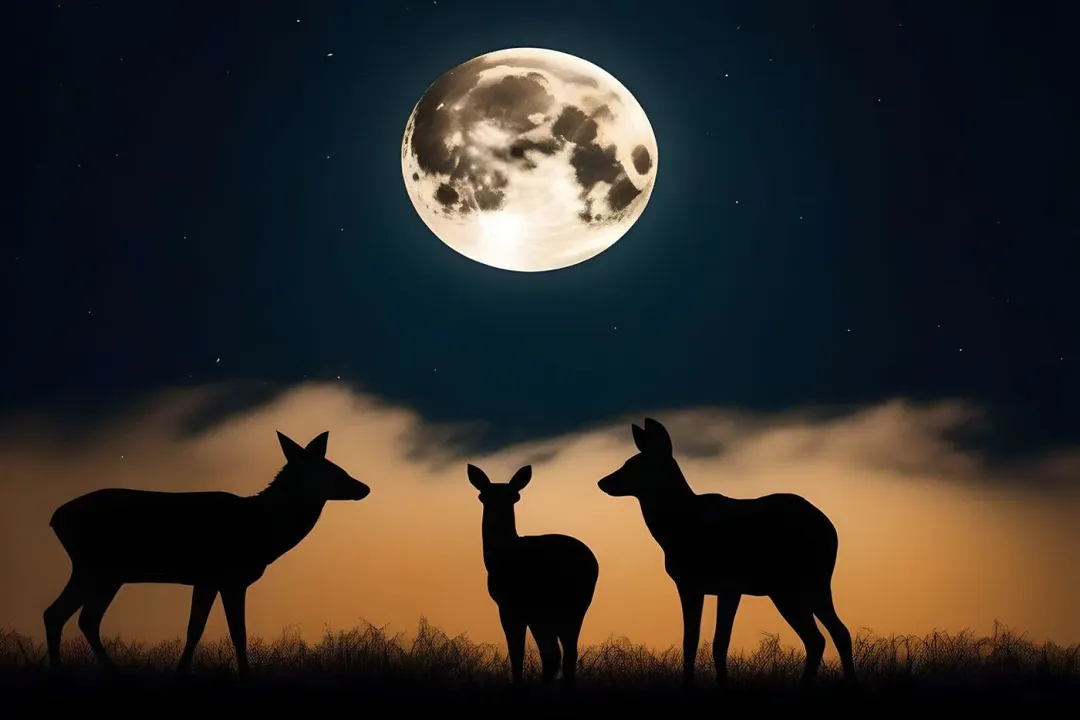
This moon is called the Hunter's Moon because its timing followed a crucial period for early North Americans who needed to stockpile food before the deep cold of winter set in. [6] The name signifies the optimal season for hunting, made possible by the persistent, bright light of the full moon that appears for several nights around its peak illumination.
# Naming Origin
The name Hunter's Moon is traditionally associated with the full moon that immediately follows the Harvest Moon. [1][4] The Harvest Moon is defined as the full moon occurring closest to the autumnal equinox in the Northern Hemisphere, which usually falls in September but can occasionally occur in October. [1][2] Therefore, the Hunter's Moon most frequently graces the October sky, though it sometimes appears in early November, particularly in years when the Harvest Moon falls late in September. [1]
The Algonquin Tribe in North America is credited with giving the October full moon this evocative name. The term itself was recorded in use by the early 18th century, with one citation pointing to a 1710 edition of The British Apollo attributing it to "the country people". The practical reason behind the name is clear: by the time the Harvest Moon had passed, farmers had typically finished reaping their fields. [1] With the fields cleared of tall crops, hunters could more easily spot animals—like deer—prowling for sustenance before the snows arrived. [1] The extended evening light provided by this bright moon allowed them to track prey into the late hours. [1]
# Unique Celestial Light
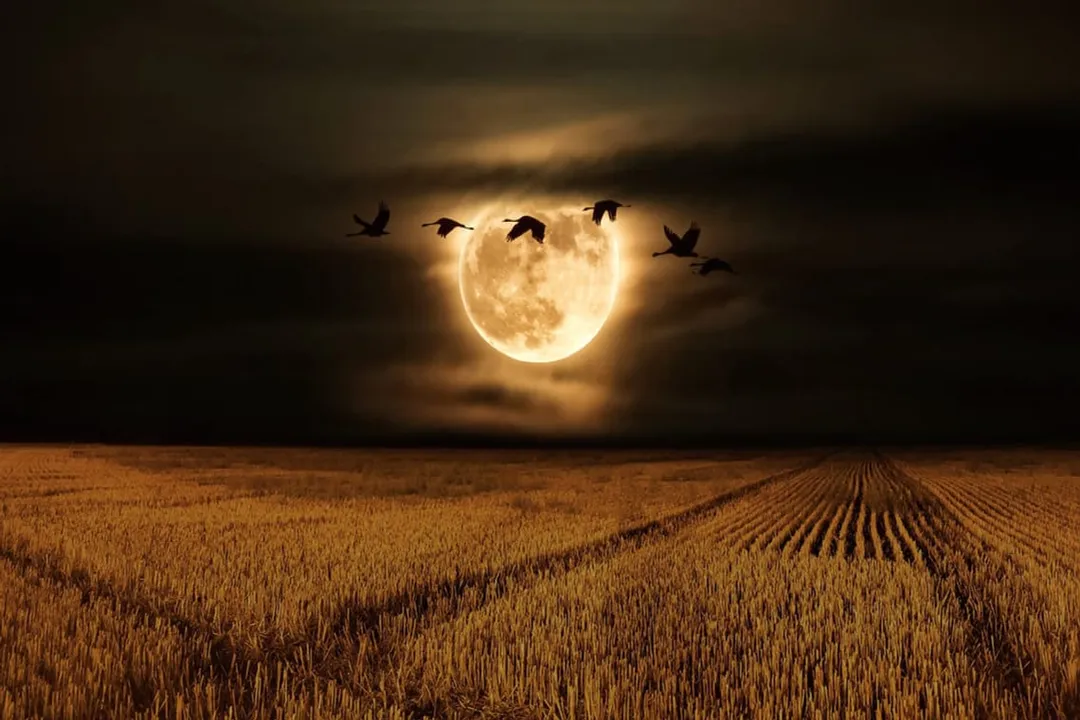
While any full moon appears round and fully illuminated, the Hunter's Moon shares a distinctive characteristic with the preceding Harvest Moon due to orbital mechanics near the autumnal equinox. On average, the moon rises approximately 50 minutes later each day. However, around the time of the Harvest Moon and the Hunter's Moon, the Moon's path makes a narrow angle with the eastern horizon in the Northern Hemisphere's mid-latitudes. [4] This shallow angle results in successive moonrises being separated by a shorter interval, often around 30 minutes a day, for several nights in a row. [4]
This reduced delay between moonrises means that for several evenings surrounding the full phase, observers witness the bright, round moon ascending in the east relatively soon after the sun sets in the west. [4] This creates prolonged twilight illumination, allowing outdoor activities to continue after dusk, benefiting both the final stages of the harvest and the subsequent hunt. For those in the Southern Hemisphere, the cycle is reversed, and this effect is tied to their autumnal equinox in March/April. [4]
It is an interesting point to note that while the Hunter's Moon is named for its practical benefit to hunters, its actual visual appearance—in terms of size or brightness compared to other full moons—is generally not different, unless it coincides with other orbital milestones. The visual drama is largely created by the timing of its rise relative to sunset, not an inherent change in its celestial dimensions.
# Color and Appearance
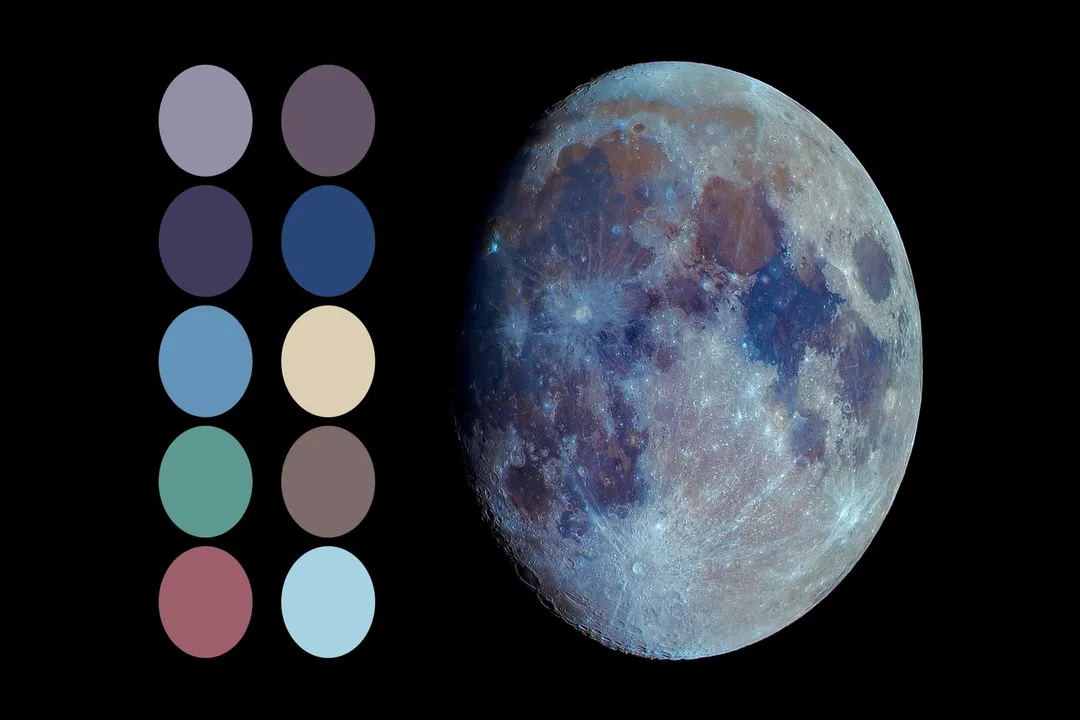
When the Hunter's Moon hangs low near the horizon, either during moonrise or moonset, it often takes on a distinctive orange or reddish hue. [1][6] This is not unique to the Hunter's Moon but is a result of atmospheric refraction affecting any low-hanging celestial body. [1] As the moonlight travels through a thicker slice of Earth's atmosphere when viewed near the horizon, shorter blue light wavelengths are scattered away, leaving the longer, warmer red and orange wavelengths to reach our eyes. [1][6]
Some traditions have connected this potential color change to the name itself. The October full moon is sometimes referred to as the Blood Moon or Sanguine Moon, although this typically refers to the hunting season and the imagery of the hunt, rather than the moon itself undergoing a true lunar eclipse. [1] A deeper look into historical nomenclature shows that the term "Drying Grass Moon" or "Dying Grass Moon" also relates to the autumnal landscape turning reddish-orange, adding another layer to the moon's coloration association. [2]
# Comparative Moon Names
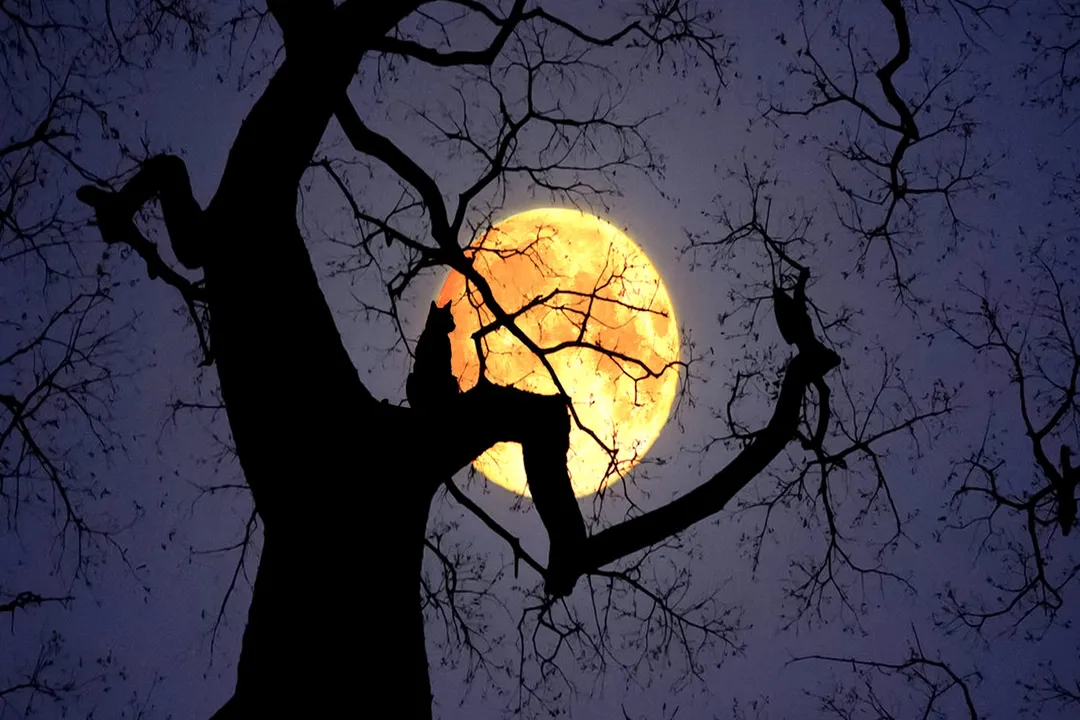
The system of naming full moons provides a rich history of agricultural and environmental observation, often stemming from Native American traditions. [2] The Hunter's Moon is defined by its relationship to the Harvest Moon, but other regional or tribal names for the October moon highlight different aspects of the season:
| Tradition/Source | Alternate Name | Meaning/Reason |
|---|---|---|
| North American (General) | Travel Moon or Migrating Moon | Birds flying south to warmer climates [2] |
| Ojibwe/Haida | Freezing Moon or Ice Moon | First frosts begin to appear [2] |
| Anishinaabe | Falling Leaves Moon | Signifies the change from summer to fall [2] |
| Dakota | Drying Rice Moon | The time to prepare harvested rice |
| Chinese | Kindly Moon | (General cultural name) [2] |
| Wiccan | Blood Moon | (Often associated with the hunt/season) [2] |
It is valuable to recognize the distinction between the traditional sequential naming (Harvest followed by Hunter's) and the seasonal naming often found in other traditions. For instance, while the Harvest Moon centers on the equinox, other names like the "Freezing Moon" are purely descriptive of the weather conditions rapidly approaching in October. [2] This highlights that the name Hunter's Moon is rooted in activity, while many others are rooted in environment.
# Supermoon Status and Viewing Experience
In certain years, the Hunter's Moon can coincide with the Moon being near its closest approach to Earth in its orbit, known as perigee, thus qualifying it as a Supermoon. [4] For example, the Hunter's Moon in November 2025 is noted to be the closest full supermoon of that year, appearing up to 16% brighter than an average full moon. [4]
While a Supermoon might sound like it results in a dramatically larger visual size, sources suggest that the size difference is often undetectable to the casual observer; the increased brightness, however, can be noticeable. [4] A practical tip for any skywatcher, regardless of Supermoon status, is to observe the moon near the horizon—this maximizes the visual impact of the Moon Illusion, a trick of the eye that makes the low-hanging moon appear much larger than when it is high overhead. [1] To truly appreciate the specific light characteristics of the Hunter's Moon—the short lag time between moonset and moonrise—it is best viewed over several consecutive evenings, perhaps beginning at sunset on the day before the peak illumination. [1][4]
A fascinating consequence of the close orbital proximity during a Supermoon is the enhanced tidal pull. [4] Coastal residents might experience slightly higher-than-normal tides, sometimes referred to as king tides, in the days surrounding the event. [4]
# Practical Viewing Insight
For those interested in capturing the Hunter's Moon photographically, understanding the atmospheric effects is key to achieving a desired look. If the goal is a large, dramatic orange moon, one must specifically plan to photograph it right as it clears the eastern horizon, accepting the trade-off of a less detailed lunar surface due to the thick atmosphere scattering light. [1] Conversely, if the goal is maximizing surface detail, waiting until the moon has ascended higher in the sky, even if it appears less orange and smaller, will result in a sharper, whiter image where settings like exposure and focus are less challenged by atmospheric distortion. [4] Planning a photograph with a foreground element, like a distant tree line or landmark, will also effectively convey the scale difference between the illusionary low moon and its true, smaller size high above the horizon. [4] This compositional choice uses the illusion to your advantage rather than fighting it. [4]
# The Seasonal Context
The defining feature of the Hunter’s Moon is its placement after the Harvest Moon, firmly grounding it in the season of transition and preparation. [1] This period is crucial in the annual cycle, moving from the bounty of the late summer harvest into the stark realities of impending winter. This sense of preparation is echoed in the cultural names given by various tribes: gathering remaining stores (Drying Rice Moon) and preparing for the cold (Freezing Moon). [2] In a practical sense for those living in agrarian or hunting-based societies, this specific moon phase signaled the final opportunity to ensure survival stores were adequate, lending a weight of importance to this particular night sky event that many modern observers may overlook. It isn't just about the light; it's about the deadline it illuminates. [1]
The Hunter's Moon, therefore, is not simply "the October full moon," but rather a specific marker in the agricultural and hunting calendar—the second moon marking the autumnal shift, which only falls in October due to the way the calendar aligns with the equinox. [1][4] Its significance is tied entirely to its position relative to the season's midpoint marker, the Harvest Moon.
Related Questions
#Citations
Super Hunter's Moon – 2025's brightest full moon – on November 5-6
Hunter's moon 2025: Occurrence, Meaning, and Origin - Calendarr
The Hunter's Moon (Oct 17th) : r/Damnthatsinteresting - Reddit
October 2025 Full Moon: Largest and Brightest Harvest Supermoon ...
What is a Hunter's Moon? - Universe Today
When Is the Full Moon in October: Meet the Hunter's Moon 2026