Does a ring around the moon mean a storm is coming?
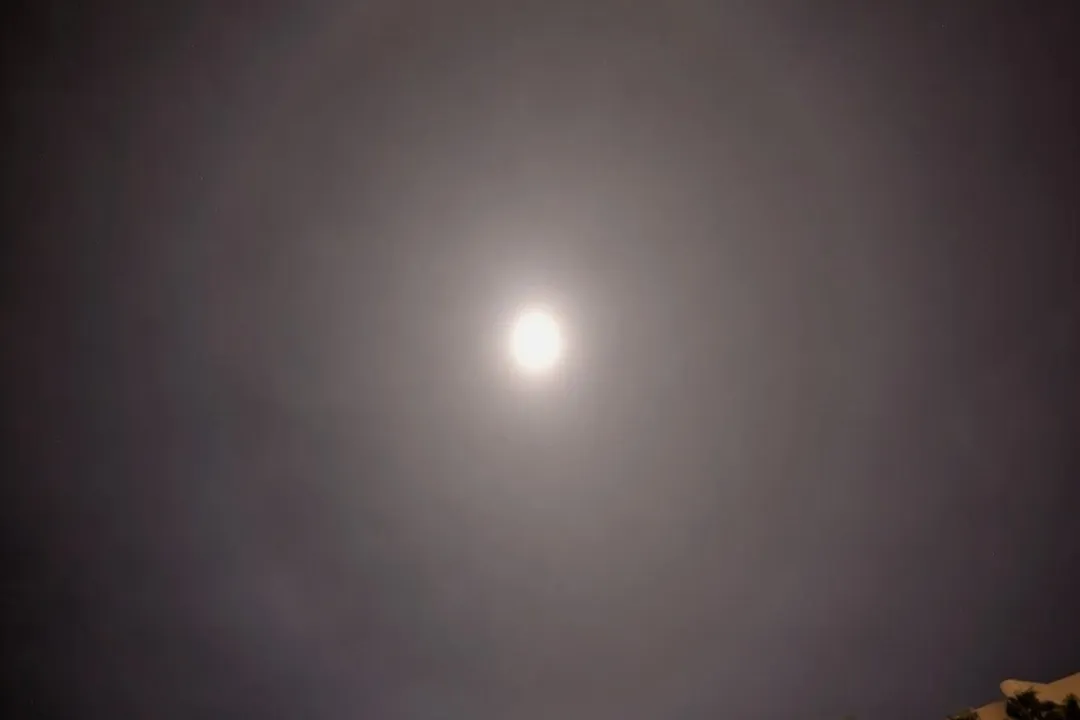
The sight of a luminous ring encircling the moon has long been a source of both wonder and apprehension for observers worldwide. For centuries, this celestial display has been woven into the fabric of weather lore, with the age-old adage suggesting that such a feature is a sure sign that foul weather, like rain or a storm, is not far off. [1][3][6] This common folk wisdom, often summarized in rhymes like, "Ring around the moon or sun, rain or snow is sure to come," has persisted across generations, passed down by farmers, sailors, and general outdoorsmen who relied on these visual cues for planning their activities. [2][3][9] The persistence of this belief across various cultures suggests there must be some observable pattern connecting the appearance of the halo to subsequent weather changes. [6]
# Optical Illusion
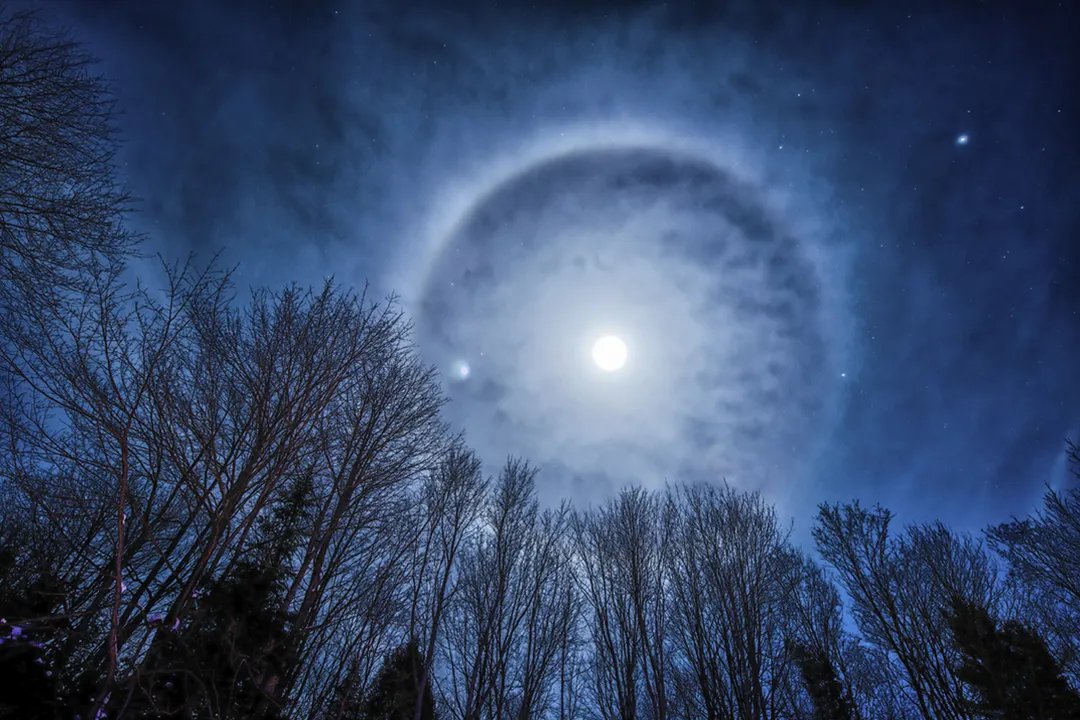
The atmospheric phenomenon responsible for this luminous circle is scientifically known as a 22° halo. [4][9] It is not the moon itself that is changing, nor is it an object physically close to the moon, but rather an optical effect created within the Earth's atmosphere. [1] Specifically, the ring is generated by the interaction of moonlight with countless ice crystals suspended high up in the atmosphere, typically within thin, wispy clouds. [4][9]
The critical components for a 22° halo are these high-altitude ice particles, which are usually found in cirrus or cirrostratus clouds. [1][4] These clouds exist at significant elevations, often above 20,000 feet, where temperatures are consistently cold enough to maintain ice in crystal form. [4] The crystals responsible are generally hexagonal columns, and they act like tiny prisms in the sky. [4] As the moonlight passes through these millions of precisely oriented ice crystals, the light is refracted—or bent—by the crystals. [1][4] The specific geometry of the hexagonal crystals causes the light to bend consistently at an angle of approximately 22 degrees relative to the line drawn from the observer to the moon. [4] This consistent bending angle is what creates the perfectly circular ring centered on the moon. [4] While the phenomenon is most commonly observed around the moon (a lunar halo), the exact same optical principles apply when the sun is shining on these ice clouds, creating a solar halo. [4][6]
# Color Structure
Although the moon emits far less light than the sun, a well-formed 22° halo can sometimes display subtle colors, though they are often muted compared to a solar halo. [4] The light refracting through the ice crystals spreads the light out slightly, similar to how a prism works. [4] If you observe closely, the red portion of the spectrum will appear on the inside edge of the ring, closest to the moon, while the blue or violet light is refracted further out, making the outer edge appear slightly cooler in tone. [4] The fact that the ring appears relatively bright and white to the naked eye is part of what leads people to believe it is a tangible object or sign, rather than just a trick of light bending through airborne ice. [1]
# Weather Correlation
The reason the folklore linking moon rings to incoming storms holds so much water comes down to the type of cloud required to produce the halo. [1][5] Cirrus clouds, the high, thin clouds containing the necessary ice crystals, are themselves often the first visible indicators of an approaching warm front. [1][6] Weather systems, particularly those that bring widespread, steady rain or snow, move as large-scale frontal systems across the sky. [5]
A warm front is characterized by a large mass of warmer, moist air slowly sliding up and over a receding cooler air mass. [5] The initial sign of this massive structure arriving at the surface is often the appearance of these high cirrus clouds, followed by slightly lower altostratus clouds, and finally, precipitation within the next 12 to 48 hours. [1][5] Therefore, seeing the 22° halo is essentially seeing the very first visible marker of a large-scale weather change moving in from the west (in many mid-latitude locations). [1][6] It is the high cloud shield preceding the main moisture plume, not the halo itself, that signals the coming change in weather. [9]
It is important to note that the ring is a predictor of the front, not the cause of the storm. [5] If the sky is otherwise clear and only those high cirrus clouds are present with no further thickening or lowering of the cloud deck later on, the approaching front might dissipate or weaken, and the expected rain may never materialize. [1] This explains why the old saying is often right, but not always right. A distinct, widely visible ring suggests a well-defined, moisture-rich system aloft that is likely to reach the surface, whereas a faint, quickly dissipating ring might signal a weaker disturbance. [9]
# Practical Observation
Understanding the science allows for a more refined personal forecast, moving beyond the simple binary of "storm coming" or "no storm coming." When you spot that ring, take a moment to observe the sky critically. Is the ring bright and sharp, or is it faint and hazy? A sharp, well-defined ring indicates a very uniform, stable layer of ice crystals, which often correlates with a strong, organized weather system moving in. [4]
One useful technique for confirming the 22-degree measurement, which is the signature of the common halo, is to use your own hand as a rough measuring tool. Hold your arm straight out in front of you at eye level, with your arm fully extended. [1] You can use your little finger held vertically against the moon to gauge the vertical span of the halo. At arm's length, the width of your pinky finger held vertically covers roughly one degree of arc in the sky. [1] Therefore, the 22-degree halo should span an arc equivalent to about 22 pinky-finger widths from the bottom edge of the ring to the top edge. [1] If the ring you see is significantly smaller or larger than this span, you are looking at a different, perhaps rarer, optical phenomenon, though the 22-degree halo is by far the most common one associated with approaching weather. [4] This simple measurement allows you to verify the phenomenon is indeed the classic precursor to a frontal system.
Furthermore, consider the direction from which the ring appears to be moving relative to the moon itself, or more accurately, the direction the clouds are moving across the sky. In many mid-latitude regions, weather generally travels from west to east. If the ring and its associated cirrus clouds are visibly sweeping in from the west or southwest, it lends more credibility to the forecast that precipitation will arrive within the next day or so, as the cloud shield is actively advancing toward your location. [5] If the clouds appear stationary or are moving north/south, the frontal system might be skirting your area, making the expected rainfall less certain. [9] This added layer of directional observation transforms a mere sighting into a more informed micro-forecast.
# Sun Versus Moon
The optics are identical whether the ring circles the Sun or the Moon, but the experience of observing them differs vastly due to brightness. [6] Seeing a solar halo requires extreme caution. Because the Sun is so intensely bright, looking directly at it to confirm a halo is dangerous and can cause permanent eye damage. [6] If you suspect a solar halo, you should only observe it indirectly, perhaps by viewing the sky in a reflection on a dark surface or using specialized, certified solar viewing equipment. [6] Conversely, the moon is much dimmer, making the lunar halo much easier and safer to observe directly on a clear night, which is why it is the halo most commonly associated with folklore. [1][3]
While the 22° halo is the most famous, it's worth remembering that other, less common, ice crystal halos exist. The 46° halo is another possibility, though it requires a different orientation of the ice crystals, and it appears much further out from the moon or sun. [4] If you see a ring that seems twice as far away as the standard one, you are likely observing this larger structure. [4] However, these rarer formations are less reliably linked to the standard frontal weather patterns that bring immediate rain, so stick to assessing the 22-degree ring for immediate weather planning. [9]
# Folklore Validity
Ultimately, the old saying that a ring around the moon means a storm is coming holds a significant degree of validity because it describes the physical reality of weather system progression. [1][6] It is a form of ancient meteorology based on reliable visual evidence. The ring is a warning indicator provided by the upper atmosphere, signaling the approach of a weather front that carries moisture capable of producing precipitation. [5] It is not a direct cause-and-effect relationship—the ice crystals do not summon the rain—but rather a consequence of being in the right place at the right time to observe the leading edge of a large-scale atmospheric system. [1][9] The accuracy rests on recognizing cirrus clouds and understanding that they often precede the arrival of low-pressure systems and associated precipitation. [5] When you see that pale circle, it is wise to note the time and keep an eye on the lower sky for the next day or two; odds are, the skies will soon be weeping. [3]
#Videos
What does a moon halo mean for snow chances? - YouTube
Related Questions
#Citations
Does a ring around the moon mean rain is coming soon?
For the outdoorsmen. What does a ring around the moon mean?
Did you see a ring around the moon on Wednesday night? You may ...
22° halo - Wikipedia
Does a Halo around the sun or moon indicate that a storm is ... - Quora
Notice a ring around the moon? Here's what it means - WHSV
What does a moon halo mean for snow chances? - YouTube
Here's What A Ring Around The Moon Might Mean For Your Weather