What does ecliptic mean?
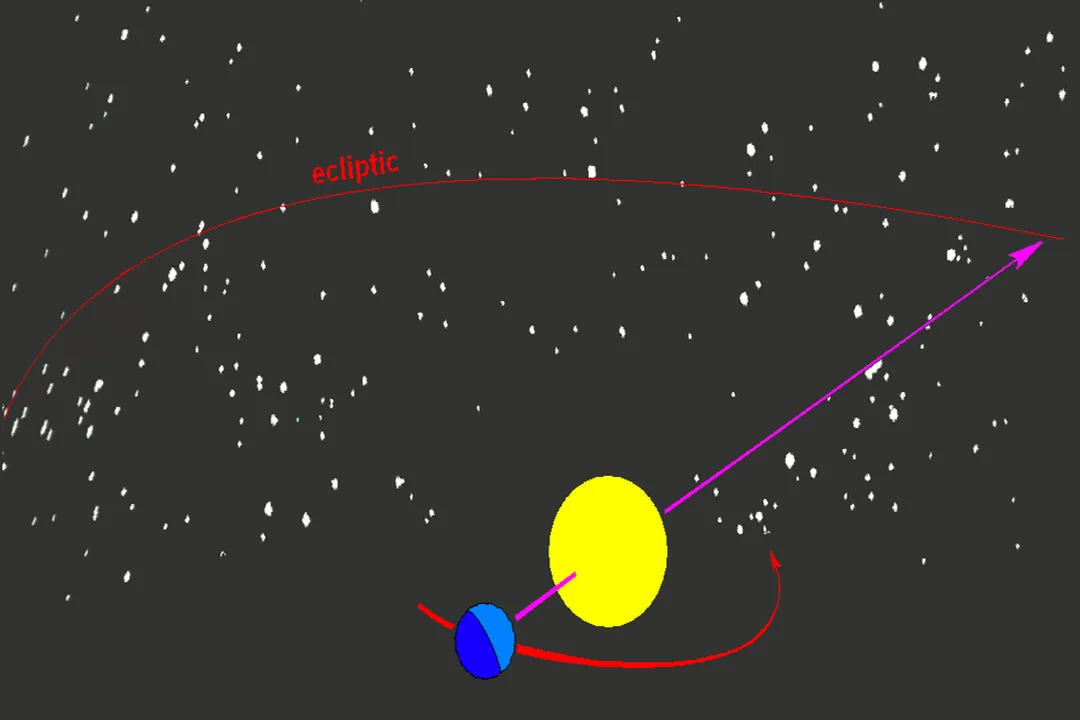
The concept of the ecliptic sits at the intersection of Earth’s motion and how we map the sky from our perspective. At its most fundamental, the ecliptic is the great circle traced across the celestial sphere by the Sun over the course of one year. [2][4] If you could watch the Sun against the backdrop of the distant stars from an Earth-bound viewpoint, you would see it slowly travel this specific loop, taking just over 365 days to complete a circuit. [2]
More precisely, the ecliptic is the projection of the ecliptic plane onto the celestial sphere. [1][4] This plane is defined by the orbit of Earth as it revolves around the Sun. [1][2][3] It represents the geometric path of our planet’s yearly journey through space, extended outward to the imaginary dome of the sky. [1][4] This imaginary line is not just an abstract concept; it was a cornerstone of ancient science, providing the foundational grid for early astronomy, calendar creation, and astrology. [2]
# Origin of Naming

The name itself gives a significant clue to its historical importance. The term ecliptic comes from the ancient understanding that eclipses—whether of the Sun (solar) or the Moon (lunar)—only occur when the Moon is crossing this specific path. [2][3] The Moon’s orbit is tilted relative to the Earth’s orbital plane (the ecliptic plane) by about . [1] For an eclipse to happen, the Sun, Earth, and Moon must align in a line, which requires the Moon to be very near the ecliptic plane at the moment it is either in conjunction (new moon) or opposition (full moon). [1][3] If the Moon’s orbit didn't cross the Sun’s apparent path, we would have an eclipse every month, but because of the slight tilt, they are rarer events, hence the line of intersection gained its distinctive name. [2][3]
# Celestial Geometry
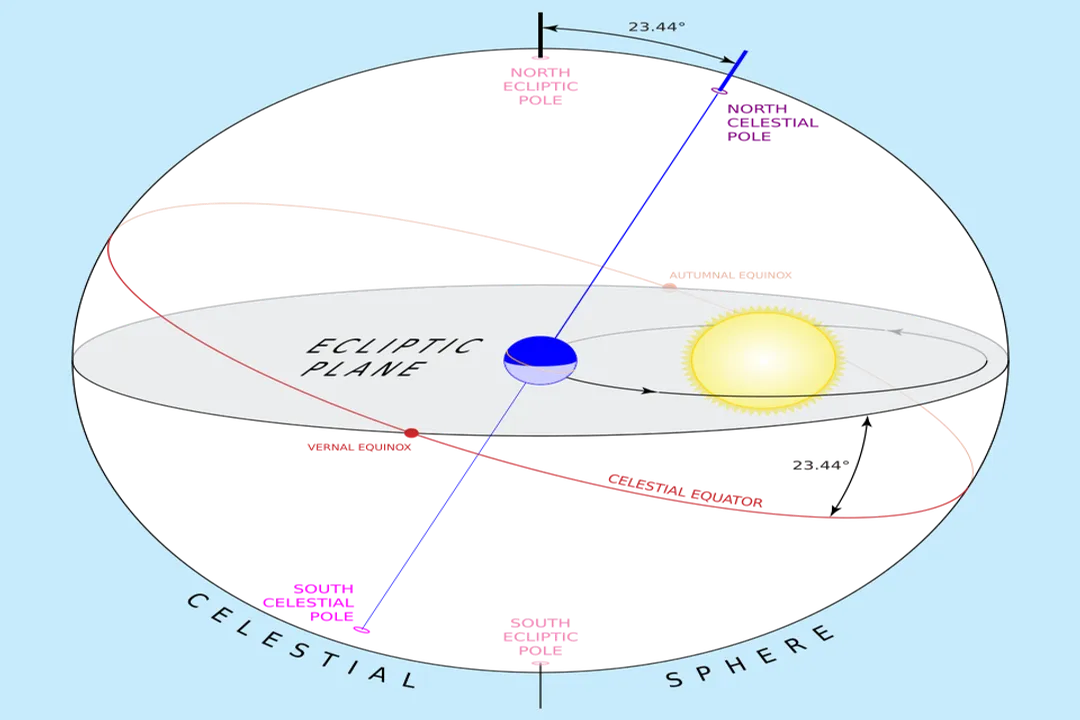
The ecliptic circle is crucial because it relates directly to the structure of our solar system and the phenomenon of seasons on Earth. [4] The plane of the ecliptic intersects another fundamental reference line in the sky: the celestial equator, which is derived from the projection of Earth’s own equator out onto the celestial sphere. [1][3]
Because the Earth’s rotational axis is not perpendicular to its orbital plane, the celestial equator and the ecliptic plane are not coplanar; they are tilted relative to one another. [1] This angle of inclination is known as the obliquity of the ecliptic, and it currently measures approximately . [1][3] This tilt is the direct cause of the seasons. [3][4] When the Northern Hemisphere is tilted toward the Sun, it experiences summer, and when it tilts away, it experiences winter. [3]
The two points where the ecliptic and the celestial equator intersect are known as the equinoxes. [1][3] At these precise instants, the Sun appears to cross the celestial equator. The crossing from south to north marks the vernal equinox (the start of spring in the Northern Hemisphere, near March 21st), and the crossing from north to south marks the autumnal equinox (the start of autumn, near September 23rd). [1][3] Historically, the vernal equinox point was defined as the first point of Aries, though due to long-term shifts in the Earth's axis, the Sun actually crosses the equator in the constellation Pisces today. [3][1]
# Reference Plane and Coordinates
In astronomy, having a fixed reference system is essential for pinpointing the location of celestial objects. The ecliptic serves as one of the two primary reference planes, the other being the celestial equator. [1] Perpendicular to the ecliptic are the ecliptic poles. [1]
Positions measured using the ecliptic are defined by ecliptic coordinates, which consist of longitude and latitude. [1][3]
- Ecliptic Longitude ( or ): This is measured along the ecliptic circle itself, typically from to eastward, starting from the vernal equinox. [1][3] It tells you where an object is along the Sun's yearly path. [1]
- Ecliptic Latitude ( or ): This measures the object’s position perpendicular to the ecliptic plane, extending toward the poles. [1][3] An object exactly on the ecliptic has latitude. [3]
This system is particularly convenient for mapping objects within our Solar System because most planets orbit the Sun in a plane that is already very close to the ecliptic plane. [1] Therefore, planets rarely stray far from latitude in this system. [3]
The ecliptic plane is also closely related to a concept called the invariable plane of the Solar System, which is mathematically defined by the total angular momentum of all bodies in the system. [1] Earth's orbit, and thus the ecliptic, is inclined by just over from this invariable plane. [1] Using the ecliptic is often preferred for practical precision because the orbital motions defining the invariable plane are subject to uncertainties, whereas the ecliptic is clearly defined by the Sun’s observable, repetitive motion. [1]
# Planetary Neighborhood
The fact that the major planets orbit in a path so close to the ecliptic is not a cosmic coincidence; it is a fundamental result of how the Solar System formed. [1] Our system originated from a spinning, flattened cloud of gas and dust known as a protoplanetary disk. [1] The orbits of Mercury, Venus, Mars, and the gas giants all settled into nearly the same plane as the Earth’s orbit within that disk. [1]
This means that if you look out at the night sky, you will find the Moon and the other naked-eye planets generally following the same path as the Sun—the ecliptic—although the Moon's path crosses it at an angle, leading to eclipses only when alignment is perfect. [3]
When using ecliptic coordinates, one must always specify the epoch, or the date for which the coordinates are valid. [1] This is because the gravitational influence of other bodies causes the Earth's orbital plane to shift slightly over long periods (a process called planetary precession, separate from the longer cycle of axial precession). [1] This means that while the ecliptic is stable compared to the celestial equator over centuries, it is not perfectly static against the background stars. [1]

# The Zodiac Belt
The constellations that lie along the ecliptic form the Zodiac. [1] For millennia, this belt of constellations was viewed as profoundly significant, forming the basis for astrology, where the position of the Sun, Moon, and planets in relation to these signs was believed to influence earthly events. [1][4]
The ancient Babylonians divided this belt into twelve segments, each spanning of longitude, corresponding roughly to the Sun’s apparent motion over one month. [1] Since most of the constellations along this line represented animals, the Greeks called this region the zōdiakos kyklos, or "circle of animals". [1]
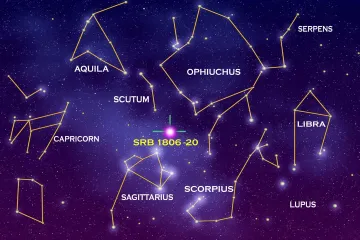
It is important to note the difference between the astronomical ecliptic and the astrological zodiac today. Because of the precession of the equinoxes—a slow, 26,000-year wobble in Earth's axis—the constellations have shifted relative to the fixed points on the ecliptic circle. [1] For instance, the Sun enters the astrological sign of Aries on March 21st, but astronomically, it is now in the constellation Pisces at that time. [1] Furthermore, the true ecliptic passes through thirteen constellations, including Ophiuchus, which is generally excluded from the traditional twelve-sign astrological framework. [1]
# Deeper Look at Orbital Speed
While we often treat the Sun's motion along the ecliptic as uniform, moving in $365.25$ days, or about per day, this is a simplification. [2] Earth’s actual orbit is not a perfect circle; it is an ellipse, meaning Earth’s orbital speed varies throughout the year. [1]
This variation in orbital speed directly influences the Sun’s apparent speed along the ecliptic. When Earth is closer to the Sun (near perihelion in January), it moves faster, and the Sun appears to advance more quickly along the ecliptic. Conversely, when Earth is farther away (near aphelion in July), it moves slower, and the Sun’s apparent progress along the ecliptic slows down. [1] This variation is a key component in calculating the equation of time, which reconciles the difference between apparent solar time (based on the Sun's actual position) and mean time (the uniform time kept by clocks). [1] Understanding the ecliptic means appreciating that this celestial path is traced at a slightly varying pace, not a constant one, a nuance critical for precise navigation and timekeeping historically. [1]
# Practical Application for Spotting Planets
For a general observer or a modern stargazer interested in the Solar System, the ecliptic provides an immediate "hunt area" for planets. Since the Sun defines the ecliptic, and all the major bodies orbit near the Sun's plane, knowing the ecliptic’s position on any given night tells you where to look for Venus, Mars, Jupiter, and Saturn. [3]
Imagine you are observing the sky and notice the Moon is setting near a particular constellation like Sagittarius. Because you know the Moon is always close to the ecliptic, you can confidently predict that Jupiter or Saturn, if they are visible that night, will also be found within a few degrees north or south of Sagittarius, near that same imaginary line. [3] This principle transforms the seemingly random scattering of bright objects into a predictable band across the sky. A practical exercise is to watch the Moon over a few weeks. Its path will closely hug the Sun's path, but as it crosses the ecliptic (the plane of the Sun's path), you will see it shift from one side of the Sun's expected track to the other side over about a month, perfectly illustrating the orbital mechanics that cause eclipses when the Sun is also near that crossing point. [1]
This simple, observable track—the ecliptic—is the fundamental map upon which our entire model of the Solar System, from seasons to eclipses, is built. [2][3] It serves as a stable, yet shifting, reference system linking the Earth's physical journey to the patterns we see overhead. [1]
#Videos
The Ecliptic: Crash Course Kids #37.2 - YouTube
Related Questions
#Citations
Ecliptic - Wikipedia
ECLIPTIC Definition & Meaning - Merriam-Webster
Ecliptic Definition | GIS Dictionary - Esri Support
Ecliptic - eSky - Glyph Web
The Ecliptic: Crash Course Kids #37.2 - YouTube
Ecliptic | Definition, Facts, Obliquity, & Zodiac - Britannica
Glossary term: Ecliptic - IAU Office of Astronomy for Education
Ecliptic – Knowledge and References - Taylor & Francis