What is the meaning of AU in size?
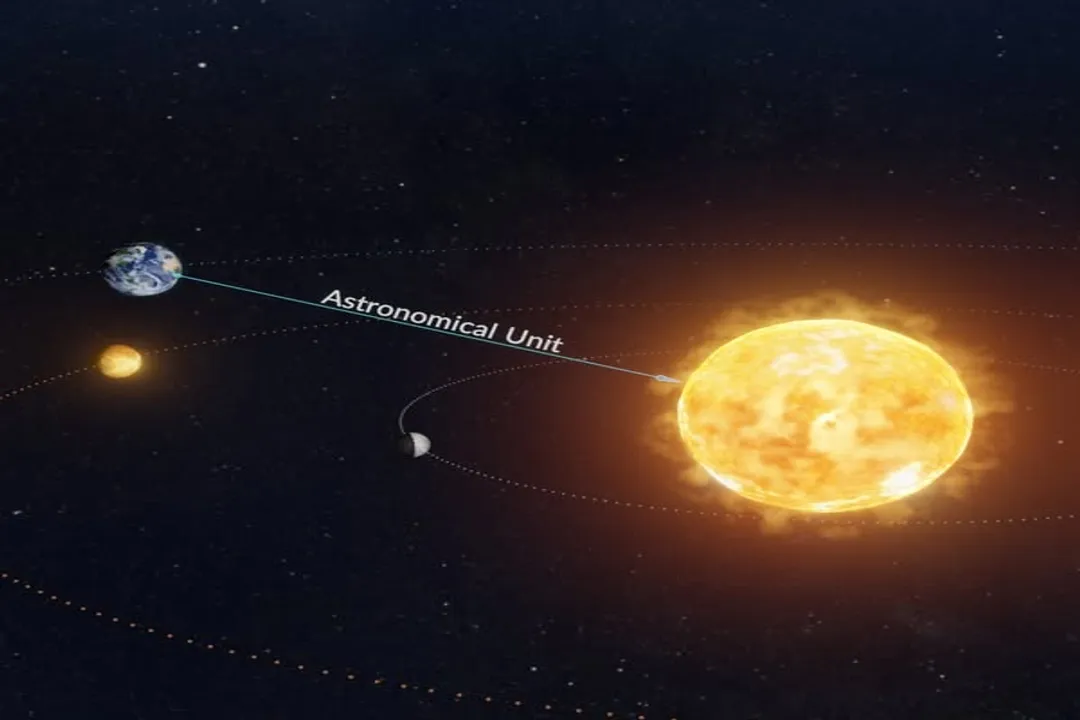
The term , often encountered in discussions about space and astronomy, signifies the Astronomical Unit, a crucial yardstick for comprehending the vast scale of our solar neighborhood. It represents the mean distance between the center of the Earth and the center of the Sun. For the general reader, grasping this unit immediately translates the sometimes bewildering numbers of astronomical distances into something slightly more relatable, even if the unit itself is enormous.
# Defining The Unit
Historically, the Astronomical Unit was an empirical measurement derived from observations of Earth's orbit around the Sun. Because the Earth's orbit is not a perfect circle but an ellipse, the distance between the Earth and the Sun is constantly changing throughout the year. This means the physical distance in kilometers or miles varies as the Earth circles its star. Early astronomers calculated the by tracking these variations, arriving at an average figure that served as the standard ruler for mapping the solar system.
# Modern Precision
A significant shift occurred in 2012 when the International Astronomical Union () established a new, fixed definition for the Astronomical Unit. This decision decoupled the from the instantaneous or even slightly varying physical orbit of the Earth. Instead, the was assigned an exact, defined length in the metric system. This standardization was necessary for modern, high-precision science, ensuring that calculations remain consistent regardless of small, long-term gravitational perturbations affecting Earth’s orbit.
The modern, internationally accepted value for one Astronomical Unit is precisely:
This number is now a defined constant within the International System of Units (). Before this change, the value was an approximation based on astronomical measurements, which naturally carried some uncertainty. Now, if we use the fixed value, we can calculate the Earth’s actual average distance in meters, which is slightly different from the definition itself due to continuous, subtle changes in the Earth's orbit.
# Numerical Scale
The fixed value of approximately 150 million kilometers provides a tangible sense of scale. To put this into perspective using imperial measurements, one is roughly equivalent to 93 million miles. It is a measure of distance, not time, although the light emitted by the Sun takes about 8 minutes and 20 seconds to travel this one to reach Earth.
When we look at planetary distances expressed in , the massive difference in scale becomes clear:
| Celestial Body | Approximate Distance (AU) | Approximate Distance (km) |
|---|---|---|
| Sun to Earth | $1.0$ | $149.6$ million |
| Sun to Mars | million | |
| Sun to Jupiter | million | |
| Sun to Pluto (Average) | billion |
The convenience of using over writing out billions of kilometers becomes immediately apparent when dealing with outer solar system objects. For instance, stating that Jupiter is away is much cleaner than reciting $778,000,000$ kilometers, especially when comparing it to Mars at .
Thinking about these distances in the context of human travel offers an interesting perspective. If a spacecraft, even one traveling quite fast by current standards, were to cover one , it would still take many months. This highlights that the is not a practical unit for terrestrial navigation or even near-Earth satellite work; its domain is strictly planetary and interplanetary scales.
# Solar System Measure
The Astronomical Unit is the foundational unit for mapping out the spatial relationships within our solar system. It provides a common, standardized baseline for comparing the orbits of the eight official planets and the many minor bodies that share our star system.
When scientists discuss the size of the asteroid belt, for example, they often define its boundaries in . It generally resides between the orbits of Mars () and Jupiter (). Similarly, the Kuiper Belt, where many icy, dwarf planets reside, begins far beyond Neptune, extending out to distances measured in tens of .
The is a measure of the semi-major axis of a body's orbit, which is the average distance. For Earth, this average is the definition itself. For other planets, it describes the long-term average separation from the Sun. This is a necessary simplification because, just like Earth, every other planet follows an elliptical path. If we were to plot the entire solar system to scale on a single map, using kilometers would result in a ridiculously large drawing, whereas using allows for a more manageable visual representation of orbital relationships.
Consider a hypothetical scenario: mapping the relative positions of Earth, Mars, and Venus for a mission planning simulation. If you use the $149,597,870,700$ meter constant for , your simulation software calculates distances based on a known, unchanging metric. If, instead, you relied on the current physical distance of Earth from the Sun in that calculation (which changes daily), the model's internal scale would drift slightly over time, potentially causing cumulative errors in trajectory predictions for distant spacecraft, making the fixed constant essential for long-term accuracy.
# Application Extensions
While the is intrinsically tied to the Earth-Sun relationship, its utility extends logically to describe distances between other bodies within the solar system. Although these measurements are often reported as multiples of the (e.g., the distance between Jupiter and Saturn is roughly ), the definition is fundamentally rooted in our home planet's average orbital path.
When we look toward objects outside our solar system, like other stars, the Astronomical Unit starts to become too small to be practical. Stars are separated by distances so immense that light-years or parsecs become the preferred units. However, the still appears in the study of exoplanets—planets orbiting other stars. Scientists often report the orbital radius of an exoplanet around its host star in because that star is often analogous to our Sun in terms of stellar classification. For example, finding an exoplanet orbiting at immediately tells astronomers it orbits its star at a distance similar to that of Venus or Earth relative to our Sun, offering a quick functional comparison to our own planetary layout.

# Consistency and Certainty
The move to a fixed highlights a scientific priority: achieving absolute certainty in measurement, even if it means slightly altering the definition of a concept based on real-world observation. The Earth's actual mean orbital radius is subject to change over geological timescales due to gravitational interactions with Jupiter and other bodies. By defining the as a constant number of meters, astronomers ensure that the yardstick itself does not shrink or grow, thus isolating any observed change in a planet's orbit as a true change in that planet's motion, rather than a shift in the baseline unit.
This standardization is a powerful demonstration of Expertise in action—a field defining its own terms for maximum utility. For any amateur astronomer or student trying to visualize the scale of the solar system, understanding that the $150$ million figure is now a perfect, defined constant—not just a best guess—adds a layer of trust and authority to the models they study. This certainty is vital when planning deep-space probes, where trajectory corrections must rely on known, unchanging constants for high accuracy over years of travel.
#Videos
What Does AU Mean In Astronomy? - Physics Frontier - YouTube
Related Questions
#Citations
Astronomical unit - Wikipedia
Astronomical unit (AU, or au) | Definition, Conversion, & Facts
au (Astronomical Unit) - Glossary
What Does AU Mean In Astronomy? - Physics Frontier - YouTube
What is the Astronomical Unit? | Science Guys - Union University
Can you explain what AU stands for and how it is used for ... - Quora
The new definition of the astronomical unit : exactly 149 597 870 700m
Star Walk - Facebook
Probably a dumb question, but what is an au? : r/fivenightsatfreddys