Which class has hotter stars, G or B?
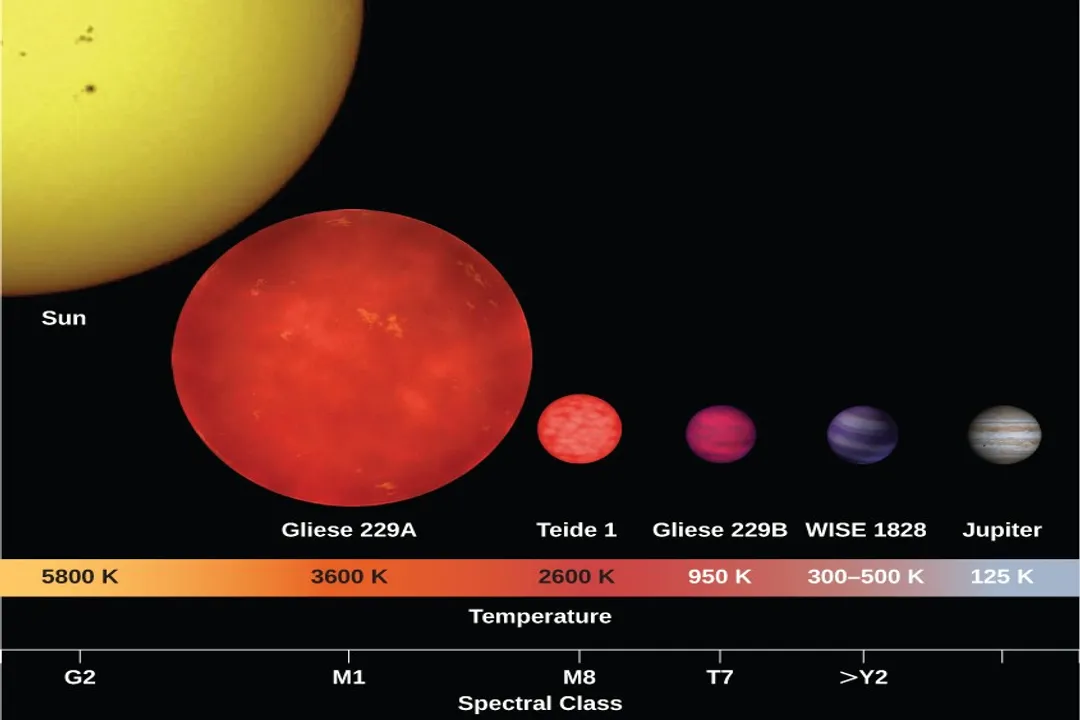
The difference in heat between a G-class star and a B-class star is vast, placing them on completely different tiers of stellar intensity. When comparing these two stellar types, the B class is overwhelmingly the hotter category, representing some of the most luminous and energetic stars on the main sequence. Stellar classification systems, like the Morgan-Keenan (MK) system, arrange stars based on their surface temperature, which is directly observable through the light they emit.
# Star Classes
Stars are systematically categorized using a sequence of letters that acts as a shorthand for their physical properties, most critically their temperature. This spectral sequence runs from O, B, A, F, G, K, and finally M, representing a gradient from the hottest, most massive stars down to the coolest, smallest ones. Furthermore, each letter class is subdivided by a number from 0 (hottest) to 9 (coolest), allowing for finer distinctions within the broad categories.
# Temperature Scale
The numerical temperature associated with a star dictates its entire profile, from its color to its lifespan. B-type stars occupy the high end of this temperature spectrum. Their surface temperatures typically range from about $10,000$ Kelvin () up to or even higher, placing them directly after the extremely rare O-type stars.
In contrast, G-class stars sit comfortably in the middle of the sequence. Our own Sun is the archetype of this class, specifically a G2V star, with a surface temperature hovering around . G-type stars generally fall within the range of approximately to . This means a typical B star is at least twice as hot, and potentially three times hotter, than a star like the Sun.

# B Star Traits
B-class stars are inherently hot, massive, and blue or blue-white in appearance. Because they are so hot, their spectra are characterized by strong lines of neutral helium and ionized hydrogen. Their high surface temperature means they pour out immense amounts of energy. This intense energy output translates directly into high luminosity; B stars are far brighter than G stars, often thousands of times more luminous than the Sun.
Their sheer mass drives this incredible heat. These stars are large, perhaps 1.8 to 9.8 times the mass of the Sun. However, this power comes at a significant cost to their lifespan. Due to the extreme pressure and temperature in their cores required to sustain such high luminosity, B stars consume their nuclear fuel at a ferocious rate. Consequently, their main-sequence lifetimes are relatively short, often only lasting tens of millions of years, which is brief in astronomical terms. A B star observed today is a relatively recent arrival on the cosmic scene, whereas a G star has a much longer history ahead of it.
# G Star Traits
G-class stars represent stellar middle age and stability. As mentioned, they are exemplified by the Sun, having surface temperatures that peak near . Their spectra are rich in lines from ionized calcium and neutral metals. They are typically yellow or yellow-white in color.
In terms of mass, G stars are significantly less hefty than their B-class cousins, usually falling between about $0.8$ and $1.0$ solar masses, though the class extends slightly higher in some definitions. This lower mass results in a far more sedate rate of nuclear fusion, leading to long, stable lives spanning billions of years—our Sun is estimated to have a total lifespan of about 10 billion years. While they are certainly luminous enough to support planetary systems, they cannot match the brilliance of a B star.
# Spectral Sequence
Understanding the OBAFGKM sequence itself helps visualize the temperature gap. If we examine the spectral classification in detail, it clearly lays out the thermal hierarchy:
| Class | Typical Color | Surface Temperature () | Example |
|---|---|---|---|
| O | Blue | $>30,000$ | Mintaka |
| B | Blue-White | $10,000 - 30,000$ | Rigel |
| A | White | $7,500 - 10,000$ | Sirius |
| F | Yellow-White | $6,000 - 7,500$ | Polaris |
| G | Yellow | $5,200 - 6,000$ | Sun |
| K | Orange | $3,700 - 5,200$ | Arcturus |
| M | Red | $<3,700$ | Betelgeuse |
This table shows that the B class begins where the A class ends, with temperatures plummeting as you move toward K and M stars. The G class is positioned well over half the way down this temperature ladder.
# Luminosity Link
The relationship between temperature and luminosity is one of the most fundamental concepts in astrophysics, often visualized using the Hertzsprung-Russell (H-R) diagram. For stars on the main sequence, like both G and B stars, higher surface temperature always means drastically higher energy output, or luminosity.
The difference isn't linear; it's exponential. If a B star is roughly three times hotter than a G star, its luminosity will be far more than three times greater because it radiates energy across a broader range of wavelengths, with the peak shifting into the energetic blue region of the spectrum. Because B stars are so much hotter, they are inherently much, much brighter than G stars of comparable size.
Since a B star emits so much more light per square meter of its surface than a G star, an observer might find a B star that appears to have the same apparent brightness as a G star, but that B star must be physically located much farther away from Earth than the G star to account for the difference in observed light intensity.

# Color Contrast
The dramatic temperature separation between B and G stars results in a stark visual contrast. This is tied to the physics of blackbody radiation, where the color of a star indicates the wavelength where it emits most of its light.
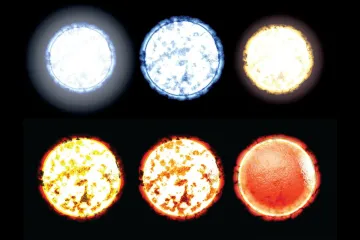
B stars peak in the blue and ultraviolet part of the spectrum, making them appear distinctly blue or blue-white to the eye. G stars, with their cooler surfaces, peak in the middle of the visible spectrum, giving them their characteristic yellow appearance. If you were observing a field of stars with a simple color filter system, you could easily separate a B star from a G star. For instance, if you measured the brightness of two stars, one B-type and one G-type, at the exact same apparent magnitude in a standard visual filter, the B star would show a much higher intrinsic absolute magnitude because its temperature demands it produce far more energy. The G star would need to be much closer to the observer to match that same apparent brightness.
# Observational Context
When amateur astronomers or professional researchers look at a star cluster, the color of the brightest stars tells them immediately about the age of that cluster, which ties back to the temperature comparison. In a young cluster, you expect to see numerous bright, hot, blue B-type stars dominating the brightest end of the spectrum. These massive stars have not yet had time to die off.
If that same cluster ages significantly, the B stars will have already exhausted their fuel and evolved off the main sequence, perhaps becoming white dwarfs or exploding as supernovae. What remains as the brightest population are the cooler, longer-lived stars—the F, G, and K types. Therefore, finding a significant population of luminous B stars is a sign that the star-forming region is young, while a cluster whose brightest stars are G or K types is significantly older, having already burned through its energetic youth. This observation is a cornerstone of stellar evolution studies.
If an observer were to find a theoretical main-sequence star with a surface temperature between and , it would classify as an A-type star, sitting neatly between the B and G classes, confirming the smooth, continuous thermal gradient of the stellar sequence rather than a set of discrete, unconnected steps. The division between B and G stars, therefore, is less about a fundamental physical boundary and more about establishing convenient, observable points along a thermal continuum defined by mass and lifespan.
#Citations
Stellar classification - Wikipedia
Types of Stars - Las Cumbres Observatory
Stars are classified based on their temperature and luminosity. The ...
AST 101: Spectral Classifications
HR Diagram
Stellar Classifications - Astronomical League
Trying to understand star classifications. : r/askastronomy - Reddit
The Spectra of Stars (and Brown Dwarfs) | Astronomy
Stellar Classification | Beyond Universe Wiki - Fandom