What was one disadvantage of the early refracting telescope?
The earliest instruments designed to bring the distant heavens closer fundamentally changed humanity’s perception of the cosmos. When Hans Lippershey first conceived of a spyglass, and Galileo quickly adapted it for the sky, the world witnessed the mountains on the Moon and the moons orbiting Jupiter. Yet, the very principle that made these telescopes work—refraction, or the bending of light by glass lenses—carried within it an inescapable optical flaw. This primary disadvantage, which haunted astronomers for over a century, was chromatic aberration, a spectral problem inherent to the glass itself.
# The Spectral Problem
Chromatic aberration is the failure of a simple lens to bring all colors of light to a single, common focal point. When white sunlight, or starlight, passes through the convex objective lens of an early refractor, the glass acts much like a prism. Different wavelengths, or colors, are refracted at slightly different angles. Blue light might focus slightly closer to the lens, while red light focuses a bit further away.
The visible result of this spectral dispersion was anything but subtle. Instead of a perfectly crisp image of a planet or a sharp point of light from a distant star, the observer saw a bright, colored fringe surrounding the object. For instance, the edge of Jupiter might be bordered by a prominent purple or blue halo. This effect severely limited the achievable sharpness and contrast, essentially placing an upper bound on the useable quality of the image, regardless of how large the lens was ground. While modern, high-end refractors correct this with complex, multi-element apochromatic designs using exotic glass, the early instruments were stuck with the primitive optics of their age.
# Inherited Instability
The optical reality of chromatic aberration directly dictated the physical constraints placed upon early telescope builders. To combat the premature focusing of the blue light—which causes the most immediate blur—the designer’s only recourse was to increase the objective lens's focal length. By making the path that the light traveled inside the tube significantly longer, the differing focal points of the colors were spread out over a greater distance, making the resulting color fringing less dramatic relative to the overall image, though the aberration itself was never eliminated.
This pursuit of a longer focal ratio, simply to keep the image somewhat tolerable, meant that even modest apertures necessitated incredibly long, unwieldy tubes. A 4-inch objective lens might require a tube 40 feet long to achieve a functional focal ratio like F/120. Imagine the engineering nightmare: a long, slender tube made of wood or metal that had to remain perfectly straight, with the objective lens supported only around its edge, fighting gravity over those many feet. This structural challenge meant that reflectors, which use a mirror supported from behind, could much more easily achieve large apertures because their primary optical element didn't risk sagging or deforming under its own weight. Thus, the optical failure (chromatic aberration) forced a physical penalty (extreme length and bulk) that ultimately prevented refractors from growing as large as their reflective counterparts.
# The Observational Toll
For the astronomers using these new instruments in the 17th and early 18th centuries, the constant presence of color fringing represented a kind of "fringe tax" levied on every observation. While a reflector telescope, using a front-surface mirror, is inherently free of chromatic aberration because the light never passes through glass to focus, the refractor user had to live with this visual impurity.
This toll was especially evident when observing bright targets like the Moon or planets. The lack of true color fidelity and the reduced contrast meant that subtle details—the faint bands on Jupiter or the true topography of the lunar surface—could easily be obscured by the artificial colored glow bleeding in from the edges of the field. It wasn't just an aesthetic flaw; it was a barrier to achieving the highest possible precision in measurement and mapping. The breakthrough was not just seeing objects, but seeing them correctly, and early refractors fundamentally failed that test for every color except two.
# A Dual-Glass Remedy
The solution to this fundamental flaw arrived in the mid-18th century when observers realized that the dispersive nature of glass was not uniform across all types. The scientific breakthrough involved pairing two different lens elements made from different glass compositions—one with low dispersion and one with high dispersion.
This innovation led to the creation of the achromatic doublet, first developed by Chester Moore Hall and later popularized by John Dollond. By carefully combining a positive lens (convex) made from one type of glass with a negative lens (concave) made from the other, optical engineers could force two specific wavelengths of light (usually red and blue) to focus at the exact same point. This dramatically reduced the colorful halos, providing much sharper and clearer images than previous designs. While this combination did not correct all colors perfectly—leading to a residual, less noticeable secondary spectrum—it was revolutionary enough to usher in the era of the "Great Achromats," allowing refractors to temporarily become the world's premier astronomical instruments before large, well-coated mirrors became practical.
# Compounded Limitations
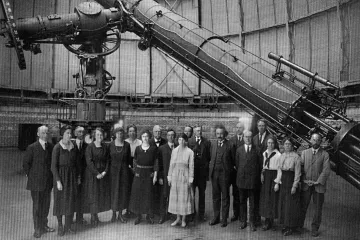
The physical burden of the refractor did not vanish with the invention of the achromatic lens; it simply shifted. The move toward achromatic correction required more complex lens arrangements and the manufacturing of larger, perfectly matched pieces of glass, maintaining the high cost associated with refractors compared to mirrors. Even with the optical flaw mitigated, the physical requirement to support the massive objective lens only at its rim, combined with the difficulty of making large, flawless glass blanks, placed a hard ceiling on aperture size.
If an astronomer desired superior light-gathering capability—the ability to see fainter nebulae and galaxies—they had to seek aperture. For the refractor, this meant seeking larger and larger lenses. Since larger lenses sagged more severely, the only way to maintain a usable image quality was to make the focal length even longer, leading to truly enormous and exceptionally expensive instruments that were difficult to mount and manage. This inherent structural penalty, born from the necessity of battling chromatic aberration, ensured that for the pursuit of maximal light collection, the reflector design, which sidestepped the entire spectral issue by using reflection, would eventually dominate professional astronomy. The very principle that allowed early astronomers to see the planets also ensured that the largest, most powerful telescopes of subsequent generations would look very different indeed.
#Videos
What Are Two Disadvantages Of Refracting Telescopes? - YouTube
Related Questions
#Citations
Advantages and Disadvantages of Refracting Telescopes - UBC Math
What Are Two Disadvantages Of Refracting Telescopes? - YouTube
What are the pros and cons of reflectors and refractors? : r/telescopes
Refracting Telescopes: A Comprehensive Guide - Band Optics
1791: Telescopes: Refractor vs Reflector - explain xkcd