What did Galileo's observations confirm?
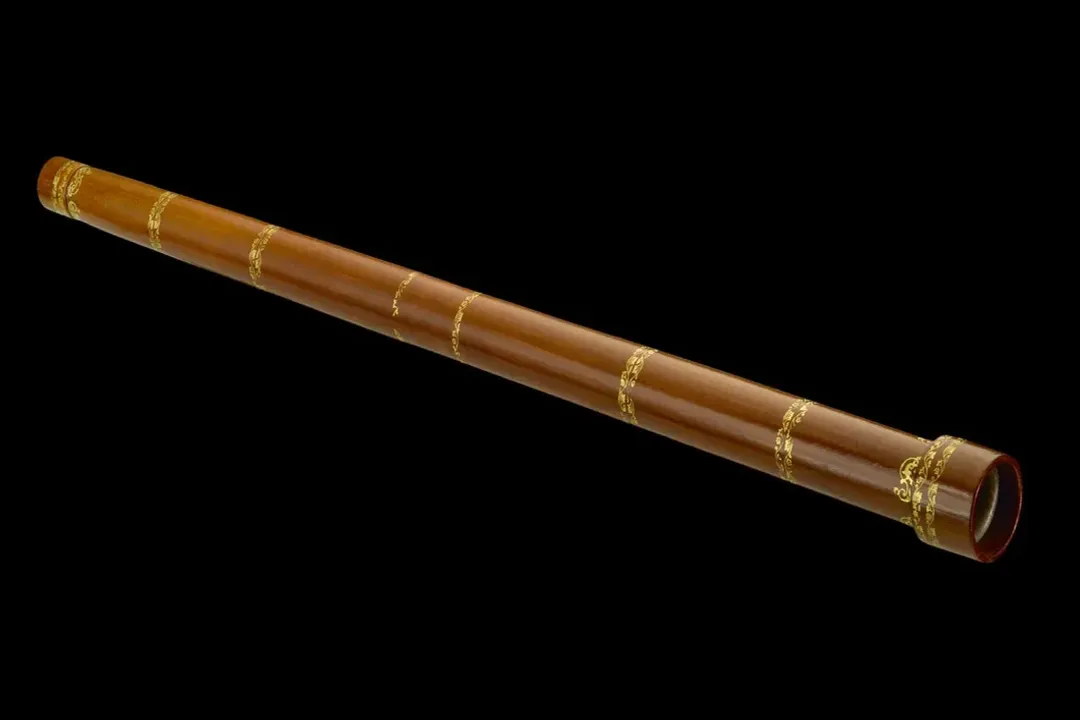
Galileo Galilei’s persistent gaze through his improved telescope fundamentally shattered the prevailing cosmic model inherited from antiquity, providing concrete, observable evidence that lent powerful support to the emerging heliocentric theory championed by Copernicus. [1][3] His series of astronomical observations, beginning in earnest around 1609 and 1610, were not merely incremental scientific updates; they represented a philosophical earthquake, moving astronomy from a realm of pure mathematical description to one grounded in physical reality accessible through careful measurement and scrutiny. [1][5] The true confirmation Galileo delivered was the empirical refutation of the Aristotelian-Ptolemaic universe, the long-held belief system that placed a static, perfect Earth at the center of all creation. [1][2][9]
# Imperfect Heavens
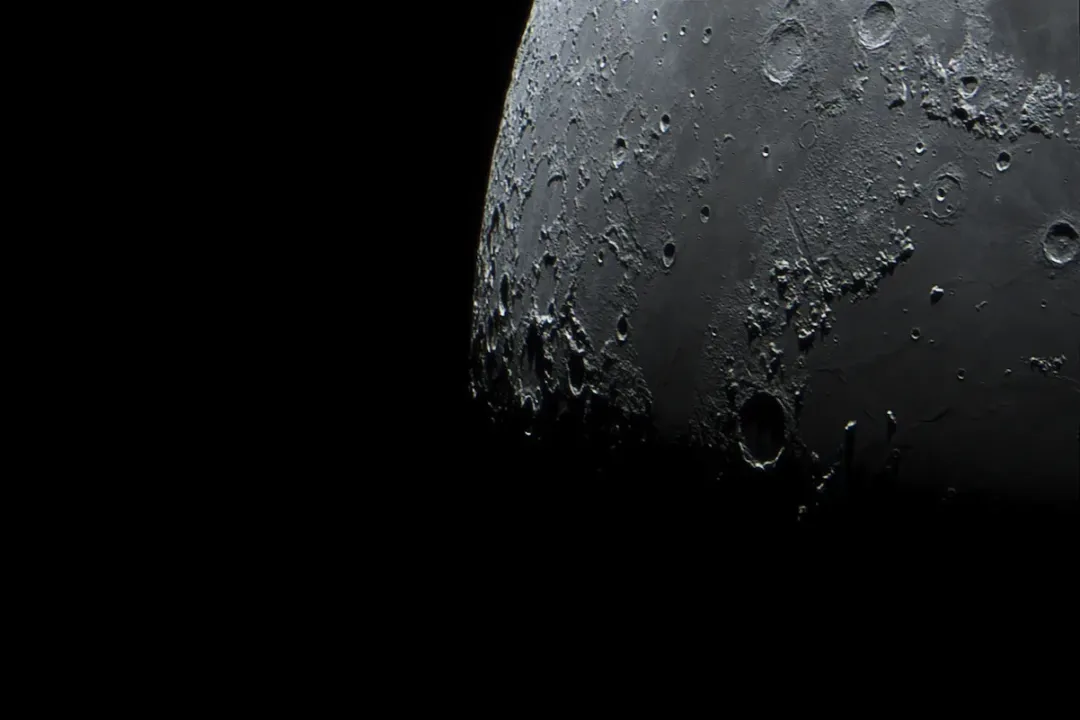
One of Galileo's earliest and most visually striking confirmations came from turning his instrument toward the Moon, our nearest celestial neighbor. [2][7] Before the telescope, the heavens were thought to be composed of a perfect, unchanging substance—the quintessence—and celestial bodies were imagined as perfectly smooth, luminous spheres. [1][2] Galileo’s observations directly contradicted this notion. [1][2]
He saw mountains, valleys, and craters scarring the lunar surface, much like features on Earth. [1][7] This suggested that the Moon was not an ethereal, flawless orb but a physical body composed of matter subject to processes like erosion and shadow casting, similar to our own world. [2] He noted that the edges of the sunlight on the Moon were uneven, suggesting topography, and he even calculated the height of some lunar mountains by measuring the length of their shadows at different times of illumination. [1][2] This finding demolished the sharp division between the corruptible, changing Earth and the immutable, perfect heavens, effectively terrestrializing the Moon and paving the way for a universe governed by universal physical laws, not dualistic substances. [1][6]
# Companions to Jupiter
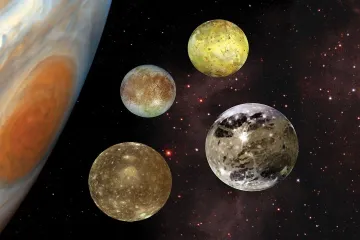
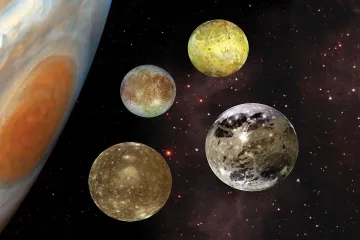
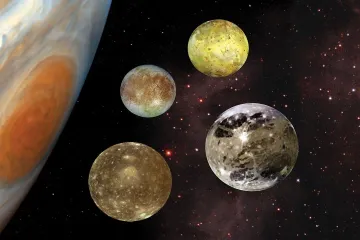
Perhaps the most damning evidence against the established geocentric model came in January 1610. [1][4][7] Using his telescope, Galileo began observing Jupiter, expecting to see a steady, unchanging point of light. [4][7] Instead, he observed four small, bright objects positioned near the planet, which he initially named Sidera Medicea (the Medicean Stars), though they are now known as the Galilean moons: Io, Europa, Ganymede, and Callisto. [1][2][4][7]
Crucially, he noticed these "stars" moved in relation to Jupiter over several nights. [4][7] He recorded observations of their changing positions, noting that they sometimes disappeared behind the planet, indicating they were orbiting it. [1][2][7] The first documented observation of this phenomenon occurred on January 7, 1610. [4]
The confirmation derived from this was profound: not everything in the heavens orbits the Earth. [1][7] If Jupiter had its own satellites revolving around it, the Earth could not possibly be the exclusive center of all celestial motion. [1][2] This observation provided a miniature, observable model of a secondary orbital system within the larger cosmos. To visualize the impact, consider the Ptolemaic system required every celestial body to circle the Earth. Galileo offered an immediate counterexample—a system within a system—that was perfectly consistent with the Copernican description of an Earth that was just one planet among several circling the Sun. [6] It demonstrated that complex, stable orbital mechanics existed independent of Earth-centric assumptions. The ability to observe these movements night after night, recording their positions, provided a level of empirical certainty previously unattainable in cosmological debate. [1][9]
# Phases of Venus
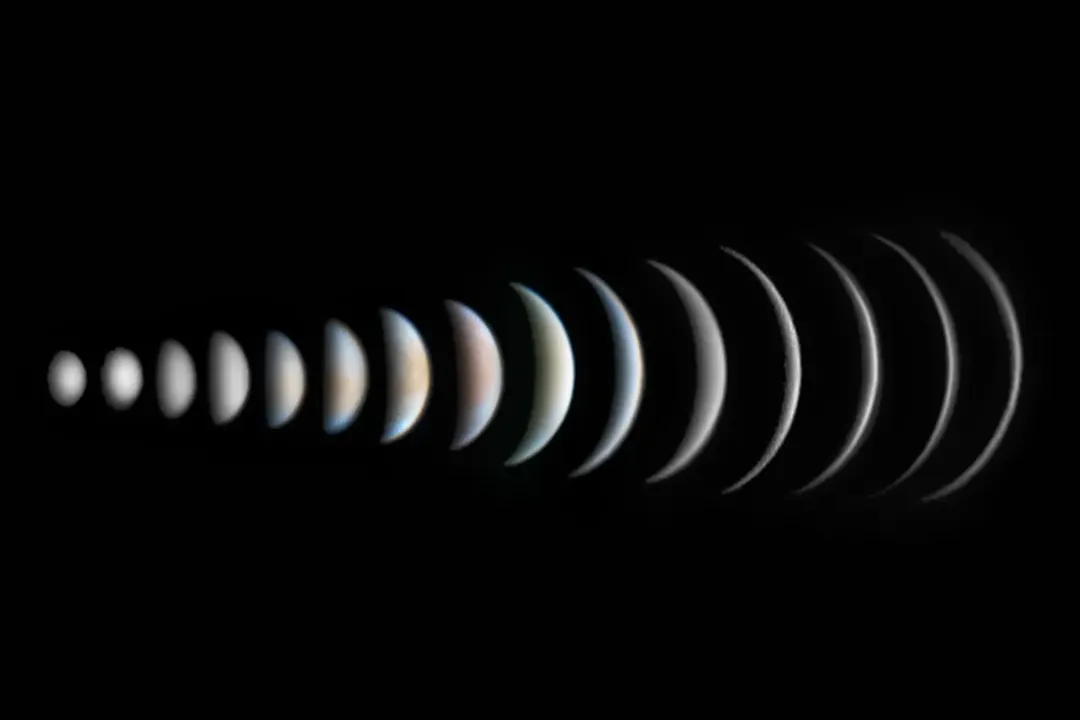
While the moons of Jupiter were a stunning discovery, the observation of Venus exhibiting a full set of phases—crescent, gibbous, full, and new—provided the definitive observable proof that Venus orbited the Sun, not the Earth. [1][2] In the Ptolemaic system, Venus orbits the Earth on a path called an epicycle, meaning it should always appear as a crescent or a thin sliver because it stays relatively close to the Sun in the sky as viewed from Earth. [1][2] It should never appear fully illuminated (full) or nearly fully illuminated (gibbous). [2]
Galileo, however, observed Venus displaying phases identical to those of the Moon, including a nearly full phase. [1][2][6] This is only possible if Venus is orbiting the Sun inside Earth’s orbit, allowing observers on Earth to see the sunlit side of Venus change its angular presentation as the planet moves around the Sun. [1][2] This phase cycle was predicted precisely by Copernicus and was impossible to explain fully under the Earth-centered model. [2][6] The observation of the gibbous phase, in particular, was critical; it showed Venus could be on the far side of the Sun relative to Earth, a geometrical impossibility in the traditional model. [1] The shift in appearance from crescent to full phase provided irrefutable visual evidence of the Sun occupying the central position in the planetary arrangement. [2]
# Solar Imperfection and Rotation
Galileo’s investigations were not limited to points of light and orbiting bodies; he also turned his improved instrument toward the Sun itself. [1][6] Through diligent observation of sunspots—dark markings on the solar surface—he confirmed two significant points that further undermined the notion of heavenly perfection. [1][6]
First, the very existence of these blemishes on the Sun indicated that the Sun was not an immaculate, unchanging body, mirroring the earlier finding about the Moon. [1] If the Sun could have blemishes, the underlying assumption of flawless celestial bodies dissolved entirely. [6]
Second, and just as scientifically important, Galileo tracked the movement of these spots across the solar disk over several days. [1] By charting their progression, he concluded that the spots moved together as the Sun rotated on its axis. [1] This confirmed that the Sun, like the Earth, was a rotating, material body, providing yet another common physical characteristic between the Earth and the celestial objects previously deemed entirely different. [6] The ability to measure the rotation of a distant star was a monumental achievement in empirical astronomy, confirming that terrestrial laws of motion and physical composition applied universally across the heavens.
To truly appreciate the weight of these findings, one must contrast the observational process. Under the old system, astronomers like Ptolemy or Tycho Brahe meticulously observed phenomena and then built increasingly complex mathematical constructs (like epicycles upon epicycles) to make the observations fit the required model. Galileo, conversely, observed an anomaly—like a phase or a moon—and then followed the empirical data where it led, regardless of established dogma. [9] This shift from a priori assumptions to a posteriori verification is arguably the most enduring confirmation Galileo provided: the triumph of direct observation over inherited authority in the pursuit of natural philosophy. [1][3] Imagine attempting to track the phases of Venus before the telescope; it would appear as a small, slightly varying crescent, never a full disk, thereby "confirming" the old system. The instrument was not just an amplifier of light; it was a revealer of truth that the naked eye could not perceive, fundamentally altering the scale of human certainty.
# The Structure of the Cosmos
Galileo’s observations also drastically altered the perceived scale and composition of the cosmos beyond the known planets. [1][6] Before his work, the Milky Way was often described vaguely or dismissed as a phenomenon not truly composed of individual stars. [1] When Galileo turned his telescope toward the hazy band of light stretching across the night sky, he resolved it into an uncountable number of individual, faint stars. [1][6]
This revelation confirmed that the universe was vastly larger and far more populated with stars than previously imagined, challenging the neat, self-contained spheres of the old cosmology. [1] If the apparent brightness of a star indicated its true distance (a concept that would later be refined, but the principle of vast distance was established), the universe must stretch out to distances incomprehensible under the Aristotelian framework. [6] The heavens were not just a few dozen illuminated points placed on crystal spheres; they were an infinite or near-infinite expanse populated by innumerable suns. [1] This confirmation of spatial immensity was a necessary prerequisite for accepting a Sun-centered system where the Earth was merely another planet traveling an immense orbit. [6]
# Confirmation of Heliocentrism
While Galileo’s direct discoveries confirmed phenomena—moons orbiting Jupiter, phases of Venus, rough lunar surfaces—the synthesis of all these observations confirmed the Sun-centered (heliocentric) model as the only geometrically and physically plausible description of the known solar system. [1][2][6]
The observations can be summarized as follows in relation to the two dominant models:
| Observation | Ptolemaic (Geocentric) Prediction | Galilean Observation | Confirmed Model |
|---|---|---|---|
| Moon's Surface | Perfectly smooth, ethereal | Rough terrain, shadows visible | Universal Physics |
| Jupiter | No orbiting bodies | Four moons orbiting Jupiter | Earth is not the sole center |
| Venus | Always crescent or new | Displays full, gibbous phases | Venus orbits the Sun |
| Sun | Perfect, unblemished | Exhibits dark spots | Celestial bodies are material |
| Milky Way | Hazy band | Resolved into countless stars | Universe is vastly larger |
This table starkly illustrates how each piece of empirical evidence chipped away at the old guard and built the case for the new. [1][2][6] The ability to see Jupiter’s moons changing position, recorded precisely on sheets of paper, contrasted sharply with the abstract mathematics used to defend the Earth-centered view. [4][7] One could simply look through the telescope and verify the truth of the Jovian satellites' motion, an immediate and direct challenge to terrestrial uniqueness. [9]
It is worth noting an interesting implication stemming from the conflict surrounding these confirmations. Galileo's discoveries, particularly the moons of Jupiter, provided a physical structure that mechanically supported Copernicanism, which had previously existed primarily as a mathematical hypothesis since the time of Copernicus himself. [6] However, the resistance these observations met from certain scholastic philosophers highlights a crucial aspect of scientific confirmation: it often requires not just evidence, but a willingness to accept the observational apparatus itself. Many critics refused to even look through the telescope, believing that any imperfection in the lens or any optical illusion it created would be the source of the strange sightings, rather than accepting that the heavens themselves were different from ancient descriptions. [1][9] The true confirmation, therefore, rests on accepting the telescope as a legitimate tool for empirical investigation into the natural world, something that required a deep restructuring of scientific methodology itself. [3]
# Physics and Motion
Beyond pure descriptive astronomy, Galileo’s work involved foundational confirmations in mechanics that were necessary for a moving Earth to make sense. If the Earth were hurtling through space, as Copernicus proposed, why did objects dropped from towers not land far behind the base?. [1] Galileo tackled this by studying relative motion. [1][9] His understanding confirmed that an object dropped from a moving platform (like a mast of a ship) continues to move horizontally at the original speed of the platform while it falls vertically. [1] This principle of inertia, or at least the precursor to it, showed that objects moving with the Earth—including the air, buildings, and dropped stones—retain that motion even as the Earth rotates and orbits the Sun. [1][9] This addressed one of the most common and immediate objections to the heliocentric model, transforming a perceived physical impossibility into a demonstrable physical reality based on continuous motion. [1]
In summary, Galileo’s observations confirmed several interconnected truths: the heavenly bodies are material and imperfect like Earth; other centers of motion exist in the universe besides the Earth; and the physical laws governing motion on Earth are also operational throughout the cosmos. [1][2][3][6] These confirmations, derived from persistent, careful telescopic study, decisively shifted the intellectual foundation of Western cosmology away from reliance on ancient authority and toward empirical, mathematically supported observation. [9] He didn't invent the idea of the Sun being central, but his observations were the irrefutable, physical proof that brought the theory into the realm of established fact for many who followed. [1][7]
#Videos
Galileo's Revolutionary Observation - YouTube
#Citations
Galileo Galilei - Wikipedia
What did Galileo discover? | Royal Museums Greenwich
Galileo Galilei - New Mexico Museum of Space History
On this day: 7 January 1610, Galileo Galilei observed with his ...
Galileo's Revolutionary Observation - YouTube
Space Science after Galileo
Galileo Discovers Jupiter's Moons - National Geographic Education
Galileo Challenge - Stanford Solar Center
Galileo First Hears About the Telescope - American Physical Society