What are the densest stars called?

The cosmos holds objects of unimaginable mass squeezed into impossibly small volumes, but when we ask what the densest stars are called, the answer points to one specific, exotic remnant: the neutron star. [2][5][9] These celestial bodies represent a boundary condition in physics, a place where the pressure generated by gravity is so immense that it forces protons and electrons to merge, creating a super-dense ball composed almost entirely of neutrons. [1][3] They are not just dense; they are the densest known objects in the Universe that are still technically classified as stars. [2][9]
# Stellar Death
The birth of a neutron star is a violent affair, marking the endpoint for only the most massive stars. [1][5] When a giant star exhausts its nuclear fuel, its core can no longer support itself against the crushing inward force of its own gravity. [1] This leads to a catastrophic collapse, often resulting in a supernova explosion that blasts the star's outer layers into space. [5][7] If the remaining stellar core is between about $1.4$ and $3$ times the mass of our own Sun, gravity wins the first round against electron degeneracy pressure but is halted by neutron degeneracy pressure. [1][7] This process, known as core collapse, compresses the matter down to atomic nuclear density. [1][3]
The initial mass of the progenitor star dictates the fate of the remnant. Stars with masses below a certain threshold might end as white dwarfs, while those significantly more massive than what forms a neutron star will continue collapsing past the neutron star stage to become a black hole. [1][7] The formation process itself, the dramatic implosion into an object only a few kilometers across, is what establishes the record-breaking density. [3]
# Matter Extreme

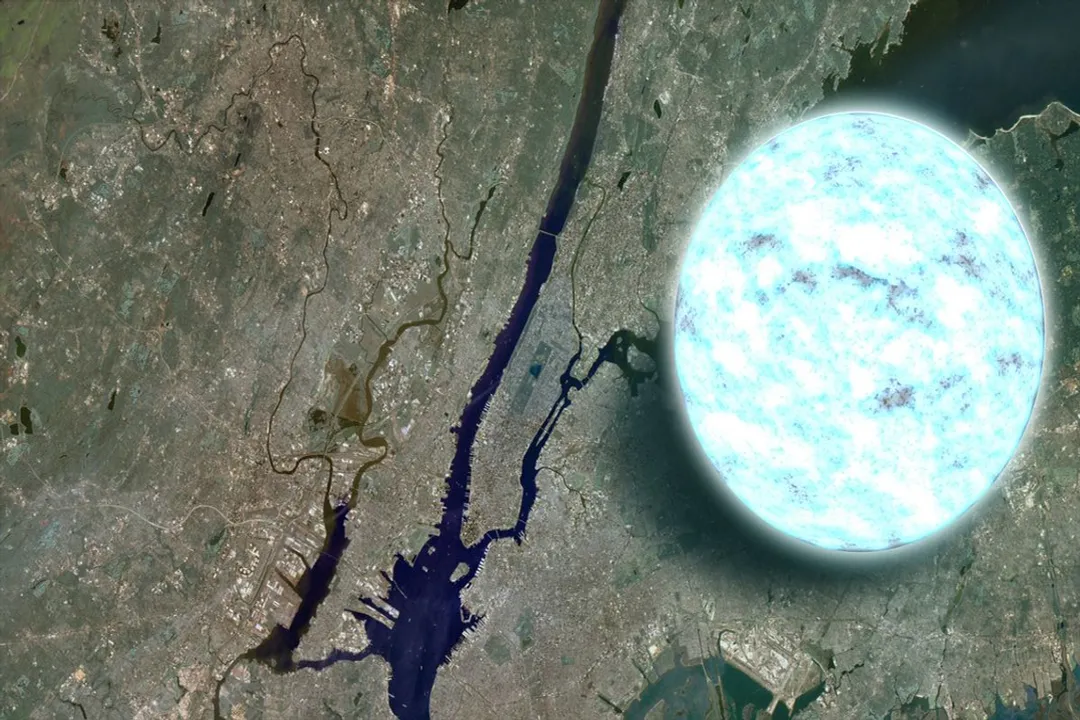
To truly grasp the density of a neutron star, simple analogies often fall short, but they are necessary starting points. [8] A typical neutron star packs roughly $1.4$ to $2.1$ times the mass of the Sun into a sphere only about $10$ to $20$ kilometers in radius. [1][3][7] Considering the Sun is about a million times the volume of Earth, this compression is extreme. [8]
The resulting density figures are staggering. If we could take a teaspoon or sugar cube worth of material from the interior of a neutron star, it would weigh billions of tons, perhaps around $6$ billion tons, or as some sources suggest, more than all the people on Earth combined. [4][5][8] For a more precise comparison based on mass ratios, consider this: if the Sun were compressed to the size of a city like Houston, Texas, it would be approaching neutron star density. [8]
Here is a snapshot comparing these cosmic heavyweights:
| Object | Typical Mass (Solar Masses, ) | Typical Radius (km) | Approximate Density () |
|---|---|---|---|
| Sun (Main Sequence) | $1$ | ||
| White Dwarf | $0.6$ to $1.4$ | (Million) | |
| Neutron Star | $1.4$ to | $10$ to $20$ | (Hundred Trillion) |
The density unit is useful, but a neutron star's density reaches to kilograms per cubic meter. [1] This level of compression means the matter exists in a state where it is denser than an atomic nucleus itself, which is why the primary constituent becomes the neutron. [3] Trying to replicate this environment on Earth is impossible; the pressures involved exceed anything achievable in terrestrial laboratories. [8] The sheer consistency of these measurements, derived from observing the star's gravitational effects on companion stars or through timing signals, confirms their status as the densest stars we can currently measure. [2][6]
# Interior Structure
The internal architecture of a neutron star is layered, a direct consequence of the extreme pressure gradient from the surface inward. [8] Near the surface, there exists a thin atmosphere, perhaps only a few centimeters thick, overlying a solid, crystalline crust. [8] This outer crust is composed of a lattice of heavy, neutron-rich atomic nuclei suspended in a sea of relativistic electrons. [8]
Deeper down, the pressure becomes so intense that the electrons are squeezed into the protons, creating free neutrons—hence the name of the star. [1][3] This inner crust transitions into a superfluid interior composed almost entirely of neutrons. [8] Just what happens in the very center, the core, remains one of the great unsolved problems in astrophysics. [8]
The equation of state—how pressure changes with density—is not fully understood in this ultra-dense regime. The core could consist of a "soup" of neutrons, possibly mixed with some exotic particles like hyperons or even deconfined quarks, forming a quark-gluon plasma. [8] Because the interior is shielded from direct observation by the thick, opaque crust, understanding the core relies entirely on theoretical models and indirect measurements of the star's mass and radius, which constrain the possible equations of state. [8] The fact that we can measure the mass to $3$ solar masses while still observing a physical surface (rather than an event horizon) tells us that this state of matter is just stable against total gravitational collapse. [7]
# Pulsar Beams
Many neutron stars are observed not just by their immense gravity or sheer presence, but by the beams of radiation they emit, leading to the designation pulsar. [6] A neutron star often rotates incredibly fast, sometimes completing many rotations in a single second. [1][6] Simultaneously, the star possesses an intensely powerful magnetic field, orders of magnitude stronger than any field we can generate on Earth. [1][6]
This magnetic field is responsible for channeling beams of radio waves, X-rays, or gamma rays along the magnetic poles. [6] If these poles are not aligned with the star’s rotational axis, the beams sweep across space like the light from a lighthouse. [6] When one of these beams happens to cross Earth’s line of sight, we detect a regular, periodic pulse of radiation. [1][6] This phenomenon is what gives pulsars their name. [6]
The rotation speed is a direct legacy of the star's collapse. As the progenitor star shrinks from hundreds of thousands of kilometers in radius down to about $15$ kilometers, its spin rate must increase dramatically to conserve angular momentum, similar to how an ice skater spins faster when they pull their arms in. [1] Some millisecond pulsars rotate hundreds of times per second. [1] Monitoring the precise timing of these pulses provides scientists with an incredibly accurate clock and allows them to study general relativistic effects, such as gravitational redshift, if the pulsar is in a binary system. [6]
# Density Limits
While neutron stars represent the pinnacle of stellar density, they are not the absolute densest objects in the Universe. [2] That title belongs to black holes. [2] A black hole forms when the core remnant exceeds the maximum mass limit for a stable neutron star, often cited around $2$ to $3$ solar masses, though the precise "Tolman-Oppenheimer-Volkoff (TOV) limit" is still being refined. [1][7]
The critical difference lies in the nature of the end state. A neutron star, no matter how compressed, maintains a physical surface supported by neutron degeneracy pressure. [8] A black hole, conversely, has collapsed past this limit, and its gravity is so strong that nothing, not even light, can escape once it crosses the boundary known as the event horizon. [2] Inside the black hole lies the singularity, a point of theoretically infinite density, where our current laws of physics break down. [1][2]
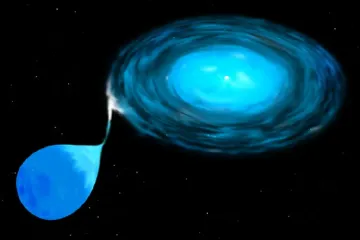
When observing systems where a neutron star orbits another massive object, astronomers look for the tell-tale X-ray signatures produced when the star accretes matter. [2] However, if the orbiting companion is too massive, the continuous fall of material onto the neutron star might eventually push its mass over that critical threshold, triggering a final, irreversible collapse into a black hole. [7] Understanding where that line is—the maximum stable mass for a neutron star—is crucial for mapping the final evolutionary paths of massive stars and confirming theories of extreme gravity. [7] Our continued ability to find neutron stars with masses approaching $2$ solar masses, like PSR J0740+6620, helps astrophysicists place constraints on the physics operating at the very edge of stellar existence. [1]
Related Questions
#Citations
Neutron star - Wikipedia
ESA - The densest objects in the Universe - European Space Agency
Neutron Star - ESA/Hubble
Neutron Stars - Imagine the Universe! - NASA
Neutron stars are among the densest objects in the universe, formed ...
Neutron Stars and Pulsars
Astronomy Jargon 101: Neutron Star - Universe Today
What happens inside neutron stars, the universe's densest known ...
Densest stars | Guinness World Records