How does acceleration differ from velocity?
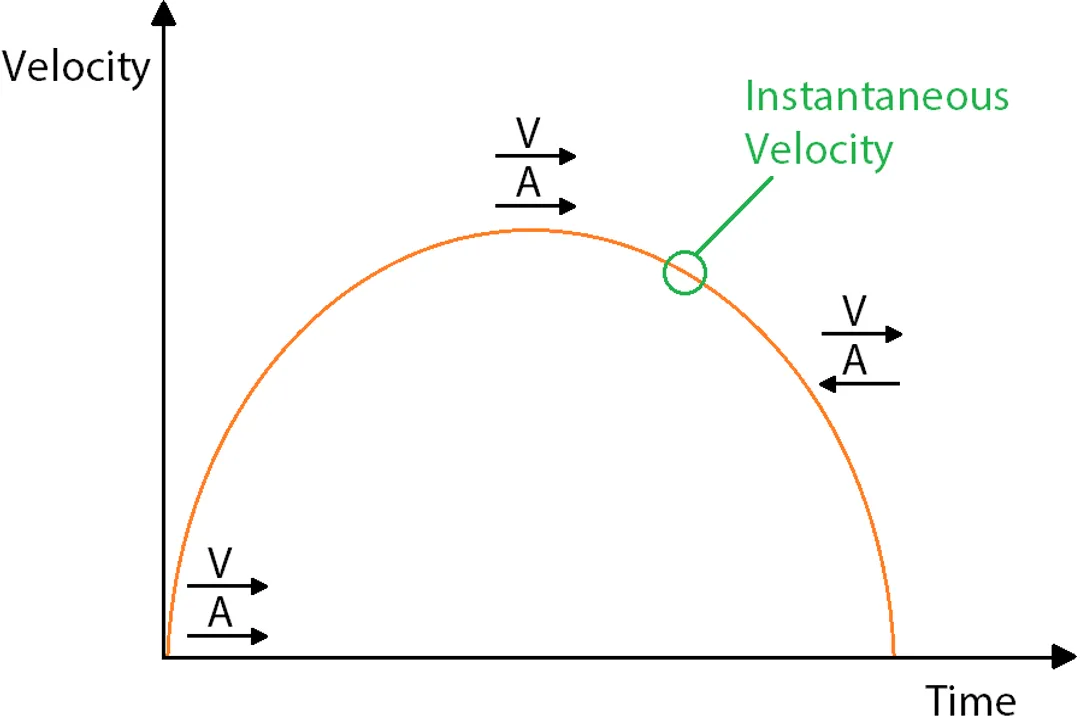
The distinction between velocity and acceleration often causes confusion, even for those familiar with basic physics concepts. While both terms describe aspects of motion, they quantify fundamentally different things about how an object moves over time. Think of it this way: velocity tells you where you are going and how fast, while acceleration tells you how quickly that 'where and how fast' is changing.
# Defining Velocity
Velocity is, at its most basic, the measure of an object's rate of motion in a specified direction. [2] In physics, this is precisely defined as the rate of change of an object's displacement with respect to time. [3][5] Displacement is a key term here; it is not the same as total distance traveled, but rather the vector difference between the object's final point and its initial point. [5]
Because velocity depends on displacement, it must account for direction. This necessary inclusion of direction makes velocity a vector quantity. [2][3][5] A vector possesses both magnitude (the numerical value, often thought of as speed) and direction. [2] For instance, saying a car is moving at 30 miles per hour only describes its speed; saying it is moving at 30 miles per hour southwest describes its velocity. [2]
We calculate average velocity by taking the total displacement and dividing it by the total time taken for that change to occur. [3][5] If an object moves along a path, its instantaneous velocity refers to its velocity at an exact second, which is often determined using calculus by finding the derivative of the position function with respect to time. [2][5]
# Rate of Change
If velocity describes the change in position over time, acceleration describes the change in velocity over time. [3] Acceleration is defined as the rate at which an object’s velocity changes. [2] It is the physics term for how quickly you are speeding up, slowing down, or turning. [5]
Like velocity, acceleration is also a vector quantity, meaning it has both magnitude and direction. [2][3] The SI unit for velocity is meters per second (), [3][5] whereas the SI unit for acceleration is meters per second squared (). [3][5] This difference in units clearly signals their distinct roles: velocity is a rate based on distance over time, while acceleration is a rate of a rate based on velocity over time. [5]
The mathematical relationship is hierarchical: the derivative of position gives velocity, and the derivative of velocity gives acceleration. [4] If you are comfortable thinking about how velocity relates to where an object is, you can apply that exact same thinking to understand how acceleration relates to velocity. [4]

# Vector Directions
Since both quantities are vectors, their directions relative to one another are critical for understanding motion.
When an object maintains or increases its speed in a given direction, its acceleration points in the same direction as its velocity. [2] For example, when a car is moving east and steps on the gas pedal, the increase in speed (the change in velocity) is directed east.
However, when an object is losing speed, this change in velocity is termed deceleration in common language, but in physics, it is still categorized as acceleration, just one that points opposite to the direction of travel. [2][5] If the car is moving east but is slowing down because it is braking, the acceleration vector points west (opposite the velocity). [2] The velocity vector itself always points along the direction of travel, even while the object is decelerating. [2]
A change in velocity can occur in three ways:
- A change in the speed (magnitude). [3]
- A change in the direction. [3]
- A change in both speed and direction. [3]
If a car travels around a corner at a constant speed, its speed is steady, but its direction is changing. Because velocity includes direction, a change in direction inherently means there is a non-zero acceleration. [5] This is why you feel the push when turning a corner, even if the speedometer reading remains fixed. A perfect illustration of this occurs in uniform circular motion, such as a satellite orbiting Earth: the speed might be constant, but the acceleration (centripetal acceleration) is always directed toward the center of the orbit, perpendicular to the tangential velocity.
# Zero Cases
The relationship between zero velocity and zero acceleration is straightforward but important to grasp:
- Constant Velocity Means Zero Acceleration: If an object moves such that its velocity is not changing—neither its speed nor its direction varies—then its acceleration must be zero. [2][4][5] A car cruising at exactly due north on a perfectly straight highway has zero acceleration. [5]
- Zero Velocity Does Not Mean Zero Acceleration: It is entirely possible for an object to have an instantaneous velocity of zero while simultaneously having a non-zero acceleration. [5] The classic example is a ball thrown straight up into the air. At the very apex of its flight, it momentarily stops (), but the acceleration due to gravity is still pulling it downward (). [5] This downward acceleration is what immediately causes the ball to begin moving downward again.

# Comparing the Concepts
To make the differences more concrete, consider how we sense these quantities. If you are in a closed vehicle moving at a high speed, you might not feel the velocity itself; you could be going or and feel relatively the same if the speed is constant. [4] What you do feel is the change in velocity—the jolt when someone presses the gas pedal or the shift when the brakes are applied. [4] This feeling corresponds directly to acceleration. [4]
Here is a summary of the core differences:
| Comparison Basis | Velocity | Acceleration |
|---|---|---|
| Meaning | Rate of change of displacement [3][5] | Rate of change of velocity [3] |
| Nature | Vector (Magnitude and Direction) [3][5] | Vector (Magnitude and Direction) [3] |
| SI Unit | Meters per second () [3][5] | Meters per second squared () [3][5] |
| Formula (Average) | Displacement / Time [3][5] | Change in Velocity / Time [3][5] |
| Graph Derivative | Slope of the position-time graph [5] | Slope of the velocity-time graph [5] |
# Contextualizing the Rates
The inherent difference in their units— versus —provides an immediate, quantifiable way to separate them. Velocity tells you, for example, that you are moving 5 meters forward every second. [4] Acceleration, being measured in meters per second per second, tells you how much that will increase or decrease after the next second passes. [4] If your acceleration is , it means that every second that goes by, your velocity gains in magnitude (assuming the direction remains the same). [4] The closer the time interval gets to zero, the more precise the measurement of the instantaneous rate becomes. [5]
Consider a driver starting from a stop sign. The car moves from to east. The east is the final velocity. [4] If this took 10 seconds, the average acceleration was gained per second. [4] If it had taken twice as long, $20$ seconds, to reach the same , the acceleration would be half as large (), because the change occurred over a longer duration. [4] The resulting velocity is the same, but the effort (acceleration) required to achieve it differed greatly based on the time spent changing the speed. [4]
The change in direction is where many people find acceleration the most counterintuitive. An object moving in a perfect circle at a steady pace is experiencing a continuous change in its velocity vector, because its direction is constantly sweeping around the circle. Even though its speed value stays the same, the change in direction necessitates an acceleration component acting perpendicular to the motion.
If you were tracking your progress on a long drive, you might note your average speed for the whole trip, which is based on total distance. [5] If you then calculate your average velocity using displacement, you might find a surprisingly low number if your route involved a lot of looping back towards the start. [5] For example, if a race car driver travels $500$ miles around a track and ends exactly where they started, their total displacement is zero, resulting in an average velocity of zero for the entire race, despite their high average speed. [5] Acceleration is the metric that captures the dynamic process of getting from that starting point to the end point, regardless of whether the final position matches the start.
This emphasis on the rate of change is why calculus is often involved in precise movement descriptions. [5] Velocity is found by differentiating position with respect to time, and acceleration is found by differentiating velocity with respect to time. [5] In a scenario where velocity is increasing steadily (a linear function on a graph), its derivative (acceleration) is a constant value. [4] If velocity is perfectly constant, its derivative is zero, meaning acceleration ceases. [4]
# Motion Implications
The concepts of velocity and acceleration help describe different aspects of motion, such as free fall. When an object is dropped, it starts with zero initial velocity. [5] Gravity then applies a constant downward acceleration—the acceleration due to gravity, approximately . [5] This constant acceleration means the object gains of downward speed every second it falls. [5] If you ignore air resistance, this rate applies equally to a feather and a bowling ball. [5] As the object falls faster, it might eventually reach a terminal velocity, which is the speed where the downward acceleration from gravity is perfectly balanced by the upward force of air drag; at terminal velocity, the net acceleration is zero because the velocity is no longer changing. [5]
To put this into perspective for non-physicists, imagine you are using cruise control on the highway. Your speed reading on the dashboard represents your speed, which matches your velocity if you are on a straight road segment. This reading is your . If you leave cruise control on, your is constant, and your is zero. Now, suppose you see traffic ahead and tap the brakes lightly. The number on the speedometer starts decreasing. That decrease—the rate at which the number changes—is your acceleration, in this case, negative acceleration. The reading on the dashboard is the velocity; the action of the dashboard needle moving downward is the acceleration. Even if you turn the steering wheel slightly to stay in your lane, that subtle change in direction is a small amount of centripetal acceleration acting sideways, changing your direction vector even if the speed number stays the same.
The critical takeaway is the hierarchical dependence. Velocity is a description of position change; acceleration is a description of velocity change. You cannot have an acceleration without a corresponding change in velocity, but you can certainly have a velocity that requires no acceleration to maintain it.
Related Questions
#Citations
Struggling to understand the difference between Velocity ...
Differences Between Acceleration and Velocity
Speed, Velocity & Acceleration | Difference & Relationship
Acceleration vs Velocity: Understand the Differences
Difference Between Velocity and Acceleration? (Video)
Acceleration vs. Velocity