How did Galileo describe the Moon's surface?
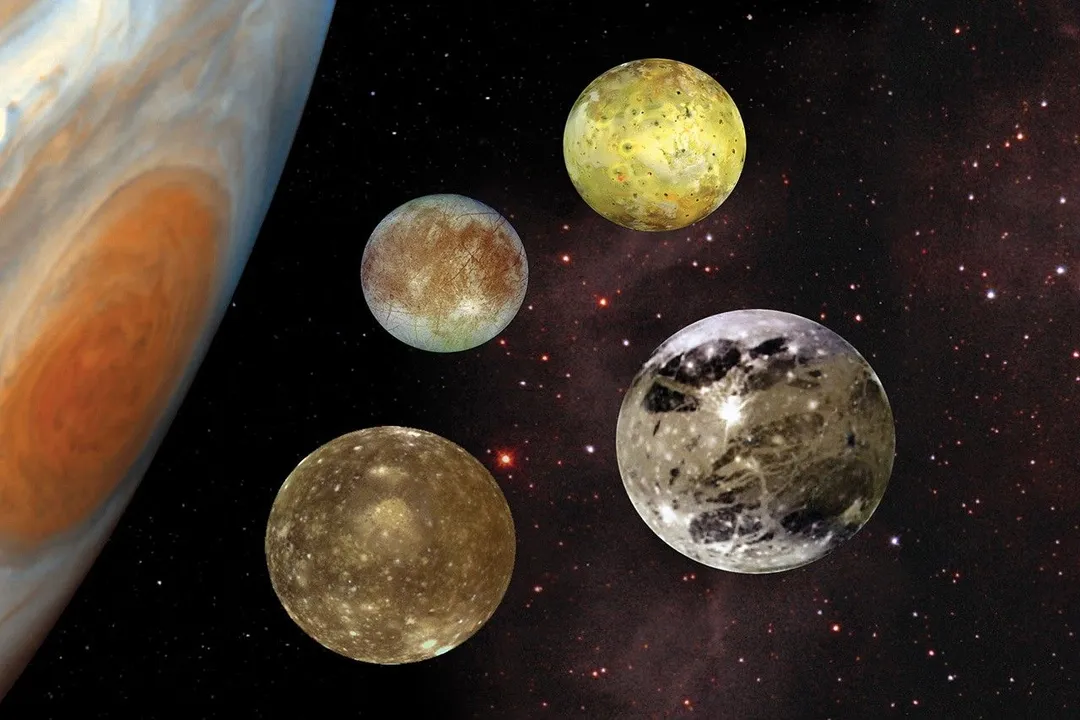
The understanding of the Moon took a dramatic turn when Galileo Galilei first turned his improved telescope toward the heavens in the early 17th century. Before his observations, the prevailing view, rooted in Aristotelian philosophy, held that the Moon and other celestial bodies were perfect, smooth, and ethereal spheres, fundamentally different from the flawed, changeable Earth. Galileo’s descriptions shattered this millennia-old consensus, replacing the perfect orb with a world startlingly similar to our own—a place of rugged terrain, towering heights, and deep depressions.
# Celestial Perfection
For centuries, the model accepted across European academia dictated that the heavens were composed of pristine, unchanging matter. The Moon, being a heavenly body, was therefore expected to be flawlessly smooth and round, a divine object set apart from the messy, imperfect realm beneath the lunar orbit. This was the accepted reality supported by both philosophical doctrine and naked-eye observation, where any minor irregularities were attributed to flaws in the observer's vision or the atmosphere, not the Moon itself.
# New Sight

Galileo’s critical advantage came from adapting and significantly improving the Dutch spyglass, transforming it into a powerful astronomical instrument. By late 1609 and early 1610, he began systematically pointing this device skyward, focusing intently on the Moon. The difference was immediate and profound. What the unaided eye saw as a uniform, flat disc revealed itself under magnification to be variegated and uneven. He was the first person to confirm through direct visual evidence that the Moon was not a perfect sphere. His findings marked a fundamental shift, anchoring new astronomical knowledge in direct observation rather than ancient textual authority.
# Rough Surface
Galileo described the lunar surface in terms that emphasized its terrestrial nature. He noted distinct regions of light and dark areas across the Moon’s face. The most striking revelation, however, was the presence of significant topography. He observed features that he correctly identified as mountains and valleys. Instead of a placid, polished surface, Galileo saw texture, suggesting a geography that possessed elevation changes comparable to those found on Earth. This observation supported the radical idea that the heavens were made of the same basic stuff as our own planet, eroding the clear division between the sublunary and superlunary worlds.
The descriptions he produced were not mere sketches of blobs; they were detailed topographical surveys based on visual evidence gathered over multiple nights. When he looked at the line separating day from night on the Moon—the terminator—he saw clear evidence of three-dimensional structure.
When the sun grazed the Moon's surface near this twilight zone, the mountains cast long, distinct shadows that stretched out across the plains below. This visual effect was the smoking gun for terrestrial-style relief. If the Moon were perfectly smooth, the line between light and dark would have been sharp and uniform across its entire face. Instead, the jagged edge of the terminator proved that peaks caught the sunlight while valleys remained shrouded in darkness.
# Measuring Height
Galileo did more than just report seeing mountains; he attempted to quantify them, a practice that lends significant credibility to his descriptions. He understood the principle that the length of a shadow cast by an object is related to the height of that object and the angle of the light source. By observing the shadows cast by lunar peaks near the terminator, he used geometry—specifically trigonometry—to calculate the approximate heights of these mountains.
His calculations, based on the known diameter of the Moon and the observed shadow lengths, suggested that some of these mountainous features reached heights comparable to, or perhaps even exceeding, the highest mountains known on Earth. This quantitative approach moved the description of the Moon from mere qualitative description into the realm of actual scientific measurement, even if the initial measurements carried inherent errors due to the limitations of the early telescopes and the difficulty in precisely determining the angle of illumination. The mere act of attempting to measure the features demonstrated his conviction that they were real, solid structures.
One way to visualize the difference in perspective Galileo introduced can be seen by comparing the apparent effect of the terminator on a perfectly smooth sphere versus a rugged one. On a smooth sphere, the light gradient would be purely mathematical across the terminator arc. On Galileo’s Moon, however, the terminator line was highly irregular, punctuated by bright points (sunlit peaks) protruding into the dark area and deep, dark pockets (valleys) intruding into the light area. This visual asymmetry was the very essence of his description of a world shaped by geological processes, not celestial perfection.
# Written Records
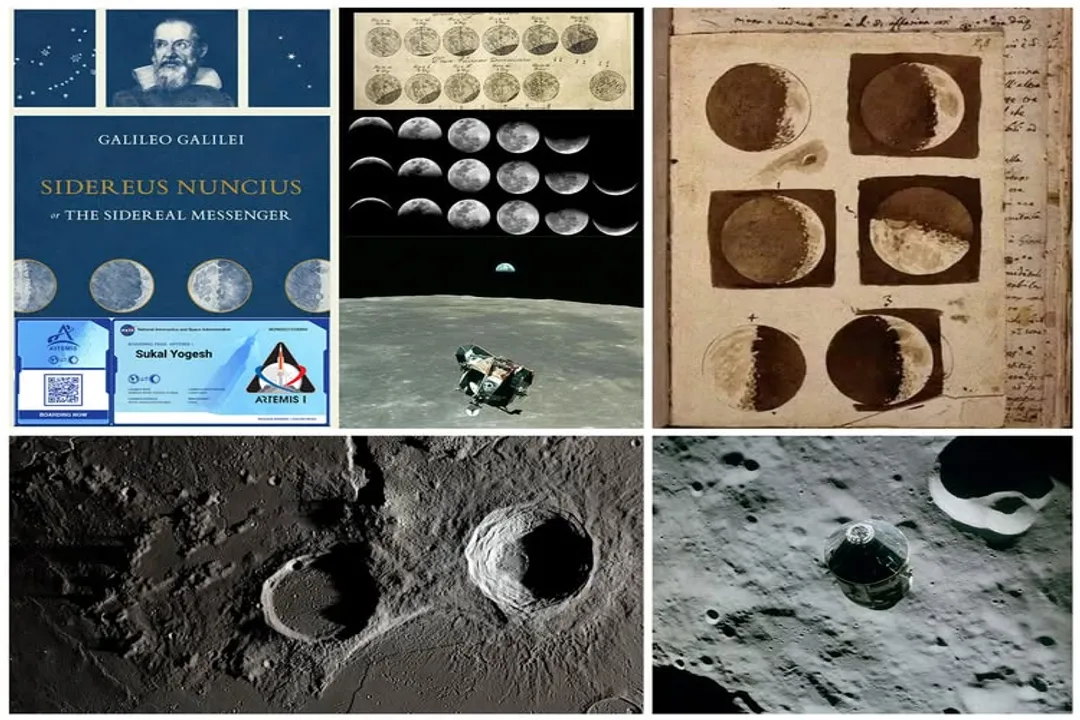
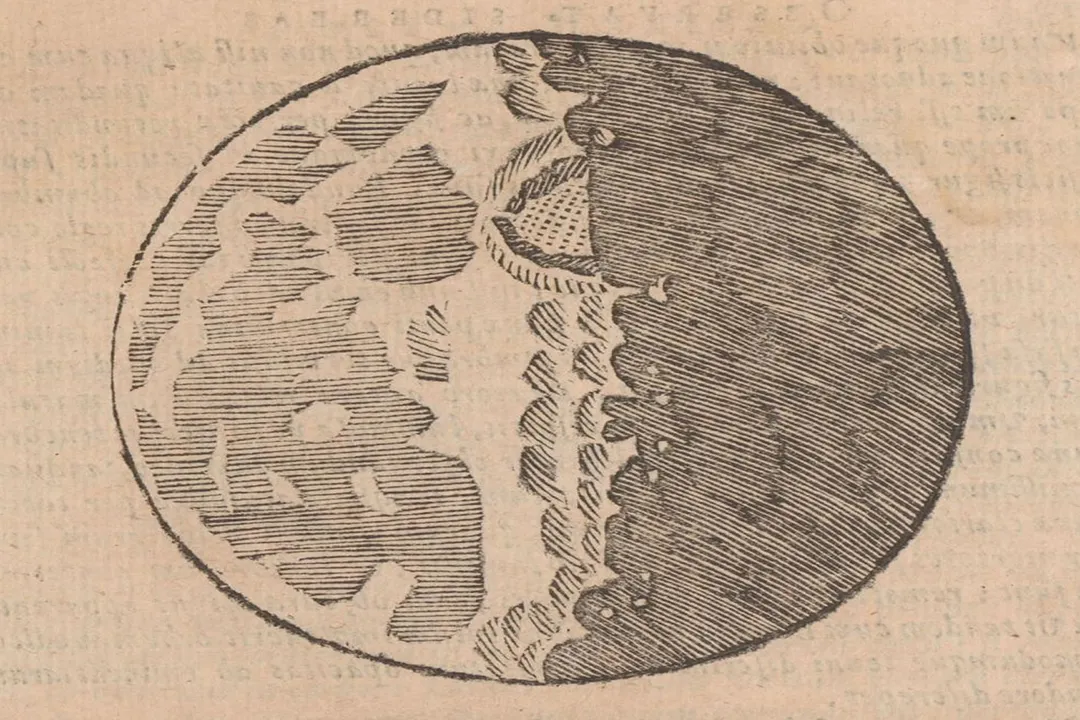
Galileo formally documented his stunning observations in a short treatise published in 1610 called Sidereus Nuncius (The Starry Messenger). This pamphlet was essential because it contained not only the textual descriptions but also the crucial drawings that illustrated what he saw. Later, in his Dialogue Concerning the Two Chief World Systems, he revisited and further elaborated on these early findings.
The drawings were themselves a form of description—a visual language attempting to convey a phenomenon never before witnessed. They showed the rough outline of the Moon, peppered with spots and streaks corresponding to the features he detailed, serving as visual proof that the concept of a smooth, crystal sphere was obsolete. The speed with which Sidereus Nuncius was published and disseminated across Europe speaks to the perceived importance of these initial lunar sketches and descriptions.
The immediate impact of his description highlights a significant challenge in scientific communication: describing the unprecedented. Galileo had to find language familiar to his readers—mountains, valleys, shadows—to explain features that existed outside their observational experience. This reliance on familiar terrestrial terms was necessary for the idea to take hold, even though the scale and environment were alien.
Thinking about Galileo’s context, it is fascinating to consider how much the tool dictated the description. His telescope, while groundbreaking for the time, had a very narrow field of view and limited resolving power compared to modern instruments. Therefore, his description was one of large-scale features—the major contrast between light and dark areas and the concept of peaks casting long shadows—rather than the intricate detail of smaller craters we see today. He saw the forest, not every single tree, and that was enough to overturn an established worldview.
Furthermore, the philosophical inertia Galileo was fighting was immense. When he wrote that the Moon was "like the Earth, full of irregularities," he wasn't just describing bumps; he was asserting a physical and ontological equality between the heavens and Earth that had been forbidden by dogma for centuries. The description of mountains becomes less about geology and more about theology and cosmology at that moment in history.
# View Impact
Galileo’s description of a rugged, imperfect Moon had profound, cascading effects that went far beyond astronomy. It provided concrete, repeatable evidence that challenged the established cosmic order. If the Moon was imperfect, then the supposed perfection of the heavens was an illusion, suggesting that the laws governing Earth might also apply to the celestial realm.
This observation was instrumental in validating the heliocentric model proposed by Copernicus, as it chipped away at the core assumption that the Earth was unique and fundamentally separate from the planets. A textured, Earth-like Moon was a much better companion for an Earth that was itself moving through space. The description of the Moon's surface thus became a cornerstone for modern physical science, shifting the study of nature from deductive reasoning based on ancient texts toward inductive reasoning based on empirical evidence.
The fact that Galileo observed these features starting around November 1609 and rapidly published his findings in early 1610, sometimes sharing initial observations in private correspondence before the formal publication, shows an understanding of the importance of establishing priority in discovery. He knew that claiming the Moon was rough was not enough; the visual proof had to be captured and disseminated quickly to assert his authority in this new field of observation. His commitment to documenting the visual evidence, warts and all—the imperfections of his own instrument included—is what cemented his description in history. The Moon, thanks to Galileo, ceased being a symbol of ethereal perfection and became, instead, a tangible world waiting to be explored.
#Videos
What Did Galileo Discover About The Moon's Surface? - YouTube
#Citations
The Galileo Project | Science | Moon
Galileo's Observations of the Moon, Jupiter, Venus and the Sun
How Galileo Discovered Mountains On The Moon - Forbes
Galileo's moon observations paved the way for space exploration
TIL Galileo was the first to confirm the Moon's rough and ... - Reddit
The Moon in Sidereus nuncius and the Dialogue – ETH Library
Galileo begins observing the moon | November 30, 1609 - History.com
What Did Galileo Discover About The Moon's Surface? - YouTube