How did Galileo find Jupiter's moon?
The night sky, for centuries, had been interpreted through a very specific lens: everything visible orbited the Earth. This geocentric view, formalized by Ptolemy and Aristotle, was the cornerstone of both scientific understanding and religious doctrine across Europe. When Galileo Galilei turned his improved spyglass toward Jupiter in early January 1610, he was not seeking to overturn this world order; he was simply following his curiosity about the heavens, an endeavor made possible by a technology that was, at the time, brand new. [1][2]
# Instrument Refinement
Galileo did not invent the telescope, but he rapidly became its master craftsman and most effective user. [2] After hearing reports of a Dutch device that made distant objects appear closer, Galileo acquired one and immediately set about making substantial improvements. [6] The original Dutch instruments typically offered only about three-power magnification. Galileo, through ingenious grinding and lens placement, managed to increase this magnification to perhaps twenty or thirty times. [2] This refinement was the absolute prerequisite for his discovery. Without the increased clarity and power, the faint pinpricks of light next to Jupiter would have remained invisible, lost in the glare of the brighter planet. [7]
It is worth noting that others had pointed rudimentary telescopes at the heavens before him. However, what separated Galileo was his systematic approach. A casual glance might reveal something unusual, but only persistent, dedicated observation could reveal the nature of those observations. [5] He recognized that this new instrument offered an unprecedented window, and he applied an intense, scientific discipline to what he saw, charting the movements with meticulous care. [2][5]
# Celestial Tracking
The process of discovery was not a single 'eureka' moment, but rather a patient accumulation of data over several nights. [1][5] On January 7, 1610, Galileo first observed Jupiter accompanied by three small, bright objects arranged in a straight line. [1][4] Because he was observing them through a telescope, he initially recorded them as fixed stars associated with Jupiter, believing them to be much farther away than the planet itself. [1]
Over the next few nights, Galileo continued his observations, diligently recording the position of Jupiter relative to these "stars". [5] He noted that sometimes one or two of the objects were on one side of the planet, and sometimes they were on the other. [1] Crucially, on some nights, one or more of the companions seemed to vanish entirely, only to reappear later. [2] A casual observer might have dismissed a disappearing light as an optical fluke or a passing cloud; Galileo, armed with his charting data, saw a pattern. [5]
The sheer discipline required to chart these objects over several days, distinguishing them from background stars or simple visual anomalies, stands in stark contrast to modern sky surveys which can detect thousands of objects instantly. It was this sustained persistence, not just the possession of the instrument, that delivered the scientific proof. [5] He realized that these objects moved with Jupiter, swinging back and forth around it. [1][2]
# The Shift
By the time he had observed the pattern for over a week, the inescapable conclusion formed in his mind: these were not background stars that happened to align with Jupiter. [5] They were orbiting the planet itself. [1][4] This was a revolutionary idea. The established framework held that everything revolved around the Earth. [4][9] If Jupiter possessed its own satellites, then the Earth was not the center of all celestial motion. [9]
This discovery—that a large body in the heavens had smaller bodies orbiting it—provided powerful, tangible evidence supporting the heliocentric, Sun-centered model proposed earlier by Nicolaus Copernicus. [9] Galileo did not just see new things; he had to fundamentally re-conceptualize what celestial bodies were physically capable of doing, shattering the ancient assumption that only Earth had companions. [1][9] He eventually spotted a fourth object on March 2, 1610, bringing the total visible companions to four. [1][3]
| Date of First Observation (Approximate) | Initial Appearance |
|---|---|
| January 7, 1610 | Three "stars" observed near Jupiter [1] |
| Early February 1610 | One moon occasionally hidden/obscured [2] |
| March 2, 1610 | The fourth moon was confirmed [1][3] |
# Publication and Patronage
Galileo recognized the immense significance of his findings and the need to publish quickly before others might replicate the observation and claim the credit. [2] In March 1610, just months after his initial sighting, he published his findings in a short treatise titled Sidereus Nuncius, or The Starry Messenger. [1][2] This short work announced the discovery of Jupiter’s moons, the rugged, mountainous nature of our own Moon, and the hidden stars of the Milky Way. [2]
In a move blending scientific advancement with political maneuvering, Galileo named the four new bodies the Medicean Stars, dedicating them to his patron, Cosimo II de' Medici, the Grand Duke of Tuscany. [1][3] This secured him patronage and protection, which were essential given the controversial nature of challenging established cosmology. [2] While this political naming served its immediate purpose, the names fell out of common use over time. Today, we universally refer to these four primary satellites as the Galilean moons in honor of their discoverer. [3]
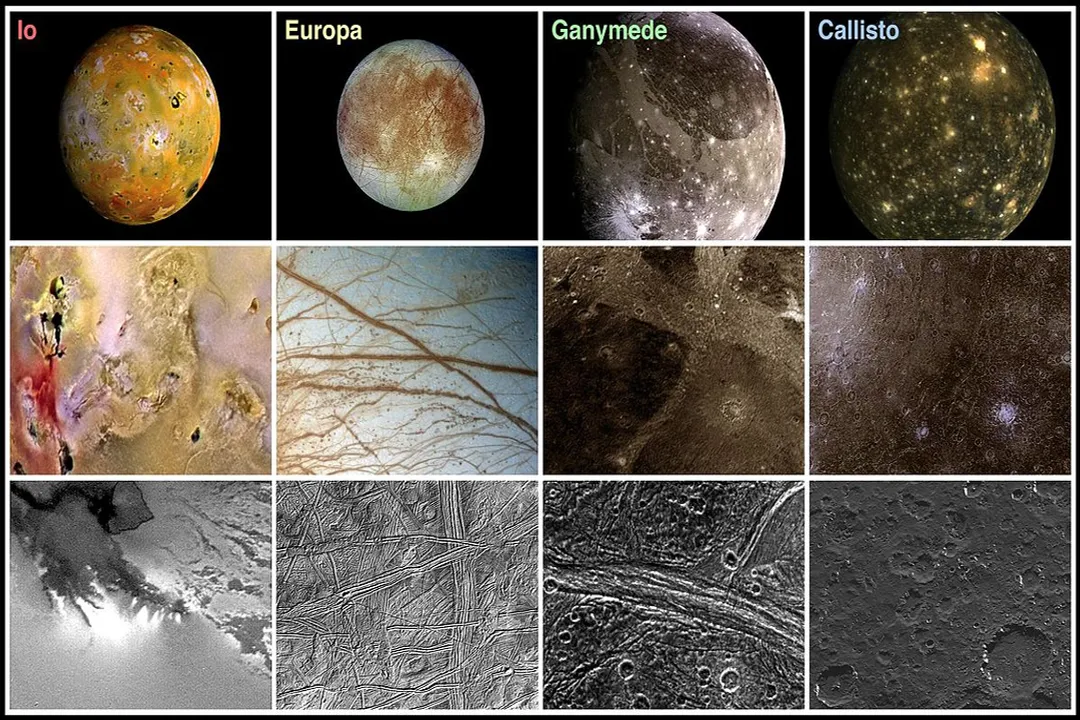
The moons were Io, Europa, Ganymede, and Callisto, though Galileo never knew their individual chemical makeup or true scale; he only saw bright points of light indicating orbital mechanics. [3] His discovery signaled the true beginning of modern observational astronomy, transforming the telescope from a curiosity into an essential scientific instrument and irrevocably altering humanity's place in the cosmos. [4][9]

# Seeing Today
The discovery remains one of the most important moments in the history of science, definitively demonstrating that not every celestial object orbits the Earth. [9] While Jupiter is bright enough to be seen with the naked eye as a star-like point, its four largest moons are far too faint to be resolved without optical aid. [7] Even when pointing a telescope toward the planet, the moons appear as tiny specks of light, often requiring one to be patient and chart their positions over several evenings to confirm they are indeed accompanying Jupiter, just as Galileo did over four centuries ago. [7] The modern observer, using far more powerful equipment, can confirm the positions in moments, but the foundational scientific victory belongs entirely to the meticulous observations made with that improved spyglass in the winter of $1610$. [2][5]
#Citations
Galileo Discovers Jupiter's Moons - National Geographic Education
410 Years Ago: Galileo Discovers Jupiter's Moons - NASA
Galilean moons - Wikipedia
We figured out exactly what Galileo saw when he discovered the ...
Galileo: Discovering Jupiter's Moons | PBS LearningMedia
[PDF] In the Footsteps of Galileo: Observing the Moons of Jupiter
How were Jupiter's moons discovered? Can they be seen ... - Quora
Galileo's Discovery of Jupiter's Moons - Facebook
Galileo's Discovery Of Jupiter's Moons, And How It Changed The ...