Which statement best describes Earth?
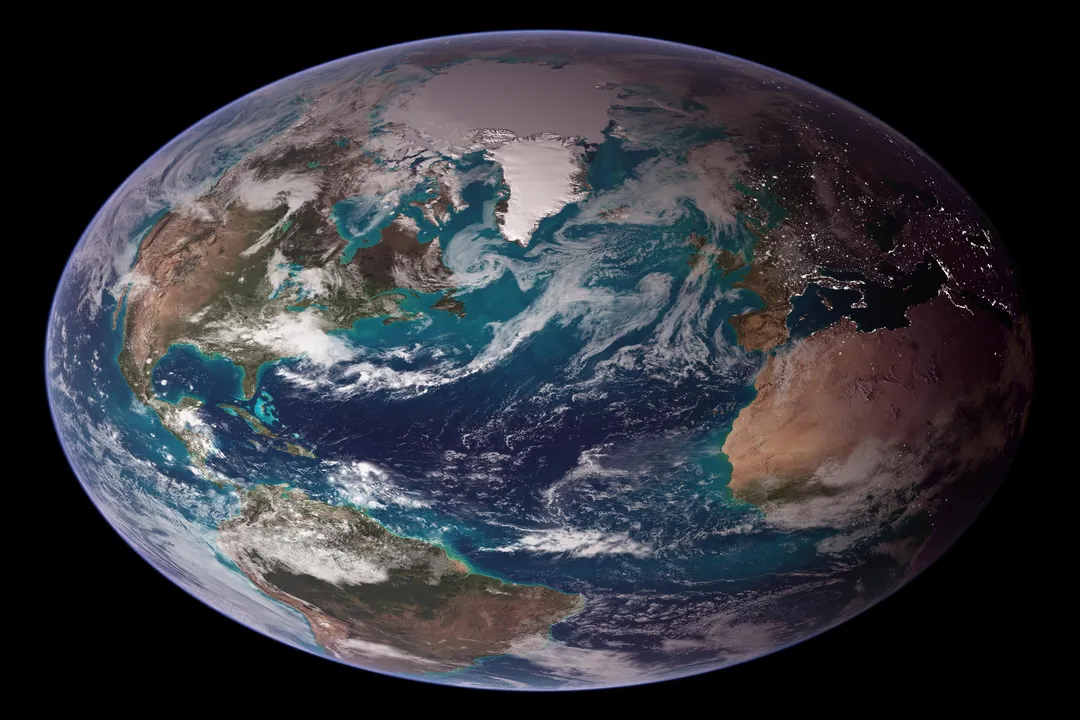
The statement that best describes our planet is a complex one, encapsulating its unique physical structure, chemical composition, and its singular distinction as a habitat. Earth is fundamentally a terrestrial world, positioned as the third planet orbiting our star, the Sun. [2][4] While simple descriptions might label it as "a large rock in space," a more accurate portrayal involves understanding its deep internal architecture and the delicate balance of its surface environments. [5]
# Planetary Position
Earth holds a very specific address in the solar system, being the third rock from the Sun. [2][4] This orbital distance places it within the habitable zone, a concept crucial to its very existence as we know it. It is the largest of the four inner, or terrestrial, planets—Mercury, Venus, Earth, and Mars—which are primarily composed of rock and metal. [4] Overall, however, when compared to the gas giants further out, Earth ranks as the fifth largest planet in the entire solar system. [2] This positioning allows for the presence of liquid water on the surface, a feature so rare and essential that it immediately sets our world apart from its neighbors. [4] Furthermore, its rotational axis is tilted, a factor that dictates the changing seasons experienced across its surface. [2]
# Internal Structure
To truly understand Earth, one must look far beneath the surface. The planet is organized into distinct layers, a fundamental characteristic derived from its formation and ongoing geological processes. [6] This layered arrangement includes the crust, the mantle, the outer core, and the inner core. [6][9]
The crust is the thin, rocky shell upon which all life exists and interacts with the planet's geology. [9] Directly underneath this surface layer lies the thick mantle. [6] Deeper still, the planet’s interior transitions into the core, which is itself divided into two parts. The outer core is composed of liquid metal, constantly in motion. [6] This churning, molten layer is perhaps one of the most functionally important aspects of Earth's description, as this movement generates the planet's protective magnetic field. In contrast to the liquid metal surrounding it, the inner core remains solid due to immense pressure, despite being incredibly hot. [6][8] This differentiation into solid and liquid metallic layers, governed by temperature and pressure gradients, describes a dynamic internal engine that shapes surface conditions over geological timescales. [6] Considering the vast volume occupied by the mantle compared to the thinness of the crust, it's remarkable how much of Earth's mass is locked into these deeper, hotter regions that are inaccessible to us. [1][6]
# Surface Spheres
The definition of Earth is incomplete without acknowledging the interacting systems that blanket its rocky interior. These systems involve the cycling of matter and energy across the planet's surface and atmosphere. [5] Scientists often describe Earth by these major components: the lithosphere (the solid, rocky part), the hydrosphere (all the water), the atmosphere (the gaseous envelope), and the biosphere (all living things). [5]
The presence of water is a defining characteristic. Earth is often described as the Blue Planet because of the vast amounts of liquid water covering its surface. [4] This liquid water is critical, contrasting sharply with the more volatile or frozen states found elsewhere in the solar system. The interplay between the solid lithosphere, the fluid hydrosphere, and the gaseous atmosphere creates the conditions necessary for biology to thrive. [5] It is this complex interaction—where the planet’s interior heat drives plate tectonics in the lithosphere, influencing ocean currents in the hydrosphere, which in turn moderates the temperature controlled by the atmosphere—that defines Earth’s environmental stability. [5]
# Atmosphere and Moon
Earth’s gaseous layer is equally defining. The atmosphere is not merely a collection of gases; it is a specific mixture that sustains our biology. [4] It is primarily composed of nitrogen and oxygen. [4] This specific composition, particularly the high concentration of free oxygen, is a direct result of biological activity over billions of years, a clear marker separating Earth from other planetary bodies. [5]
Another essential component of Earth's description is its solitary companion: the Moon. [2][4] Earth possesses only one natural satellite. [2][4] The Moon's gravitational influence is significant, playing a role in stabilizing Earth's axial tilt, which helps maintain relatively consistent seasonal variations over long periods. A planet with no moon, or multiple small moons, would experience far more chaotic long-term climate shifts.
# The Life Imperative
When synthesizing all these descriptive elements—a terrestrial world, third from the Sun, layered interior, abundant liquid water, nitrogen-oxygen atmosphere, and a stabilizing moon—the most compelling statement remains its biological status. Earth is, uniquely, the only known world confirmed to harbor life. [4]
If we were to create a functional description based on what makes Earth work for us, we might focus on this energy flow. Life exists because the planet constantly receives energy from the Sun, which is then processed and recycled through the various spheres. [5] The fact that the liquid outer core generates a magnetic field helps shield the atmosphere from solar wind stripping, preserving the conditions that allow the biosphere to flourish within the protection of that atmosphere. [6] Therefore, the best description moves beyond simple physical dimensions; it is a description of a system where geology, water, atmosphere, and energy converge to produce biology. [5] Earth is not just a planet; it is a complex, self-regulating environment where the internal engine supports an external biological community. [4]
A brief comparison helps solidify this description. While Mars is also a terrestrial planet, it lacks a substantial magnetic field, lost most of its water, and has a thin atmosphere dominated by carbon dioxide. [4] Venus, Earth’s neighbor, is similar in size but suffers from a runaway greenhouse effect, making its surface environment utterly hostile. [4] Earth’s description hinges on being the Goldilocks planet: the right size, the right composition, and the right distance to maintain a stable interface between its interior heat and external solar energy for liquid water to persist. [2][4] This persistent liquid state, powered by an active interior, is arguably the single most crucial descriptive feature distinguishing Earth from any other body we observe. [6]
#Videos
What On Earth: Crash Course Kids #10.1 - YouTube
Related Questions
#Citations
Which statement describes Earth? A. It is an outer planet. B ... - Brainly
Earth Science Final Flashcards - Quizlet
Facts About Earth - NASA Science
The Earth's Layers Lesson #1 | Volcano World
What On Earth: Crash Course Kids #10.1 - YouTube
Which statement best describes Earth's outer layer underneath ... - Filo