What will a high-mass star become?
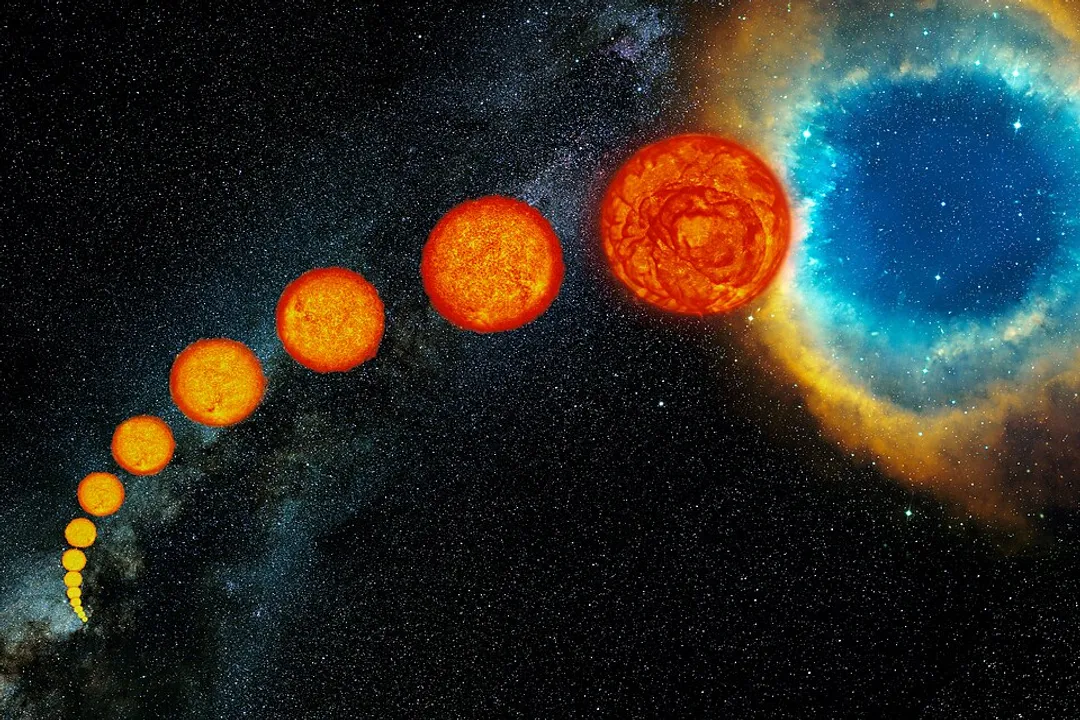
The fate of a star is written in its mass. While stars like our Sun follow a relatively serene path toward a quiet end as a white dwarf, the cosmos reserves a far more spectacular, violent destiny for its most massive stellar residents. These giants, holding many times the mass of the Sun, live fast and die young, concluding their existence in cataclysmic explosions that shape the very structure of galaxies.[1][3]
# Defining Mass
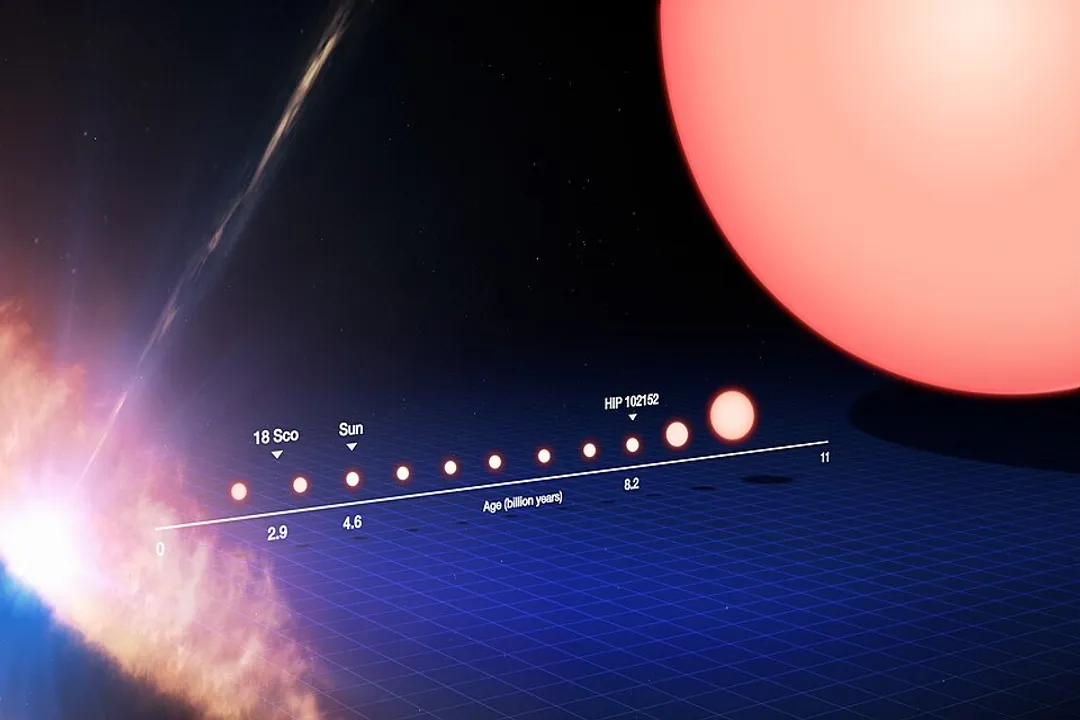
In astronomy, a star is generally categorized as "high-mass" if its initial mass is greater than about eight times the mass of our Sun—often written as . [2] These are not the most massive stars in the universe, which can exceed , but they represent a distinct class that does not share the relatively peaceful demise of Sun-like stars. [1][9] The sheer gravitational force exerted by this enormous amount of material compresses the core to incredibly high temperatures and densities almost immediately after birth. [2]
# Fuel Burn Rate
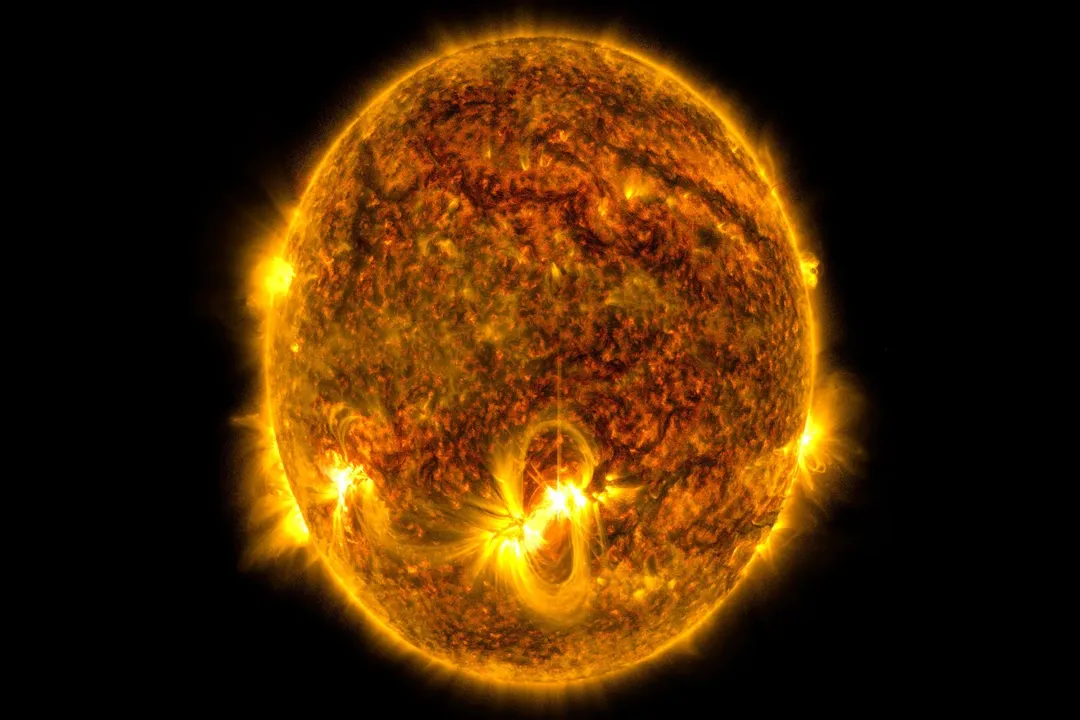
The tremendous mass of these stars dictates a drastically different life expectancy. While a low-mass star like the Sun can happily fuse hydrogen into helium in its core for billions of years, a high-mass star burns through its nuclear fuel at an alarming pace. [2][3] This is because the intense gravity creates immense pressure, heating the core far beyond what is needed for simple hydrogen fusion. [2]
This accelerated consumption is not just a matter of having more fuel; it is about the rate at which that fuel is converted into energy. A low-mass star has a gently stoked wood fire, burning steadily for eons, warming its surroundings over vast timescales. Conversely, a high-mass star is like a massive industrial furnace running perpetually at maximum capacity; it produces enormous energy output—making it incredibly luminous and hot—but it consumes its fuel supply far more rapidly as a direct consequence of maintaining that intensity. [4] Consequently, these stellar behemoths might only last for a few million years, a mere cosmic blink compared to the Sun's billion year lifespan. [2][4]
# Core Evolution
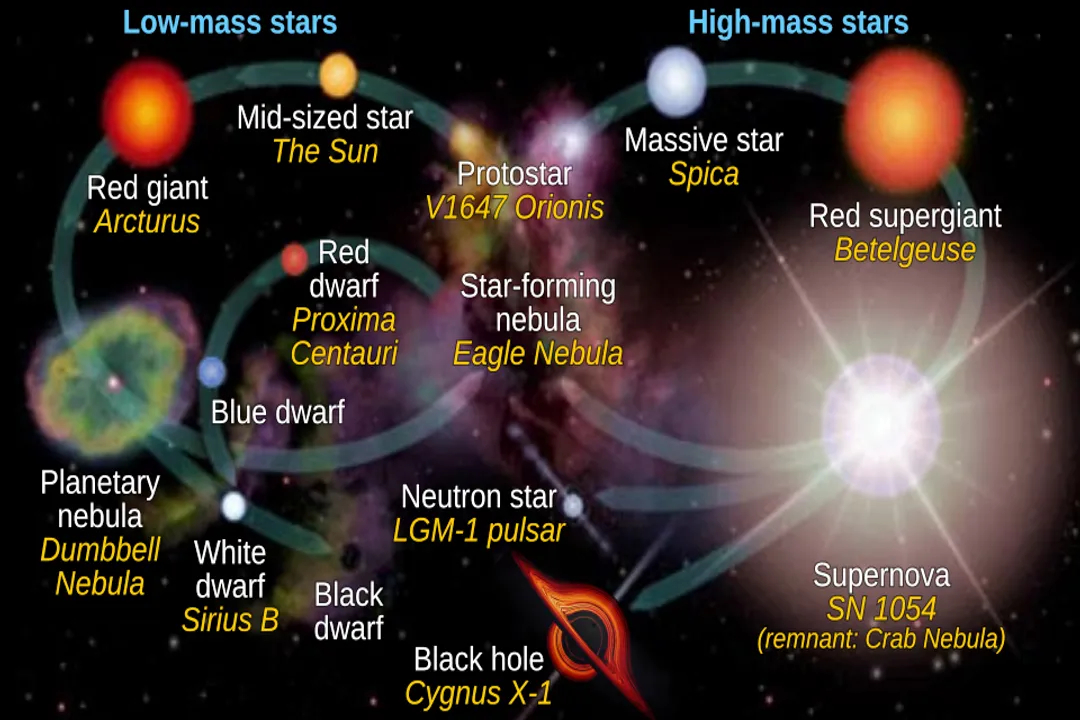
Once the hydrogen fuel in the core is exhausted, the star's evolution accelerates dramatically. For a low-mass star, the core contracts, heats up, and the star enters the Red Giant phase, slowly expanding while hydrogen fusion continues in a shell around the helium core. [9] High-mass stars, however, move through subsequent fusion stages in rapid succession because their cores reach the necessary temperatures and pressures to ignite heavier elements much sooner. [8]
This process involves the successive burning of heavier and heavier elements in nested shells around the center:
- Hydrogen fuses to Helium.
- Helium fuses to Carbon.
- Carbon fusion produces Neon and Magnesium.
- Neon fuses into Oxygen.
- Oxygen fuses to Silicon.
- Finally, Silicon fuses into Iron. [8]
The time spent in these later stages is incredibly short. While the hydrogen-burning phase might last millions of years, the silicon-burning phase might last only a day or two. [8] This is why a star massive enough to fuse elements up to silicon essentially "dies" in a matter of hours once that final fuel begins to ignite. [8]
# Final Collapse
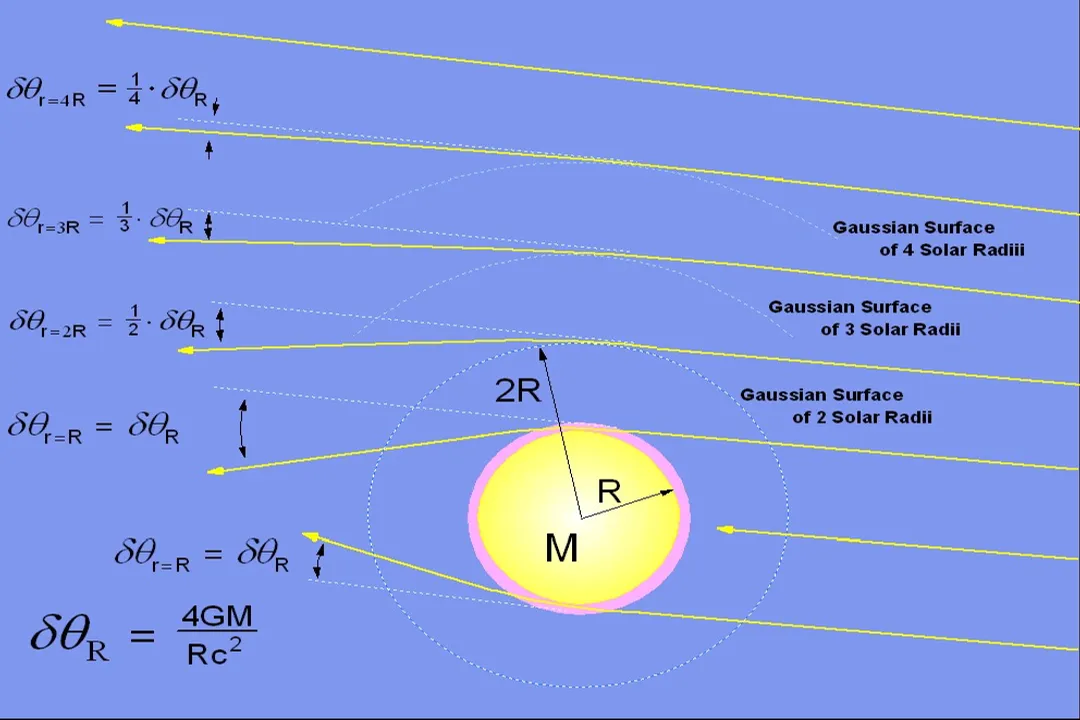
The element iron marks the absolute end of the line for stellar energy production. Fusing iron nuclei does not release energy; instead, it consumes energy (it is an endothermic process). [8] When the core is entirely converted to inert iron, the outward pressure generated by nuclear fusion abruptly ceases. Without this force to counteract the crushing weight of the star's outer layers, gravity wins instantly. [8]
The core collapses inward at immense speeds, reaching up to 70,000 kilometers per second, or about 23% of the speed of light. [6] As the core contracts, it compresses to densities far exceeding an atomic nucleus, creating a stiff core known as a protoneutron star. [8] This rapid implosion causes the overlying layers to bounce violently off this incompressible core, triggering the spectacular explosion known as a Type II Core-Collapse Supernova. [1][6] The energy released during this explosive death event can briefly outshine entire galaxies. [3]
It is interesting to note the timeline here. While a low-mass star might spend billions of years gently expanding into a Red Giant phase, the high-mass star's transition from silicon burning to the final core collapse and subsequent supernova can happen in the span of a few hours or even less, illustrating an extreme contrast in evolutionary timescales driven entirely by the initial mass of the stellar object. [8]
# Remnant Objects
The aftermath of a supernova is one of two exotic objects, depending on how much mass remains after the explosion. This remnant mass determines whether the star leaves behind a neutron star or collapses entirely into a black hole. [1][6][8]
# Neutron Stars
If the initial mass of the star was large, but not excessively large (generally thought to be stars beginning around to perhaps to ), the core collapse halts when the pressure from neutron degeneracy is sufficient to resist further gravity. [8] This results in a neutron star—an object so dense that a teaspoon of its material would weigh billions of tons. [1] Neutron stars are supported by the resistance of densely packed neutrons against further compression. [8]
# Black Holes
When the progenitor star is among the universe's true heavyweights (often exceeding or so), the mass of the collapsing core is so great that even neutron degeneracy pressure cannot stop the collapse. [8] The core shrinks indefinitely, compressing into a singularity, warping spacetime so severely that nothing, not even light, can escape its gravitational pull, forming a black hole. [1][6] This endpoint represents the most extreme gravitational outcome possible for a collapsing star. [8]
The spectacular death of a high-mass star is not just an end, but a fundamental part of cosmic recycling. These supernovae are the universe’s primary mechanism for creating and dispersing all elements heavier than iron out into the interstellar medium, seeding the next generation of stars and planets with the building blocks necessary for chemistry and life. [1][3]
#Videos
High Mass Stars: Crash Course Astronomy #31 - YouTube
#Citations
High mass star - Las Cumbres Observatory
The Lives of High Mass Stars - NMSU Astronomy
Star Basics - NASA Science
eli5 why do high-mass stars live for a shorter period of time than low ...
High Mass Stars: Crash Course Astronomy #31 - YouTube
High-Mass Stars | AMNH
Can a massive star become a red giant more than once?
[PDF] High Mass Stars
Stellar evolution - Wikipedia