What type of star remains after a supernova?
The dramatic death of a massive star, known as a supernova, is one of the universe's most energetic events, briefly outshining entire galaxies. Yet, this spectacular cosmic fireworks display is not the end of the story for the star itself; it is, in fact, the violent birth announcement for an exotic stellar corpse left behind at the center of the explosion. What remains hinges almost entirely on the initial mass of the progenitor star, a factor that determines whether the final product is a compact stellar relic or something even more mysterious.
# Stellar Fate Decided
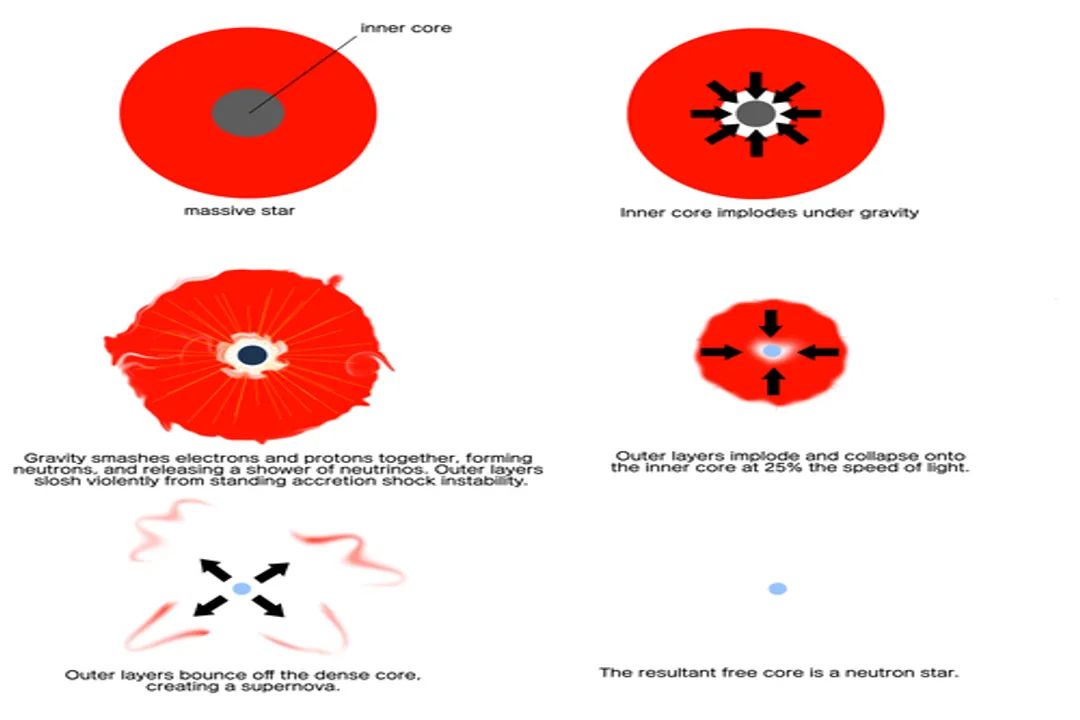
When a star exhausts its nuclear fuel, its core, unable to support itself against the crushing force of gravity, collapses catastrophically. This collapse triggers the brilliant rebound explosion we observe as a supernova, but the debris rushing outward doesn't carry all the original mass away.
The key determining factor for the remnant is the mass of the remaining core after the outer layers have been ejected. If the core mass is relatively low—somewhere in the range of about 1.4 to 3 solar masses, though precise boundaries are still refined—the collapse is halted by neutron degeneracy pressure. This results in the creation of a neutron star.
However, if the core mass exceeds this upper threshold, often estimated around 3 solar masses, even the degeneracy pressure of neutrons is insufficient to resist gravity. In this scenario, the collapse continues indefinitely, leading to the formation of a black hole. Stars that undergo a Type Ia supernova, which involves a white dwarf reaching a critical mass, typically lead to complete disruption rather than forming a distinct compact remnant like a neutron star or black hole, although some modern models suggest a possibility of a remnant in certain circumstances. For the purposes of the direct core-collapse scenario, the binary choice is a neutron star or a black hole.
# Neutron Star Properties
A neutron star is an object of staggering physical extremes. It is the densest known observable matter in the universe, packing more than the mass of our Sun into a sphere only about 20 kilometers across. To illustrate this compression, consider that the Sun is roughly a million times the volume of Earth; a neutron star packs that solar mass into a volume smaller than a typical city. If you could take just one teaspoon of neutron star material, it would weigh about a billion tons. This incredible density is achieved because the crushing gravity forces protons and electrons together to form neutrons.
This intense compression results in a surface gravity billions of times stronger than Earth's, meaning a small bump on the surface would create a mountain only a few centimeters high, but its gravitational pull would make that tiny irregularity feel immensely heavy. The core of a neutron star is thought to be composed of highly compressed neutrons, possibly interspersed with exotic states of matter like hyperons or quark matter, though the exact composition of the super-dense inner regions remains an active area of research.
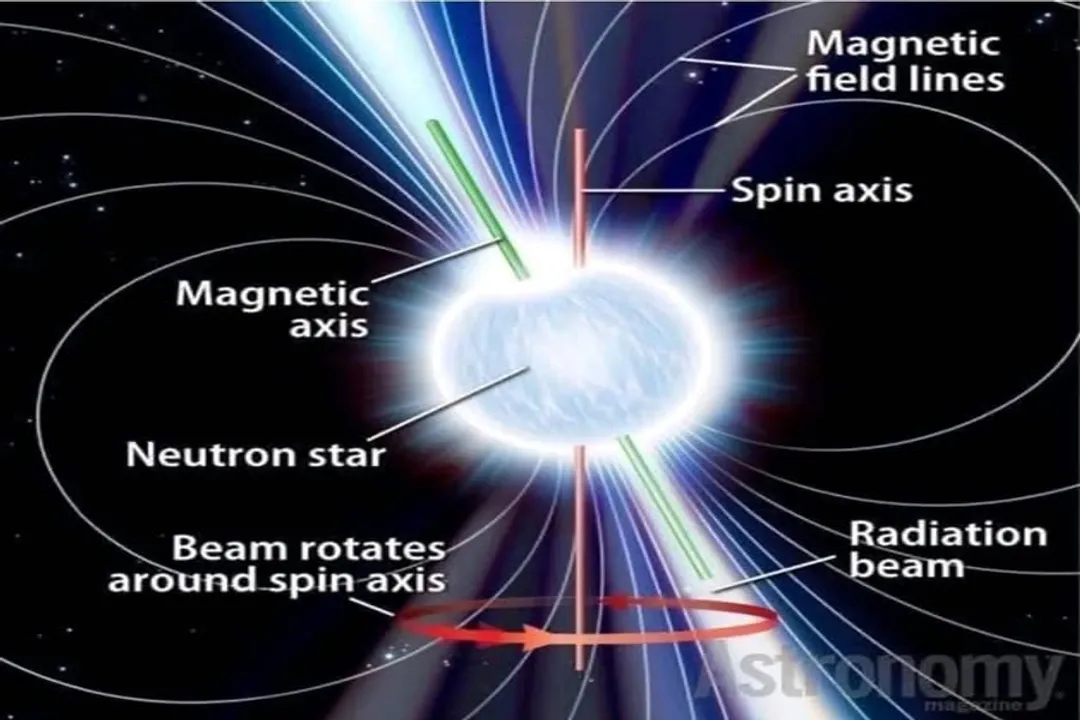
Neutron stars possess several other remarkable characteristics inherited from their massive progenitors. They spin incredibly fast, sometimes completing several rotations per second, due to the conservation of angular momentum during the collapse—just as an ice skater spins faster when pulling their arms in. Furthermore, they maintain an incredibly strong magnetic field, trillions of times stronger than Earth's, which can channel radiation into beams detectable across interstellar distances, giving rise to pulsars.
| Property | Typical Value | Comparison Point | Source Basis |
|---|---|---|---|
| Mass | Solar Masses | More massive than the Sun | |
| Diameter | Kilometers | Size of a major city | |
| Density | to | Billion tons per teaspoon | |
| Rotation Period | Milliseconds to Seconds | Extremely rapid |
# Observing the Aftermath
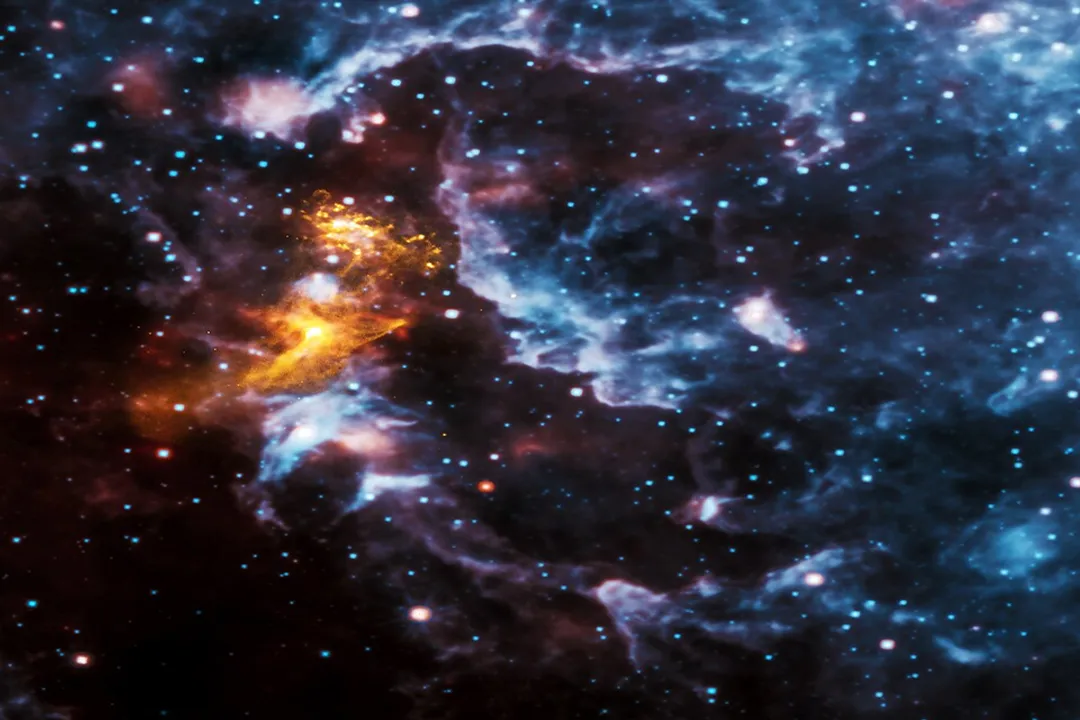
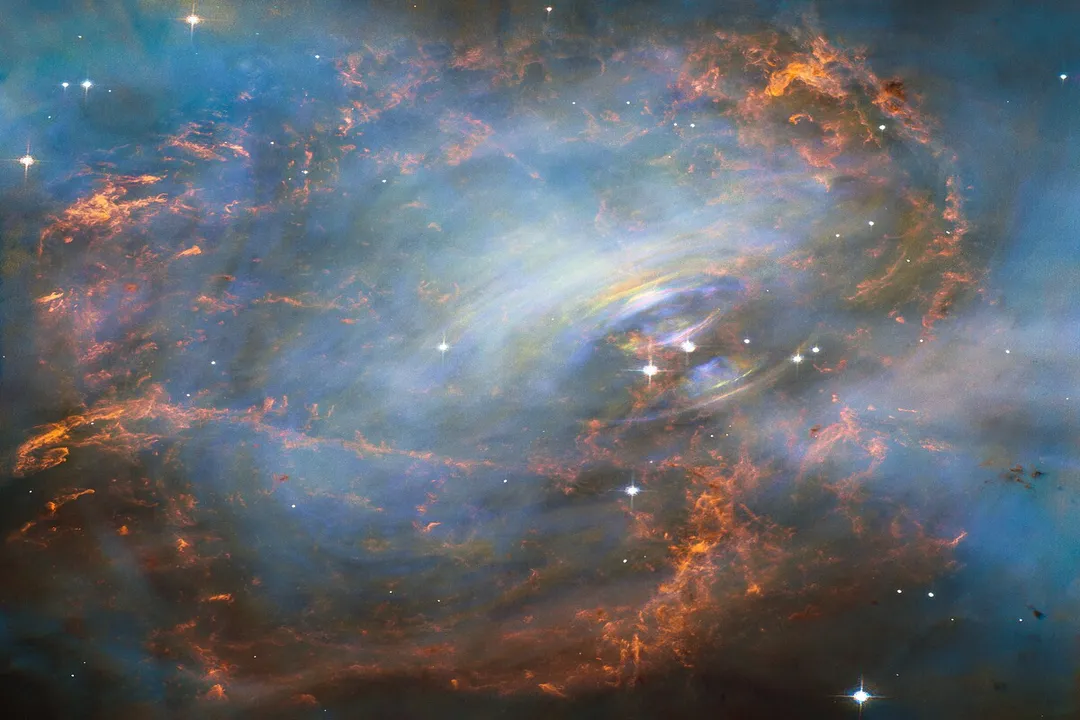
Distinguishing the newly formed stellar remnant from its immediate surroundings requires looking at different timescales. The supernova explosion itself disperses the star’s outer layers violently into space, creating a massive, expanding cloud of gas and dust known as a supernova remnant (SNR). These SNRs are visible for thousands of years, glowing brightly in X-rays and visible light as the shockwave interacts with the interstellar medium. For instance, the remnants of the supernova that created the Crab Nebula are still visible today.
The stellar remnant—the neutron star or black hole—sits at the center of this expanding shell. Finding the compact object itself can be more challenging. If the neutron star is rapidly rotating and its magnetic poles sweep a beam of radiation past Earth, we observe it as a pulsar. The process that forms these observable pulsars—the core collapse—must happen quite quickly, on the order of milliseconds, following the core implosion itself.
It is an interesting observation that while the expanding gas shell of an SNR can be easily photographed, like the Veil Nebula, the central engine is often hidden unless it happens to be a young, rapidly spinning pulsar. Therefore, when astronomers study a very young SNR, they are often observing the effect of the core collapse rather than the collapsed object directly, which might only be detectable through its gravitational influence or X-ray emission until it slows down enough to emit detectable pulsed radio waves. This difference in visibility between the ephemeral gas cloud and the persistent stellar core underscores the multi-stage nature of stellar death.
# Why Collapse Persists
A common point of confusion is why the matter remains collapsed in this hyper-dense state following such a colossal explosion. After all, the supernova is a massive outward push. The reason the core does not immediately re-expand lies in the extreme forces at play within the remnant.
The ordinary electron degeneracy pressure that supports a white dwarf is completely overwhelmed by the gravitational forces in a massive core collapse. The material is crushed down until the neutrons themselves resist further compression—this is the aforementioned neutron degeneracy pressure. This pressure is an effect of quantum mechanics, specifically the Pauli exclusion principle, which prevents identical neutrons from occupying the same quantum state in the same space. This force provides the necessary outward push to stabilize the star against further gravitational collapse, establishing the static, albeit tiny, structure of the neutron star. If the remnant is a black hole, this stabilization mechanism fails entirely, and gravity wins completely.
# Remnants Beyond Neutron Stars
While neutron stars are a fascinating and common outcome, the most massive stars end their lives differently, resulting in black holes. A black hole represents gravity's absolute victory over all known forms of matter and pressure. There is no known force that can halt the collapse once the core mass exceeds the threshold for neutron star formation. These objects warp spacetime so severely that nothing, not even light, can escape once it crosses the event horizon.
It is helpful to visualize the three primary stellar endpoints based on progenitor mass, acknowledging that the exact mass ranges are subject to ongoing refinement based on observational evidence:
- White Dwarf: Result from lower-mass stars (like our Sun) that shed their outer layers more gently or from Type Ia events. They are supported by electron degeneracy pressure.
- Neutron Star: Formed from core-collapse supernovae where the remnant core is between roughly 1.4 and 3 solar masses, supported by neutron degeneracy pressure.
- Black Hole: Formed when the remnant core exceeds approximately 3 solar masses, collapsing without limit.
Understanding which remnant forms is less about the supernova explosion itself and more about the star's state before the explosion—its initial mass and its binary companion situation, if any. The supernova is merely the mechanism that clears the way to reveal the final state of the core. The variety in outcomes speaks to the incredible range of physical parameters stars can achieve during their lives and deaths.
#Citations
Neutron star
Neutron Star
When Does a Neutron Star or Black Hole Form After ...
Neutron Stars
Neutron stars are incredibly dense remnants of massive stars
Since a supernova can leave behind a neutron star, does ...
Q & A: Supernova Remnants and Neutron Stars
Why does matter stay collapsed in the core, following a ...
What is the aftermath of a supernova? ...