Which type of star is best for life?
The character of a parent star dictates the fundamental conditions for any potential life evolving on its orbiting worlds. Finding a life-bearing planet isn't just about placing that world within the "Goldilocks Zone"—the region where liquid water can exist on the surface [4]—it is critically dependent on the star’s temperament, stability, and lifespan over cosmic timescales. [1][5] Astronomers are actively sorting through the stellar population, realizing that the most common stars might not be the best candidates, and that our own Sun may not represent the cosmic ideal. [7]
# Common Red Dwarfs
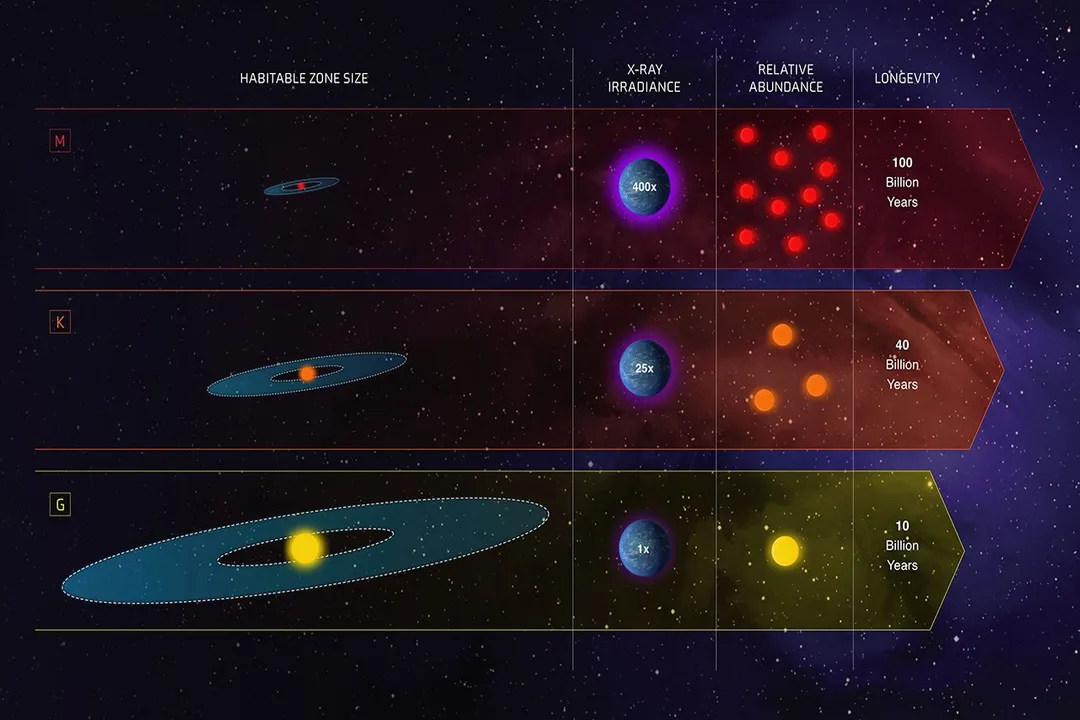
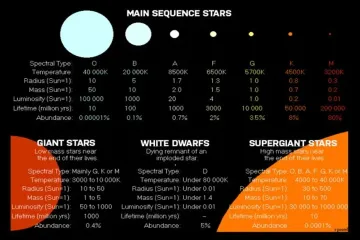
The galaxy is teeming with low-mass stars known as M-dwarfs, or red dwarfs. These are the smallest and dimmest true stars, but they are by far the most numerous stellar type found throughout the Milky Way. [5] Their primary attraction lies in their extreme longevity. While our Sun, a G-type star, has a lifespan of about 10 billion years, M-dwarfs can burn their fuel for trillions of years. [1][5] This vast expanse of time presents an unparalleled opportunity for evolution to proceed, perhaps giving biology the necessary eons to develop complexity. [5]
However, M-dwarfs come with serious trade-offs that complicate habitability assessments. Because they are faint, their habitable zones are extremely close to the star—often inside the orbit of Mercury in our own solar system. [1][2] This close proximity almost guarantees that any planet in that zone will become tidally locked, meaning one side perpetually faces the star in endless daylight, and the other is locked in eternal darkness. [1][2][5] While life could potentially survive in the temperate "terminator" zone between these extremes, [2] the more immediate threat is the star's instability. Many M-dwarfs, especially when young, are notorious for violently flaring, emitting powerful bursts of high-energy radiation that can strip away a planet's atmosphere or sterilize its surface. [1][5]
# Solar Baseline
Our Sun is a G-type main-sequence star, and it has proven perfectly capable of supporting life on Earth for billions of years. [7] It offers a stable, moderate output of energy, and its habitable zone is far enough out that Earth is not tidally locked, allowing for a global day/night cycle that aids in climate regulation. [5] Yet, when compared to other star types, the Sun's total operational time is relatively short in cosmic terms. [7] While 10 billion years seems ample, if the process that leads to advanced civilization requires 8 or 9 billion years, a G-type star leaves very little margin for error or extension. [5] Furthermore, as the Sun ages, it will expand into a red giant, rendering the inner solar system uninhabitable long before the star exhausts its fuel supply. [7]
# Orange Goldilocks
If M-dwarfs are too volatile and G-dwarfs are too short-lived for maximal evolutionary potential, the K-type stars, or orange dwarfs, often emerge as the premier candidates for hosting the best environments for long-term life. [1][9] These stars sit neatly between the M-dwarfs and the G-dwarfs in terms of mass and temperature. [8]
K-dwarfs share the M-dwarfs' primary advantage: longevity. They burn their fuel much slower than the Sun, boasting lifespans that can stretch for 20 billion to 70 billion years. [5][9] This longevity offers a significant temporal budget for evolution, far exceeding what the Sun provides. [1] Crucially, they also offer a greater degree of stellar peace. While they may exhibit flares, these events are generally less frequent and less intense than those seen around M-dwarfs. [9] Their habitable zones are situated farther out than those of red dwarfs, which means that planets orbiting within this zone are less likely to suffer from the devastating effects of tidal locking that plague M-star systems. [1] The combination of extended stability and orbital distance positions the K-type star as the "Goldilocks Star" when considering the longest possible duration for complex biological development. [1][9]
For the sake of clarity in comparing the main contenders for long-term habitability, here is a summary of their defining characteristics relative to hosting life:
| Star Type | Spectral Class | Relative Abundance | Lifespan (Approx.) | Habitability Challenge |
|---|---|---|---|---|
| Red Dwarf | M | Very High | Trillions of years | Intense flaring, tidal locking [1][5] |
| Sun-like Star | G | Moderate | ~10 Billion years | Limited total evolutionary time [7] |
| Orange Dwarf | K | Moderate | 20–70 Billion years | Optimal balance of longevity and stability [9] |
# Orbital Factors
The relationship between the star and its planet’s orbit introduces dynamic constraints on habitability that are directly linked to the star's type. For the M-dwarfs, the necessity of orbiting close to the star to remain warm enough for liquid water dictates the tidal locking problem. [1] This locking creates conditions where heat transport from the day side to the night side must be managed by the planet’s atmosphere or oceans, which is a major hurdle for climate stability. [2]
When assessing a planet around a K-star, the habitable zone tends to fall at an orbital distance where the planet can maintain a rotational period similar to Earth’s, avoiding the permanent searing or freezing inherent to tidal locking. [1] This distance also means the planet receives less high-energy radiation compared to an M-dwarf world receiving the same amount of total energy (insolation) required for liquid water. The lower energy profile of K-stars means their habitable zone planets are receiving proportionally less of the star's higher-frequency UV and X-ray output, allowing for better atmospheric retention over billions of years. [8]
# Stellar Tradeoffs
The choice of the "best" star is inherently a weighing of two competing priorities: time versus tranquility. M-dwarfs offer almost infinite time for life to arise, but present a harsh, volatile environment during those early eras. [1][5] K-dwarfs, conversely, offer a generous stretch of time—significantly more than our Sun—coupled with a significantly calmer disposition than the fainter red dwarfs. [9]
If we consider the amount of energy required to catalyze the initial steps toward abiogenesis—the beginning of life—the Sun's output is sufficient for Earth. [7] However, if we assume that complex, intelligent life requires a far longer incubation period, perhaps spanning many billions of years of stable environmental conditions, the K-type star appears superior. It provides a high degree of both longevity and stability, suggesting a safer environment over the multi-billion-year timescales likely necessary for major evolutionary leaps to occur. [9] The search for life, therefore, might be best focused on these orange-hued systems, as they seem to offer the longest runway with the fewest catastrophic stop signs along the way. [1]
#Videos
These Are The Best Stars to Find Potentially Habitable Earth Like ...
Related Questions
#Citations
Goldilocks Stars Are Best Places to Look for Life - NASA Science
Which type of star is the most habitable? : r/askastronomy - Reddit
The Perfect Stars to Search for Life On Their Planets - Universe Today
These Are The Best Stars to Find Potentially Habitable Earth Like ...
What star type is most optimal for hosting life on its planets? - Quora
Astronomers Identify Another Crucial Aspect for Planets to Support Life
Our Sun Is Not an Optimal Star to Support Life - RealClearScience
Goldilocks stars are best places to look for life - Phys.org
'Orange dwarfs' may be the best stars to study in search for life | Space