What stars are most likely to support life?

The search for life beyond Earth inevitably leads us to the stars, the energy engines around which habitable worlds must orbit. With billions of stars populating our galaxy alone, the real question isn't if other life-bearing planets exist, but where to point our best telescopes. Understanding what makes a star a good candidate for supporting life involves looking at its size, temperature, stability, and, crucially, how long it intends to shine.
# Water's Domain
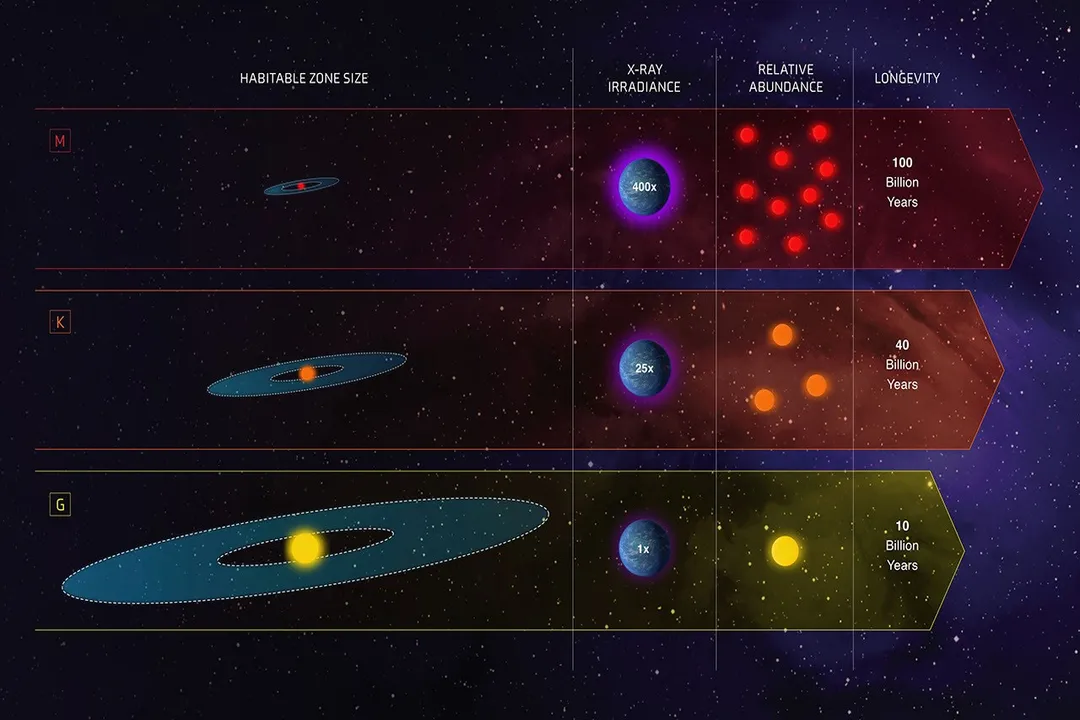
At the heart of the search lies the concept of the habitable zone (HZ), often nicknamed the "Goldilocks Zone". This is not a fixed location but a region around any star where the temperature is just right—not too hot, not too cold—to allow liquid water to pool on a planet’s surface. Liquid water is considered the bedrock for life as we understand it, making the star's energy output the primary factor in defining this orbital sweet spot.
A star that is too luminous will push the HZ far out, requiring a planet to orbit at a distance where it might still be too warm, or the required orbit might be too fast for stable conditions. Conversely, a dim star tucks its HZ very close, which can expose orbiting planets to tidal locking—where one side perpetually faces the star, creating extreme temperature gradients. Therefore, the star’s characteristics directly dictate the location and width of this critical life-supporting band.
# Stellar Classifications
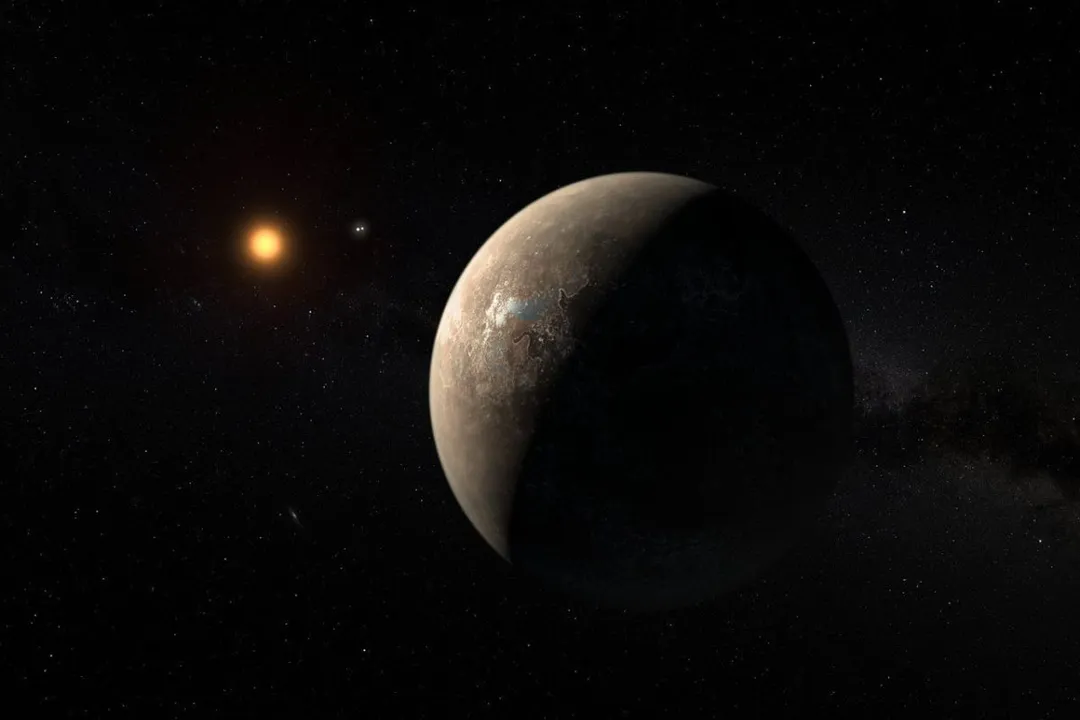
When astronomers evaluate the prospects for extraterrestrial life, they often categorize stars by their spectral type, which relates directly to their mass and temperature. The most common stars in the galaxy are M dwarfs, or red dwarfs. These stars are smaller and cooler than our Sun, radiating far less energy.
The appeal of M dwarfs is their sheer abundance and incredible longevity. While our Sun is expected to shine for about 10 billion years, M dwarfs can burn their fuel for trillions of years. This vast timescale provides an almost unimaginable window for biological evolution to take hold, far longer than the time life has existed on Earth. Because they are so dim, their habitable zones are very close in—often orbiting inside the path of Mercury in our own Solar System.
However, this proximity introduces a significant hazard. A major hurdle for planets orbiting M dwarfs is stellar activity. These smaller stars are prone to powerful flares, emitting intense bursts of ultraviolet and X-ray radiation. These flares are far more energetic, proportionally, than our Sun's flares, and their frequent nature could strip away the atmosphere of a closely orbiting planet or sterilize its surface, even if liquid water is present. The constant bombardment necessitates that any life on these worlds would either need incredible protection, such as a very strong magnetic field, or the planet itself would need a resilient, constantly replenished atmosphere.
# Stable Middle Ground
Given the flare risk associated with the most common stars, astronomers often look toward stars slightly larger and hotter than M dwarfs, sometimes referred to as the "Goldilocks Stars" themselves because they offer a better balance. These include K dwarfs (Orange Dwarfs) and G dwarfs (Yellow Dwarfs), which includes our own Sun.
K dwarfs are particularly promising. They are smaller than the Sun but significantly larger and brighter than M dwarfs. They possess longer lifespans than G dwarfs, perhaps lasting tens of billions of years, which is long enough for complex life to develop, yet they are generally much more quiescent, experiencing far fewer high-energy outbursts than their smaller cousins. A planet orbiting a K dwarf in its HZ would receive a more steady, reliable stream of energy over cosmic timescales, mitigating the atmospheric erosion problem associated with frequent, powerful flares.
G dwarfs, like the Sun, are a proven model for life development, having hosted our planet for about 4.6 billion years and still having several billion years left in the tank. While they are less abundant than M dwarfs, the stability they offer—fewer dramatic flares compared to the M-type stars—makes them top-tier candidates for hosting life that mirrors our own terrestrial experience.
A key comparison arises when weighing statistical probability against environmental stability. An M dwarf is incredibly common, meaning the sheer number of potential habitable zone planets orbiting them is very high. However, the percentage of those planets that could sustain life over billions of years due to stellar activity might be lower than the percentage of more stable K dwarfs.
One interesting analytical point to consider is the "Total Habitable Time" metric. If an M dwarf offers 10 trillion years of HZ conditions but blasts its planets with sterilizing flares every few thousand years, while a K dwarf offers 40 billion years of stable, moderate irradiation, the K dwarf might, paradoxically, be the statistically better bet for complex life that requires extended periods without catastrophic reset events. The very long lifespan of the M dwarfs might just be a red herring if their environment is too violently unstable on shorter timescales.
# Stellar Properties Checklist
The choice of star isn't just about mass; several other factors come into play when assessing habitability.
# Mass and Lifespan
The general rule is that the more massive a star, the hotter and brighter it burns, and the shorter its lifespan. Massive O and B type stars burn through their fuel in mere millions of years, an insufficient amount of time for life to emerge, let alone evolve intelligence. Therefore, the stars most likely to support life are those toward the lower end of the main sequence: K, G, and M dwarfs.
| Star Type | Spectral Class | Mass Relative to Sun | Lifespan Estimate | Habitability Concern |
|---|---|---|---|---|
| Yellow Dwarf | G | Billion Years | Proven, but long-term stability (stellar evolution) | |
| Orange Dwarf | K | $0.5 - 0.8$ | Tens of Billions of Years | Relatively low flaring, excellent longevity |
| Red Dwarf | M | $< 0.5$ | Trillions of Years | High frequency of powerful stellar flares |
# Metallicity
While not explicitly detailed in every source, the chemical composition of the star matters greatly for planet formation. Stars need heavier elements, often referred to as "metals" by astronomers (anything heavier than helium), to form rocky planets in the first place. Stars with very low metallicity might struggle to form the type of terrestrial worlds we look for. Therefore, a star must have formed in an environment rich enough to build rocky planets while possessing the stability needed for long life.

# Stellar Activity Versus Location
One crucial aspect that astronomers have zeroed in on is that while the presence of a planet in the HZ is necessary, it is stellar activity that often acts as the disqualifier. A planet orbiting a quiet, long-lived K dwarf is a far more promising target than a planet orbiting a hyperactive M dwarf, even if both planets theoretically sit in their respective HZs.
For instance, the Kepler mission has identified numerous planets in the habitable zones of M dwarfs. Yet, researchers must conduct follow-up studies to determine the activity levels of those host stars. If the star is quiet, the world is potentially habitable; if it is constantly blasting its surroundings, that world is likely a barren rock, regardless of its orbital distance.
An actionable tip for anyone following exoplanet discoveries is to always check the host star type when hearing about a potential "Earth 2.0." If the star is an M dwarf, temper excitement until data confirms low flare rates, perhaps observing the star for several years to catch its baseline activity rather than just a single quiet observation. True habitability requires consistency, not just a single good day.
The importance of this stability suggests that a star that is slightly less abundant—like a K dwarf—might yield a higher return on investment for biosignature hunting simply because its energy output is more consistent over geologic timescales than the erratic energy from the more numerous M dwarfs.
# The Galactic Context
When we zoom out from individual stars, the sheer scale of the universe paints an optimistic picture. Based on the data gathered from missions like Kepler, scientists estimate that there could be as many as 10 billion stars in the Milky Way that host habitable exoplanets.
This immense number suggests that even if only a tiny fraction of these stars are the "perfect" K or stable G types, the absolute count of potentially life-bearing systems remains staggeringly high. The galaxy is ancient, and many stars, including G dwarfs like our Sun, have been shining for billions of years, providing ample time for life to arise and perhaps even spread.
While the search often focuses on nearby, bright stars to make observation easier, the statistical reality is that the galaxy is teeming with opportunity. The universe seems configured not only to form planets but also to sustain them for immense durations, provided the host star avoids being too massive or too volatile. The most likely stars to support life are thus those that offer a long, gentle retirement plan: the K dwarfs, followed closely by the G dwarfs, with the M dwarfs presenting a massive, volatile wildcard. The key variable remains the star's temperamental nature over eons, a lesson learned from observing our own relatively calm Sun.
#Videos
Which Stars Could We Live Around? Ranking Every Type of Star
Related Questions
#Citations
Goldilocks Stars Are Best Places to Look for Life - NASA Science
Which type of star is the most habitable? : r/askastronomy - Reddit
Which stars could host alien life? | The Planetary Society
Which Stars Could We Live Around? Ranking Every Type of Star
Top 10 List of Habitable Stars to Guide Search - Space
The Perfect Stars to Search for Life On Their Planets - Universe Today
Astronomers Identify Another Crucial Aspect for Planets to Support Life
10 billion Milky Way stars might have habitable exoplanets after all