Which stars have a shorter life cycle?
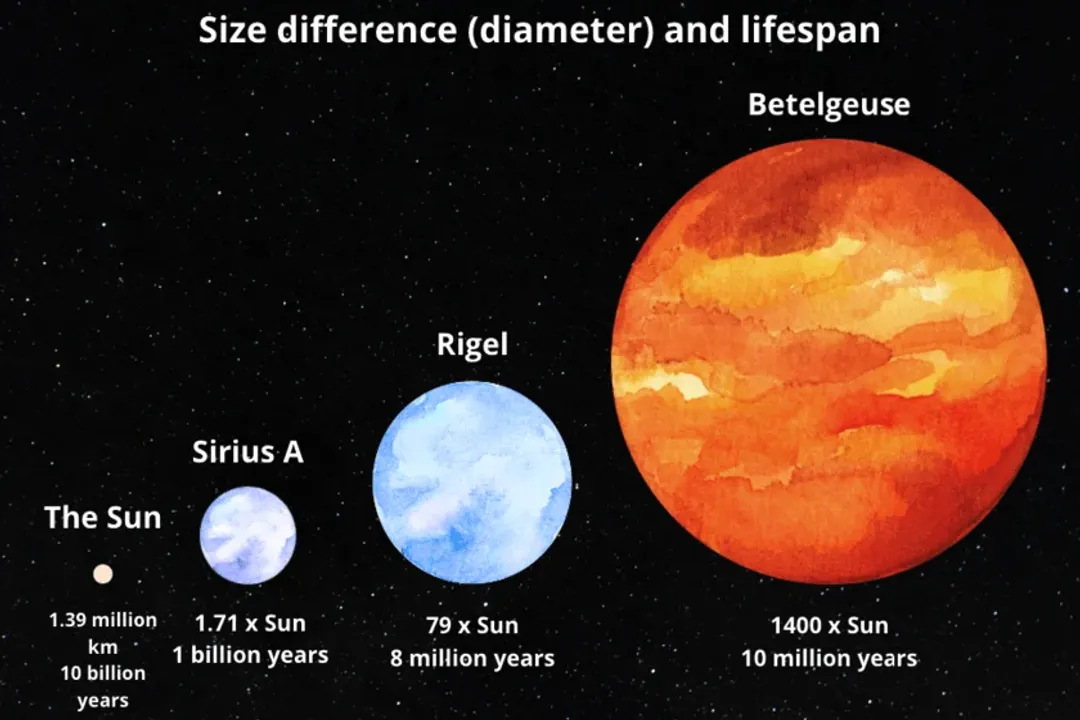
The lifespan of a star, from its initial fiery ignition to its final, fading state, is almost entirely dictated by a single characteristic: its initial mass. It might seem intuitive that a star containing more material would naturally burn longer, like a larger fuel tank, but the opposite is true in the cosmic arena. Stars born with significantly more mass than our Sun lead lives that are dramatically shorter, blazing through their energy reserves at a ferocious, unsustainable pace.
Stars spend the vast majority of their existence—about 90%—in a stable phase known as the main sequence, where they generate energy by fusing hydrogen into helium in their cores. This fusion creates an outward pressure that perfectly counteracts the inward crush of gravity, establishing a state called hydrostatic equilibrium. The moment that core hydrogen is depleted, this delicate balance is upset, and the star begins its transformation toward death.
# Mass Rules
The fundamental driver for a star's longevity is the fierce relationship between its mass and its luminosity—the rate at which it radiates energy. For stars on the main sequence, luminosity scales steeply with mass. Specifically, luminosity () is often proportional to the mass () raised to a power around 3.5 ().
Because the energy produced must support the star's immense weight against gravity, a star with greater mass requires a much higher core temperature and pressure to maintain stability. This higher temperature translates directly into a vastly increased rate of nuclear fusion. A more massive star consumes its fuel not just faster, but exponentially faster.
This principle dictates the entire stellar timeline. While small, dim stars can sip their fuel for eons, the giants require a veritable cosmic firehose to keep from collapsing immediately. This consumption rate is the key metric for determining which stars have the shortest cycle.
# Lifespan Scaling
To understand the shortest cycles, we must examine the mathematical consequences of this mass-luminosity relationship. The main sequence lifetime () is proportional to the amount of fuel available (mass, ) divided by the rate at which it is burned (luminosity, ).
By substituting the proportionality for luminosity, we arrive at a stark conclusion for how main-sequence lifetimes relate to the Sun's time (where is the Sun's main-sequence lifetime):
This inverse power law means that even small increases in mass result in a dramatic reduction in lifespan. For instance, a star four times the mass of the Sun would theoretically have a main-sequence lifetime of only (or ) of the Sun's lifetime. For the most massive stars, this reduction is steep enough to clock their entire existence in mere millions of years.
It is an interesting analytical point that these short-lived stars are the universe's primary element factories, creating everything heavier than helium and lithium through their rapid nuclear processing. However, their spectacular demise is so quick that any theoretical planet around them would have little time to develop complex chemistry, let alone life, before the central star destroys its entire system.
# Shortest Lives
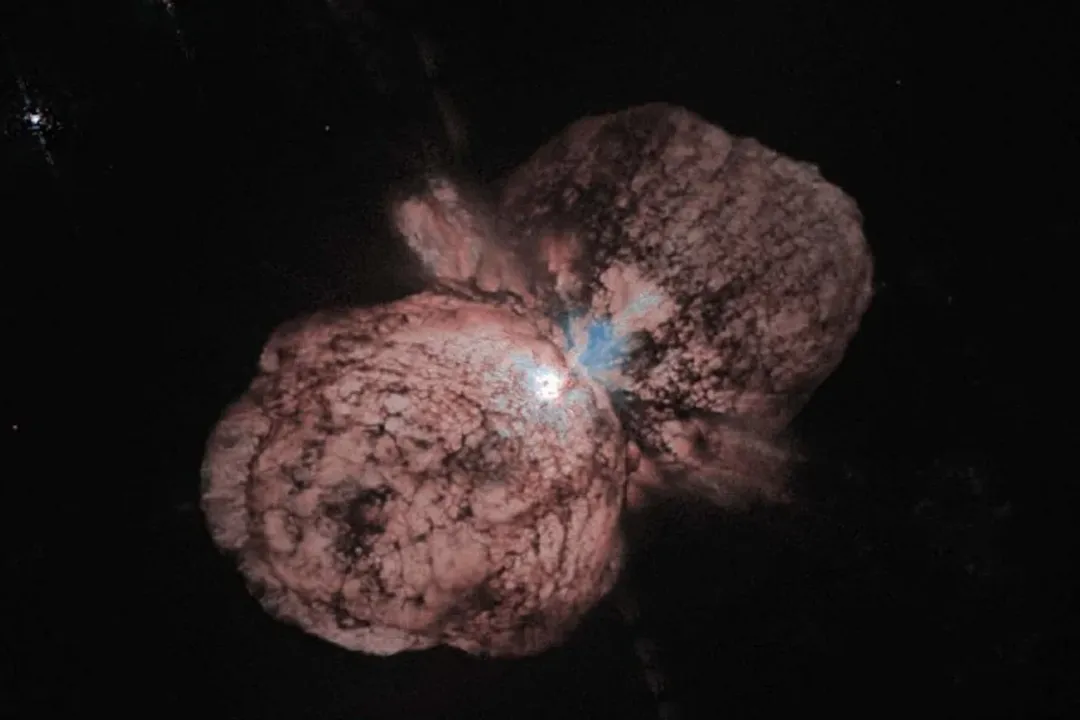
The stars that have the shortest lifecycles are the most massive ones, often classified as O-type or blue-white main-sequence stars. These stars accumulate masses around 10 times the mass of the Sun () or even much more.
Stars exceeding are so luminous that their own radiation pressure drives extremely rapid stellar winds, causing them to shed their outer layers quickly. Models suggest the largest stars born in the current era, estimated around $100$ to , face such extreme radiation pressure that they might lose their envelopes before they can even fully expand into red supergiants.
The estimated main-sequence lifespan for stars over is often only a few million years. For the exceptionally massive stars, like the hypothetical star Carinae, the main sequence may be as brief as 3 million years. These stars burn through their core hydrogen in a cosmic blink, spending only a few hundred thousand years more as a supergiant before a catastrophic end.
If we consider the very first generation of stars formed shortly after the Big Bang, theory suggests they were often even more massive—potentially hundreds of solar masses—and therefore, their lives were likely the shortest of all, possibly lasting only a few million years.
# Longest Lives
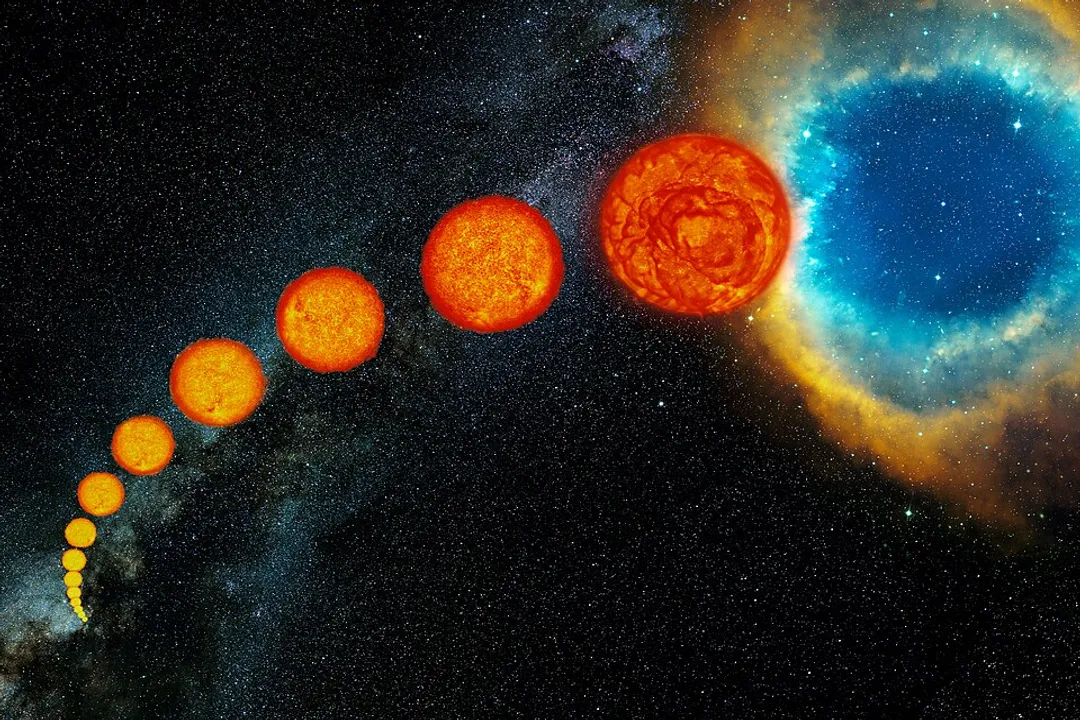
To fully appreciate the brevity of massive stars, one must contrast their fates with the longest-lived stellar objects: the red dwarfs. These are the smallest stars, with masses less than about half the Sun’s mass, and are incredibly fuel-efficient.
Low-mass stars, such as those around , fuse hydrogen so slowly through the proton-proton chain reaction that their main sequence existence is projected to last for hundreds of billions to perhaps twelve trillion years. The universe, in contrast, is only about $13.8$ billion years old. This means that no low-mass star that has ever formed in the history of the cosmos has reached the end of its main sequence life yet. Our understanding of their end stages is based entirely on stellar models, not direct observation.
The contrast between the fastest and slowest stars is staggering. A star is gone in perhaps $10$ million years, while a star has a projected time frame measured in trillions of years.
# Stellar Endpoints
The final stage of a star’s life is determined by the mass that remains after hydrogen core fusion ceases, which dictates whether it can initiate fusion of heavier elements. Stars with shorter lives meet far more energetic ends than their long-lived counterparts.
| Star Type (Initial Mass) | Approximate Main Sequence Lifespan | Post-Main Sequence Evolution | Final Remnant |
|---|---|---|---|
| Low Mass () | 6 to 12 Trillion Years | Gradual brightening/heating | White Dwarf (Helium-rich) |
| Mid-Size (Sun-like, ) | Billion Years | Red Giant Planetary Nebula | Carbon/Oxygen White Dwarf |
| Massive () | Tens of Millions of Years | Red Supergiant Core Collapse | Oxygen-Neon-Magnesium White Dwarf or Neutron Star |
| Very Massive () | Million Years | Red Supergiant Supernova | Neutron Star or Black Hole |
For the short-lived, massive stars (those ), the core develops layers of progressively heavier elements until it consists mainly of iron. Iron cannot release energy through fusion, so the core collapses in under a second. This collapse results in a spectacular supernova explosion, scattering newly formed heavy elements across space. The remnant left behind is either an incredibly dense neutron star or, if the original mass was high enough (perhaps ), a black hole.
In contrast, stars similar to the Sun become red giants, then shed their outer material to form a planetary nebula, leaving behind a cooling white dwarf composed primarily of carbon and oxygen. Stars less massive than about half the Sun won't even achieve helium fusion in the core, simply becoming helium white dwarfs that cool slowly. Eventually, over timescales far exceeding the current age of the cosmos, these white dwarfs will become theoretical, cold black dwarfs.
# Cosmic Context
The difference between the stellar extremes provides a tangible measure of deep time. A mid-sized star like the Sun exists for about 10 billion years in its stable phase, a span comparable to the entire current age of the universe ( billion years). For these stars, the time spent living on the main sequence is the overwhelming majority of their existence.
If we consider the mass-luminosity relationship again, , we can see an inverse relationship on the order of for lifetime. This non-linear dependency means that doubling the mass doesn't just halve the life; it shortens it by a factor of nearly six (). Tripling the mass shortens the life by almost twenty times (). This extreme sensitivity to mass is precisely why the shortest-lived stars are those that form at the very top of the mass scale. They are fundamentally unstable at their mass due to the immense radiation pressure generated by their high luminosity, forcing them to live fast and violently die.
The fact that astrophysicists must rely on computer simulations to predict the fate of the very smallest stars, those , underscores this vast temporal disparity. We are witnessing a universe filled with stars that are barely starting their lives, while the first massive stars that ever formed have long since become supernovae remnants, creating the heavy elements we observe today.
#Videos
Which Type Of Star Has The Shortest Life Span? - Physics Frontier
Related Questions
#Citations
Flexi answers - What type of star has the shortest lifespan? - CK-12
Low mass star - Las Cumbres Observatory
Which Type Of Star Has The Shortest Life Span? - Physics Frontier
Stellar Evolution - | The Schools' Observatory
The Life Cycles of Stars - Imagine the Universe! - NASA
How Long Do Stars Live? - Label Stars
Stellar evolution - Wikipedia
What is the shortest lifespan of a star created during the big bang ...