classification articles
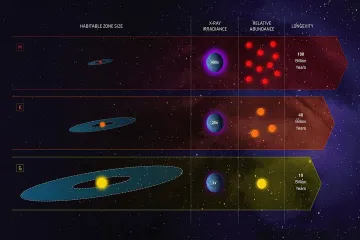
What stellar type is by far the most numerous found throughout the Milky Way?
Compared to the Sun's lifespan of about 10 billion years, how long can M-dwarfs burn their fuel?
What orbital condition is almost guaranteed for a planet orbiting within the habitable zone of a faint M-dwarf?
What inherent limitation does the Sun present when compared to other star types regarding maximal evolutionary potential?
What is the approximate lifespan range given for K-type stars, or orange dwarfs?
Which stellar class is positioned as the "Goldilocks Star" for considering the longest possible duration for complex biological development?
How do planets orbiting K-stars within the habitable zone avoid the issue of tidal locking common around M-dwarfs?
What is the primary immediate threat emitted by many young M-dwarfs that can strip away a planet's atmosphere?
What is the primary trade-off when considering M-dwarfs for hosting life?
What process are planets orbiting K-stars better able to retain over billions of years due to the star's lower energy profile?
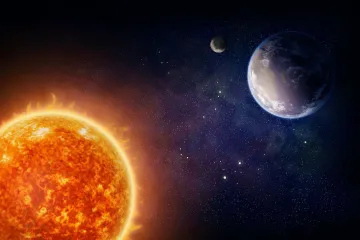
What is the less technical but highly descriptive name for the Sun's G2V classification?
What stable process currently powers the Sun's light and heat?
What is the approximate diameter of the Sun in kilometers, according to the provided metrics?
What percentage of the total mass of the entire Solar System does the Sun account for?
Which type of star makes up the vast majority of stars in the Milky Way galaxy, being smaller and cooler than the Sun?
In the stellar classification G2V, what does the luminosity class 'V' specifically indicate about the Sun?
Approximately how long is the Sun predicted to remain in its current, stable hydrogen-fusing phase?
If packed perfectly, approximately how many Earths could fit inside the Sun?
What is the Sun's predicted evolutionary stage immediately following its Red Giant phase?
Compared to the Sun, how massive can the most massive stars known be?

What is the primary focus of academic disciplines labeled as "soft science"?
The classification of sciences as "soft" or "hard" primarily relates to what aspect?
Which field is specifically mentioned as being grouped under soft sciences despite employing complex mathematical models?
What methodological tool is commonly employed in soft sciences alongside statistical surveys?
What key challenge in soft science research arises because observation can alter the behavior being measured?
In contrast to hard sciences which excel at prediction, what do soft sciences often prioritize?
What unwarranted value judgment sometimes suggests that social sciences are less rigorous than natural sciences?
Which disciplines are cited as examples that blur the traditional lines between hard and soft sciences?
What essential aspect of reality do soft sciences address that cannot be measured by a ruler or a Geiger counter?
What do soft sciences explain regarding a bridge that physics cannot?