What processes were involved in the formation of the universe?
The unfolding of everything we know—space, time, matter, and energy—begins with a single, explosive moment often referred to as the Big Bang. This event did not happen in space, but rather it was the beginning of space and time itself. In the earliest instants, the entire observable universe was compressed into an infinitesimally small, incredibly hot, and dense state. The prevailing model describing this beginning centers on the idea of a rapid, metric expansion of space from this singularity.
# Initial State
Before the Planck epoch, which is the earliest moment described by current physics (around seconds after the Big Bang), the laws of physics as we currently understand them break down. At this stage, all four fundamental forces—gravity, electromagnetism, and the strong and weak nuclear forces—are theorized to have been unified into a single superforce. The universe was unimaginably hot, exceeding Kelvin.
An interesting conceptual difficulty arises when trying to visualize this initial state. We often think of it as an explosion expanding into a pre-existing void, but the reality is far stranger. The expansion was of space itself; imagine a grid where every point is moving away from every other point simultaneously, without there being an "outside" for it to expand into. This contrasts sharply with the way we observe everyday explosions, which require a medium to travel through. The universe, in its infancy, was the medium.
# Rapid Growth
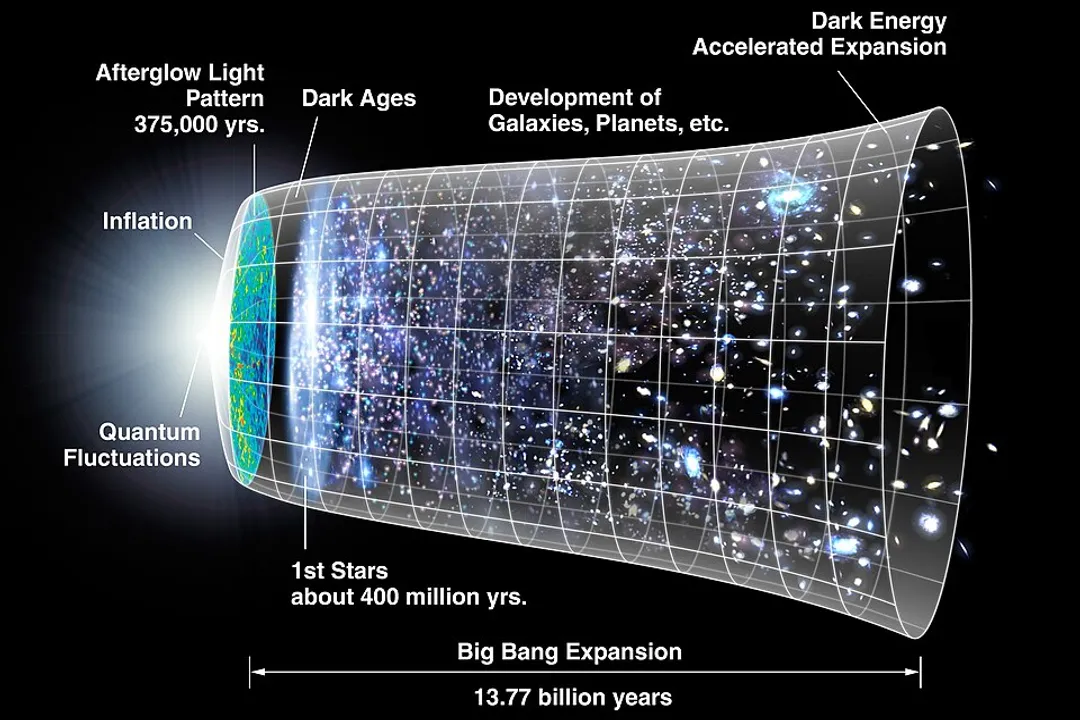
Immediately following the Big Bang, within a fraction of a second, the universe underwent a period of extremely rapid, exponential expansion known as inflation. This phase is crucial because it helps explain several observed characteristics of our current universe, such as its near-flat geometry and its remarkable uniformity on the largest scales. During inflation, which lasted until approximately seconds, the universe expanded by a factor of at least .
If you were somehow able to shrink the entire observable universe down to the size of a grapefruit before inflation, it would have ballooned out to be larger than the entire solar system in less time than it takes for a light wave to cross the grapefruit’s diameter. This idea of superluminal expansion during inflation resolves the "horizon problem"—why regions of the cosmos so far apart look similar today—by suggesting they were once in causal contact before this swift growth separated them.
# Particle Soup
As the universe expanded, it cooled. Once inflation ended, the universe was still extraordinarily hot, existing as a dense, energetic plasma of fundamental particles—a "soup" of quarks, leptons, and their antimatter counterparts. This epoch, known as the quark epoch, lasted until about seconds.
The next critical step involved the fundamental building blocks coming together. As cooling continued past the electroweak epoch, the electromagnetic and weak forces separated, and then the strong nuclear force separated from the others. During the quark epoch, quarks combined to form protons and neutrons, the constituents of atomic nuclei. Because matter and antimatter were created in nearly equal amounts, the vast majority annihilated each other into pure energy, leaving behind a tiny surplus of matter—about one extra particle of matter for every billion particle-antiparticle pairs that vanished. This slight asymmetry is the foundation for all the matter we observe today.
To put the energy scale in perspective, at seconds, the temperature was around Kelvin, a far cry from today, but cool enough for quarks to condense into the more familiar baryons like protons and neutrons.
# Element Forging
The next significant process began around one second after the Big Bang and concluded a few minutes later: Big Bang Nucleosynthesis (BBN). This was the universe's first opportunity to create stable atomic nuclei.
During BBN, the temperature dropped enough (around $10^9$ Kelvin) for protons and neutrons to fuse, primarily forming the lightest elements. This fusion process was incredibly short-lived, ending when the universe became too diffuse and cool for fusion to continue, about 20 minutes after the initial moment. The resulting elemental composition was highly consistent across the early universe, setting the stage for all subsequent stellar processes.
The primary outputs of BBN were:
- Hydrogen nuclei (single protons)
- Deuterium (one proton, one neutron)
- Helium-4 nuclei (two protons, two neutrons)
- Trace amounts of Lithium and Beryllium
A helpful way to conceptualize the result is through a ratio. The early universe ended up with roughly 75% of its baryonic mass in the form of hydrogen nuclei and about 25% in helium nuclei, with everything else being trace elements. This specific elemental ratio, predicted by BBN theory, is a cornerstone of modern cosmology, as its observation in the oldest celestial objects perfectly matches theoretical predictions. The abundance of helium we see today is overwhelmingly primordial, created in these first few minutes, not later inside stars.

# First Light
For the next 380,000 years, the universe remained a hot, opaque fog of ionized plasma. Electrons were too energetic to bind with the newly formed nuclei, meaning photons (light particles) could not travel far before scattering off a free electron. The universe was essentially a dense plasma, completely opaque to light.
The critical transition occurred at around 380,000 years post-Big Bang, when the temperature dropped to about 3,000 Kelvin. At this point, the universe had cooled sufficiently for free electrons to be captured by hydrogen and helium nuclei, forming the first stable, neutral atoms. This event is called recombination.
With the electrons now bound, the photons were suddenly free to travel unimpeded through space for the first time. This "first light" still permeates the cosmos today, though redshifted by billions of years of expansion down to microwave wavelengths. This ancient radiation is what we detect as the Cosmic Microwave Background (CMB). Analyzing the CMB gives cosmologists a baby picture of the universe, showing tiny temperature fluctuations—the seeds from which all later structure grew. If you tune an old analog television to a channel with no broadcast, about 1% of the static you see is thought to be this leftover glow from recombination.
# Structure Growth
After the universe became transparent, it entered the so-called "Dark Ages," a period stretching for hundreds of millions of years where no stars had yet formed to illuminate the cosmos. During this time, gravity began its slow, persistent work, drawing matter together. The initial non-uniformities seen in the CMB provided the necessary starting points.
The formation of large-scale structures—galaxies, clusters, and superclusters—is heavily influenced by a component we cannot directly see: dark matter. While the visible, baryonic matter (the stuff that makes up stars and planets) was still too hot and energetic to collapse quickly in the early, post-recombination phase, the mysterious dark matter was not subject to the same electromagnetic interactions and could begin clumping much earlier.
Dark matter formed gravitational "halos" or scaffolds throughout the early universe. These halos acted as gravitational wells, pulling in the neutral hydrogen and helium gas once it cooled sufficiently.
| Epoch | Approximate Time After Big Bang | Key Process | Temperature (Approximate) |
|---|---|---|---|
| Inflation | to s | Exponential expansion of space | Decreasing rapidly |
| Quark Epoch | to s | Quarks form protons/neutrons | K to K |
| Nucleosynthesis | 3 min to 20 min | Formation of H and He nuclei | K |
| Recombination | 380,000 years | Electrons bind to nuclei; universe becomes transparent | K |
| Structure Formation | million years onward | Dark matter collapses; first stars ignite | Cooling significantly |
Observing the oldest galaxies today gives us clues about the timeline for star formation. The light from these first luminous objects began to pierce the darkness perhaps 100 to 200 million years after the Big Bang, marking the end of the Dark Ages and the beginning of the Epoch of Reionization, as the intense ultraviolet light from these first massive stars stripped electrons from the surrounding neutral hydrogen once again.
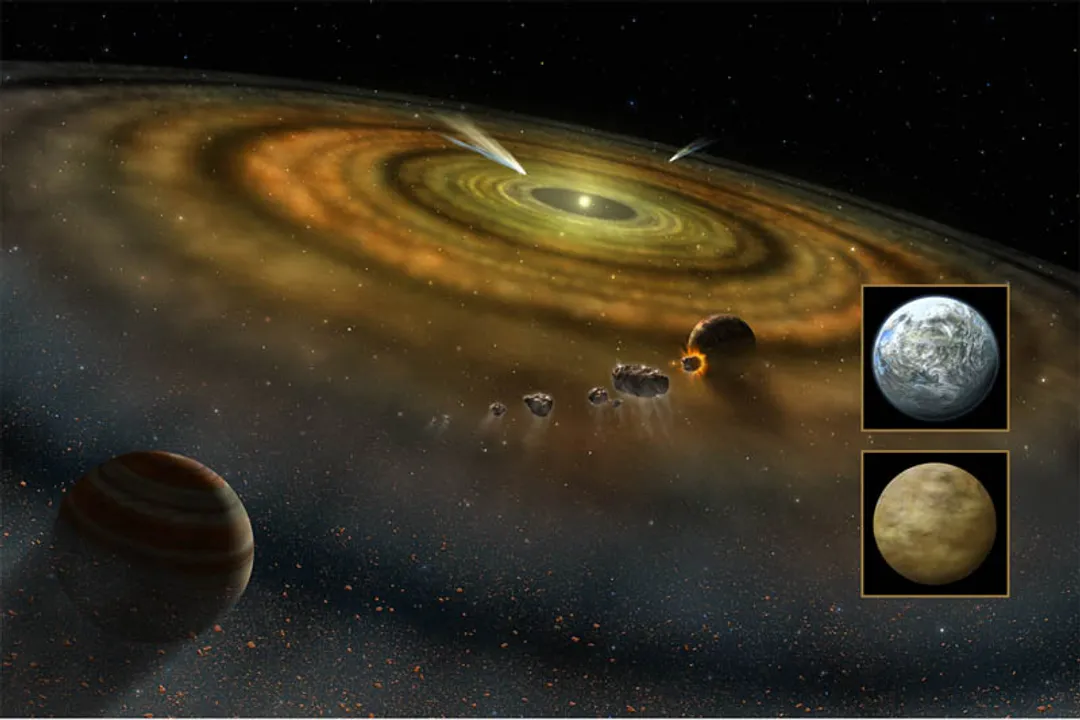
The Earth itself, and our Solar System, formed much later, about 4.6 billion years ago, which is nearly 9 billion years after the Big Bang. This later formation is testament to the hierarchical nature of cosmic structure formation: small structures (stars and their planetary systems) emerge from the remnants and recycled material created by the universe's largest, earliest structures.
# Ongoing Expansion
The story doesn't end with galaxies forming; the universe continues to evolve today. The general observation is that the universe is expanding, a fact established through the redshift of distant galaxies. For a long time, it was assumed this expansion must be slowing down due to the mutual gravitational attraction of all the matter within it.
However, observations made in the late 1990s revealed a surprising conclusion: the expansion of the universe is not slowing down; it is actually accelerating. This acceleration requires an unknown form of energy that counteracts gravity on cosmological scales, which scientists have named dark energy. Dark energy is thought to constitute about 70% of the total energy density of the cosmos, dominating the current dynamics of the universe, whereas dark matter accounts for about 25%, leaving only about 5% for all the normal matter we interact with daily.
The continued study of these processes—from the unified forces in the first instant to the accelerating expansion today—is the realm of cosmology, seeking to piece together a complete timeline of cosmic evolution. As researchers develop more sensitive instruments, they are able to probe deeper into the past, refining our understanding of what happened during the very first second of existence, where the fundamental constants were set that allowed for the development of everything that followed. The success of the Big Bang model rests on its ability to explain disparate observations, from the elemental abundance of the oldest stars to the precise temperature variations in the CMB, offering a remarkably consistent narrative for the formation of all things.
#Citations
Cosmic History - NASA Science
Universe - Wikipedia
The Early Universe - Las Cumbres Observatory
The Big Bang Theory and the Evolution of the Universe - Facebook
Origin of the Universe and Our Solar System – Introduction to Earth ...
DOE Explains...Cosmology | Department of Energy
Big Bang Timeline - The Physics of the Universe
ESA - So, how did everything start? - European Space Agency
Evolution of the Universe | Research Starters - EBSCO