What keeps stars in a galaxy together?
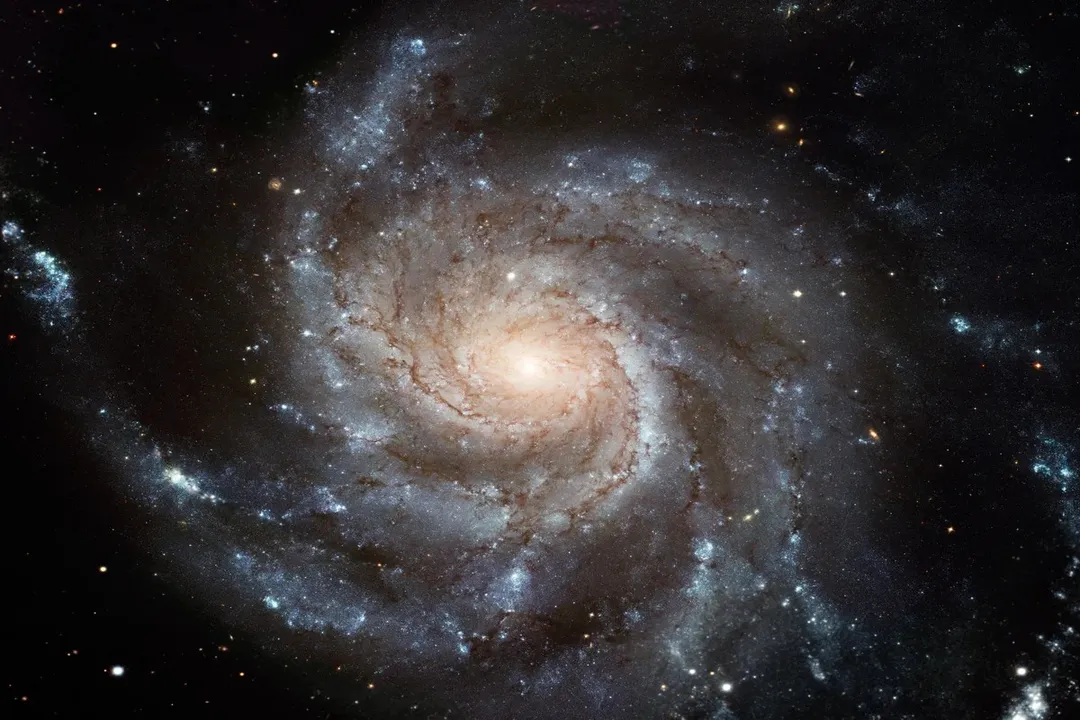
The fundamental reason stars remain bound within the immense structures we call galaxies is gravity. It is the universal attractive force that governs everything from the fall of an apple to the largest-scale structures in the cosmos. In the context of a galaxy, which is a massive collection of stars, gas, and dust held together by this attraction, gravity dictates the collective motion and cohesion of billions of stellar bodies.
# Galactic Binding Force

Imagine a single star system, like our own solar system. The Sun, being overwhelmingly massive, exerts a gravitational pull that keeps the planets, asteroids, and comets locked into predictable paths around it. In a galaxy, the situation is conceptually similar, but vastly more complex because the central object is not a single point of immense mass, but rather a distributed system of many masses.
Stars within a galaxy are constantly in motion; they do not simply float aimlessly, nor are they static. Instead, they orbit a common center of mass for the entire galaxy. This orbiting motion is what prevents the stars from flying off into intergalactic space. If a star moves too fast, it might escape, but generally, the overall gravitational field keeps the stars "in line," much like the Earth orbits the Sun. The relationship is an ongoing balance: the star’s inertia (its tendency to keep moving in a straight line) is constantly counteracted by the pull of the galaxy’s combined mass directed toward the center.
# Visible Mass Problem
When astronomers first began seriously studying the motions of stars in spiral galaxies, particularly those on the outer edges, they encountered a significant physical puzzle. They could measure the total amount of light coming from the galaxy, which allowed them to calculate the total mass of all the visible components—the stars, the gas clouds, and the dust. Using this visible mass, they could predict the orbital speeds stars should have at various distances from the galactic center based on Newtonian physics.
The prediction, however, did not match reality. Stars far from the bright, central bulge of the galaxy were moving far too fast to be held in their orbits by the gravity generated only by the visible matter they could account for. If the visible mass were the only mass present, these outer stars should have long since been flung out of the galaxy into the void.
Consider the implication: if we look at a spiral galaxy, we might estimate the mass based on the light output, concluding perhaps that it contains a mass equivalent to 100 billion Suns. If the stars on the periphery are observed moving at velocities that, based on Kepler’s laws adapted for a distributed system, require the gravitational pull of 500 billion Suns, there is a profound missing piece to the equation. This discrepancy is a key piece of evidence for the existence of components that do not emit or interact with light in the way normal matter does.
# Dark Gravity
The missing gravitational influence that keeps these high-speed outer stars bound is attributed to something called dark matter. Dark matter is an invisible substance hypothesized to make up the vast majority of the mass within a galaxy and the universe at large. It does not emit, absorb, or reflect light, which is why it is "dark" and cannot be seen directly with telescopes.
The function of dark matter in this cosmic architecture is purely gravitational. It forms a large, diffuse halo enveloping the visible stellar disk, providing the necessary, overwhelming gravitational tug to maintain the observed high orbital speeds of the stars across the entire galactic structure. In essence, the visible stars and gas are embedded within a massive, unseen gravitational structure—the dark matter halo—that dictates the galaxy’s overall shape and stability.
This phenomenon is not isolated to individual galaxies; it scales up to larger structures as well. For instance, observations of galaxy clusters—collections of hundreds or thousands of galaxies—also show similar gravitational anomalies. Astronomers have observed phenomena like a dark matter ring in a galaxy cluster, which clearly indicates that the mass holding that enormous structure together far exceeds the mass of all the visible galaxies within it. This observation reinforces the idea that dark matter is not just a local effect but a foundational component of cosmic structure.
# The Distribution Balance
When thinking about the forces, it is interesting to contrast the location of the visible matter versus the required gravitational anchor. The visible stars, gas, and dust are largely concentrated in the central bulge and the thin spiral arms. This is where we see the brightest light. However, the gravitational influence required to keep the stars orbiting at their measured speeds suggests that the majority of the mass—the dark matter—is distributed much more broadly, extending far past the visible edge of the galaxy. This invisible bulk acts as the gravitational "glue" for the entire system, even though the light we see comes from the inner regions. If a galaxy were a wheel, the bright spokes would be the visible matter, but the immense, unseen tire forming the overall structure is where most of the mass—and therefore the primary gravitational binding agent—resides.
# Stellar Dynamics
The stars are kept together by the net gravitational field, which is the sum of the attraction from every other mass component in the galaxy. While the overall structure is governed by the dark matter halo, the immediate neighborhood of any given star is also influenced by its closer neighbors.
For a star within the disk of the Milky Way, its motion is a combination of orbiting the galactic center of mass (driven largely by the smooth dark matter distribution) and being influenced by the gravitational fluctuations caused by nearby spiral arms, gas clouds, and other stars. It is a complex, dynamic gravitational dance involving billions of participants. The stars are not rigidly fixed to the dark matter structure; they are following the curves in spacetime created by the total mass distribution, much like marbles rolling on a very large, complex, and slowly rotating trampoline.
A helpful way to conceptualize this complex motion is to realize that while the overall rotation curve points to dark matter, the local motion is still Newtonian, governed by the mass enclosed within the star’s orbit. For an inner star, the gravity from the central black hole and the dense nuclear bulge plays a much more direct role in its immediate orbit than it does for a distant star near the galactic edge, where the influence of the extended dark matter halo dominates the calculation for orbital velocity.
# Stability Through Mass
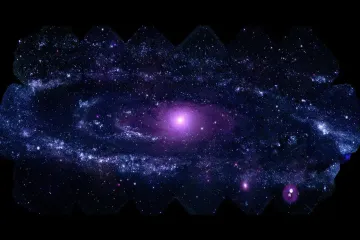
The sheer quantity of mass is what guarantees the galaxy’s stability against random dispersal. A galaxy is, in effect, a self-gravitating system. The total gravitational force exerted by all the matter—visible and dark—must be greater than the kinetic energy of the stars that would push them apart.
To put the scale into perspective, a typical galaxy contains a mass equivalent to billions or even trillions of Suns. Even if we consider only the visible components of an average galaxy, that is still an immense gravitational presence. If you could somehow instantly remove all the dark matter from a galaxy, the remaining visible stars would still possess a combined gravity, but they would immediately begin an outward expansion, as their orbital speeds would now be too high for the reduced gravitational field, causing the galaxy to gradually fly apart over cosmological timescales. The visible matter provides a local, short-range cohesion, but the dark matter provides the long-range anchor necessary for the galaxy’s continued existence as a bound entity.
# Galactic Clusters
The same principles apply, but on an even grander scale, when considering galaxy clusters. These are super-structures where dozens or hundreds of galaxies are gravitationally bound to each other, orbiting a common center of mass for the cluster. Again, observations confirm that the gravitational pull required to keep these massive galaxies from dispersing from one another is far greater than the combined light emitted by all the member galaxies. This necessitates an even larger amount of intergalactic dark matter holding the cluster together, perhaps in a vast, filamentary structure connecting the galaxies.
In summary, what keeps stars in a galaxy together is a delicate, massive, and dynamic balance dictated by gravity. This gravity is not solely provided by the light-emitting stars and gas we observe; rather, the visible matter sits within a much larger, invisible gravitational scaffolding provided by dark matter, which supplies the necessary pull to maintain the rapid, orderly, and long-lasting orbits of every star throughout the galaxy.
#Videos
What Force Binds A Galaxy Together? - Physics Frontier - YouTube
#Citations
How do galaxies stay together/what's holding them together? - Reddit
What keeps galaxies together? - Astronomy Stack Exchange
Galaxy Basics - NASA Science
What holds galaxies together- gravity or the center of mass? - Quora
What Force Binds A Galaxy Together? - Physics Frontier - YouTube
Galaxies and gravity (video) | Khan Academy
Dark matter — invisible and undetectable — holds galaxies together.
What keeps the stars in a galaxy together? A. Nebulas B ... - Brainly
Hubble sees dark matter ring in a galaxy cluster - ESA