What is the path on which the planets move called?
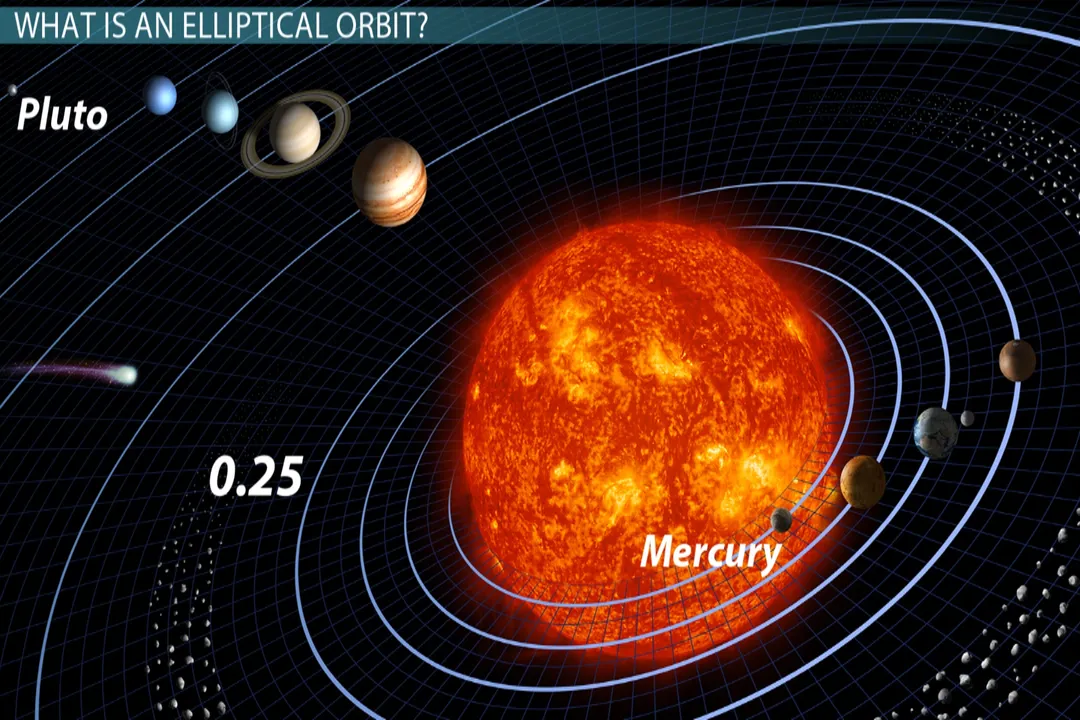
The curved trajectory that a planet follows as it circles a star is universally known as its orbit. While casual conversation might suggest these paths are perfect circles, a precise look at celestial mechanics reveals a more nuanced, slightly squashed reality for nearly every body in our solar system. The path taken by a planet around the Sun is, in fact, an ellipse—an oval shape, rather than a flawless circle.
# Shape Defined
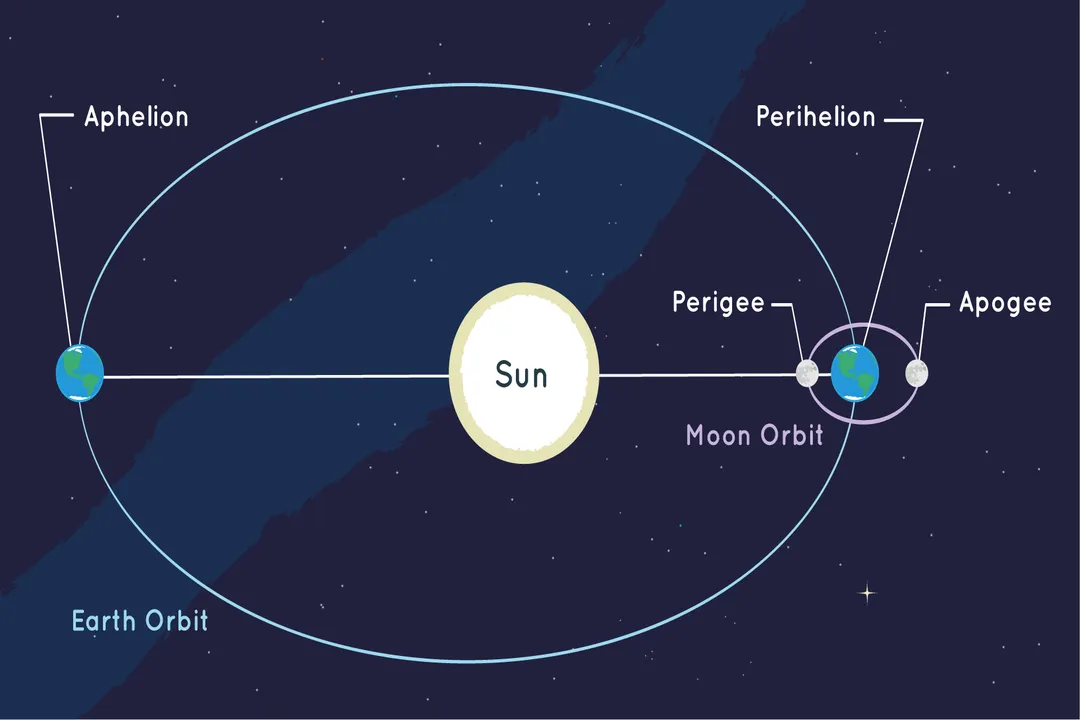
An ellipse is a specific geometric shape defined by having two focal points, or foci. Kepler’s First Law of Planetary Motion formalizes this observation, stating that planets orbit the Sun in elliptical paths with the Sun positioned not at the center, but at one of these two foci. This placement means that a planet’s distance from the Sun is not constant throughout its revolution.
This variation in distance gives rise to specific terminology for the closest and farthest points along the path. The point where the planet is closest to the Sun is called perihelion. Conversely, the point of greatest distance from the Sun is termed aphelion. For Earth, this variance in distance is measurable, though perhaps less dramatic than for other bodies; our planet is actually closest to the Sun during the Northern Hemisphere's winter month of January and farthest away in July.
How much a specific orbit deviates from a perfect circle is quantified by its eccentricity. This value ranges from zero, which represents a perfectly circular orbit, up to, but not including, one. An eccentricity closer to 1 signifies a much more elongated, or "squashed," oval. Looking across our solar system, the eccentricity of Earth’s orbit is very low, around 0.0167, which is why it often appears nearly circular in simple diagrams. In contrast, Mercury possesses the most noticeably elliptical orbit among the major planets, with an eccentricity of about 0.2056. Smaller objects, like the dwarf planet Pluto, exhibit even higher eccentricities, sometimes leading their paths to resemble those of comets more than the major planets.
# Governing Principles
The existence and shape of these orbits are a direct consequence of a persistent, dynamic interaction between two primary factors: gravity and momentum (or inertia). An object in motion, like a planet, naturally tends to continue moving in a straight line through space—its momentum carries it outward. Simultaneously, the Sun’s gravity exerts a constant inward pull.
An orbit is established when there is a delicate balance between the object’s forward momentum and the central body’s gravitational tug. If the momentum were too weak for the gravitational pull, the planet would fall into the Sun. If the momentum were too great, the planet would overcome the pull and speed off into space along a straighter trajectory. Because these forces are balanced just so, the planet is perpetually falling toward the Sun but moving sideways fast enough to constantly miss hitting it, tracing the curved path we observe.
Mathematically, this relationship is rooted in the nature of gravity itself, specifically because the force of attraction decreases according to the inverse square of the distance (). When this force law is applied to the two-body problem (Sun and planet), the only possible closed paths that result are known as conic sections. These sections—circle, ellipse, parabola, and hyperbola—represent every conceivable outcome for an orbiting body. Since planets are in closed, repeating paths, they must fall into the category of circles or ellipses.

# System Layout
Beyond the two-dimensional shape of the path, it is important to consider the three-dimensional arrangement of the solar system. While the path of an individual planet is an ellipse, the collective paths of the major solar system bodies are remarkably aligned. All eight recognized planets orbit the Sun within a relatively narrow band, referred to as the orbital plane.
This plane is closely related to the ecliptic, which is defined as the apparent path the Sun traces across the background stars over the course of a year, as seen from Earth. While the Moon’s orbit around the Earth is tilted slightly relative to this plane (about 1 degree for Earth’s orbit relative to the general system plane), the orbits of the other major planets stay within a few degrees of this reference plane. The reason for this co-planarity is historical: the solar system originated from a single, vast, rotating cloud of gas and dust—the protoplanetary disc—and the planets inherited the general plane of that original rotation. Objects like many comets or minor bodies, which were either captured later or formed outside this main disc, often have orbits that are much more inclined or highly eccentric.
# Near Circularity
It might seem like a philosophical point, but the distinction between a circle and an ellipse carries real physical implications, even when the difference is minute. Since a circle is technically a special case of an ellipse where the two foci happen to occupy the same single point, the existence of an exactly circular orbit requires perfectly balanced conditions that are almost impossible to achieve in nature.
One interesting reflection on this geometry is that the sheer number of possibilities favors the ellipse. Mathematically, there are infinitely many possible ellipses for any given gravitational setup, but only one circle. Therefore, as the solar system formed from chaotic, energetic collisions and accretion of debris, the resulting stable orbits that survived the bombardment process were overwhelmingly more likely to be elliptical than perfectly circular.
The reality of near-circularity in our main planetary orbits suggests that the initial conditions of the solar system were incredibly well-tuned. Consider that if an object did manage to achieve a mathematically perfect circular path, that stability is metastable—it requires no external nudge to maintain it. However, in the messy, multi-body environment of a solar system, slight gravitational perturbations from other planets, asteroids, or even the subtle tidal effects from a planet’s own moon—as seen with Earth—will invariably cause that perfect circle to degrade into a measurable ellipse over astronomical timescales. Thus, while Earth’s orbit is close enough to circular that we might not notice it without precise measurement, the fact that it isn't perfectly round is a testament to the constant, subtle gravitational nudges from its celestial neighbors.

# Historical Context
Understanding the path of the planets was a central problem for astronomers for millennia. Before the 17th century, the prevailing model often involved complex systems of circles upon circles, known as epicycles, to account for observed planetary wanderings. It was the painstaking observational work of Tycho Brahe, who compiled what was arguably the most sophisticated naked-eye astronomical dataset in history, that provided the raw material for the breakthrough.
Johannes Kepler, working with Brahe’s meticulous records, spent years trying to fit the data to geometric shapes. He initially struggled, but eventually abandoned the centuries-old assumption of perfect circles and found that the path of Mars—and by extension, all planets—was perfectly described by an ellipse with the Sun at a focus. This discovery, published around 1609, was fundamental because it linked the observed motion directly to a simple geometric shape, providing the groundwork that Isaac Newton would later use to mathematically derive the law of universal gravitation.
We can see the result of Kepler's work in the varying speeds of the planets. Because the orbit is elliptical, the planet speeds up as it approaches perihelion (the Sun) and slows down as it moves toward aphelion, a concept formalized in Kepler's Second Law, stating that planets sweep out equal areas in equal times. This constant adjustment of speed along the elliptical track is necessary to maintain the overall balance against gravity.
# Path Characteristics
The path itself can be described using a few key dimensions derived from the ellipse. The longest diameter of the ellipse is called the major axis, and half of that length is the semi-major axis (). This parameter is crucial because, according to Kepler's Third Law, it directly relates to the planet’s orbital period () via the equation . In simpler terms, the size of the orbit (its semi-major axis) dictates how long the planet takes to complete one revolution—its year.
For any orbiting satellite, whether it is a natural moon or a man-made craft, specific points relative to the central body are also named. For objects orbiting Earth, the closest point is the perigee and the farthest is apogee. While perihelion and aphelion specifically refer to orbits around the Sun, the underlying concept of varying distance is identical for all gravitationally bound systems.
In summary, the path on which planets move is an orbit, specifically a nearly circular ellipse with the Sun located at one focus. This path is the inevitable result of an ongoing balance between an object’s inertia and the inverse-square nature of gravitational attraction, a principle first codified by diligent observation in the early 17th century.
#Videos
Why Are Planetary Orbits Elliptical? - YouTube
#Citations
What Is an Orbit? | NASA Space Place – NASA Science for Kids
What is the path taken by the planets to go round the sun called?
Paths of the Planets
Orbits - | The Schools' Observatory
Why Are Planetary Orbits Elliptical? - YouTube
Why do planets move in an elliptical path? | CK-12 Foundation
Elliptical Orbits Definition, Equations & Example - Lesson | Study.com
ELI5: Why do planets move in an elliptical orbit instead of a circular ...